
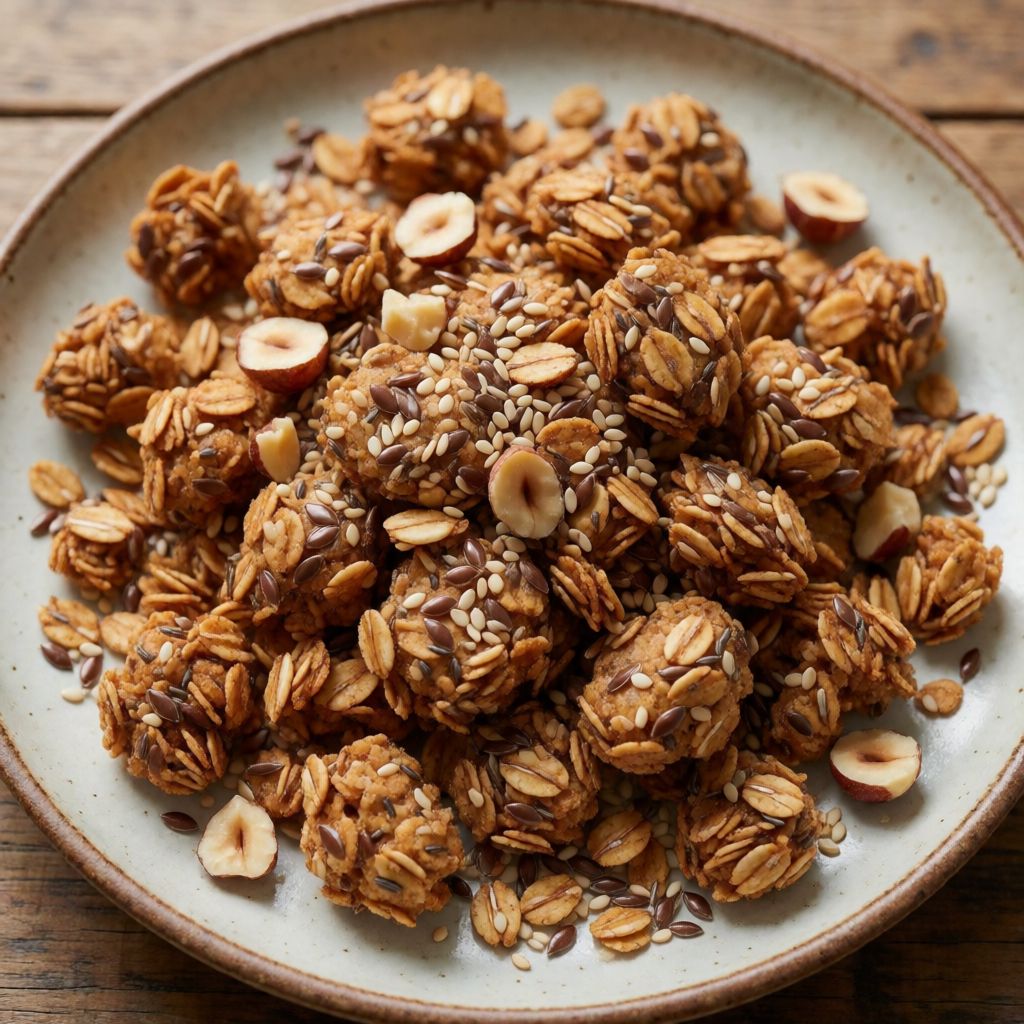
 AI photo
Oven-Baked Granola
A simple homemade granola with oats, nuts, seeds and dates, baked until golden and lightly spiced with cinnamon and cardamom.
Labels are worked out automatically from the ingredients and can be wrong. Check the packaging if it matters to you.
Ingredients
- 120 g Oats
- 2 tbsp Flaxseed
- 2 tbsp Chia Seeds alternative
- 3 tbsp Sesame Seeds
- 3 tbsp Sunflower Seeds
- 30 g Hazelnuts
- 65 g Almonds
- 3 tbsp Honey
- ½ tsp Cinnamon
- ½ tsp Cardamom
- 1 pinch Vanilla Powder
- 3 pcs Dates



Steps
Roughly chop the hazelnuts, dates and almonds, then mix everything together with the spices, seeds and oats on a baking tray lined with parchment paper.
5 minSpread the pieces of date evenly among the dry ingredients and drizzle with the honey.
Bake in the oven at 150°C with the fan on, stirring once or twice, for the next 15–20 minutes until the mixture turns golden.
18 minLet it cool, then transfer to a jar.
This recipe makes 6 servings.
This is not really a cereal recipe, it's controlled caramelisation. Oats, seeds, nuts, all getting a honey coat, going into a moderate oven just long enough for the honey to toast instead of burn and for the oats to go from soft and raw to properly dry and crunchy. The whole dish stands or falls on one thing: colour. Not a timer, not "medium heat" — colour. Honey that's gone past gold into brown has gone past sweet into bitter, the same chemistry as burnt caramel on a stove. You're watching for golden, and you stop there.
150°C with the fan on isn't an arbitrary number either. It's low enough that the honey has time to spread and toast slowly rather than scorch on contact, and the fan matters more than the degrees — it keeps air moving so the tray dries evenly instead of cooking fast at the edges nearest the fan or the back wall and staying pale in the middle. That's also why you stir once or twice: every domestic oven has a hot spot, usually at the back, and a granola left untouched there burns at the rim while the centre is still soft. Stirring isn't fussing, it's correcting for a flaw in your oven that no recipe can write around.
Oats are the bulk and the cheapest thing in the bowl — they soak up honey and toast, giving you the base crunch and most of the volume for the least money. Any rolled oats work; the only thing to avoid is the very fine instant kind, which turns to dust rather than crunch, because it hasn't got the structure to hold a shape once baked.
Flax and chia sit in the recipe as near-interchangeable — the note calling chia an "alternative" to flax is the right way to think about both of them: small, neutral-tasting seeds added for fibre and a bit of crunch, not for flavour. If you've got neither, poppy seeds or just more sunflower seed will do the same job — the criterion is small, dry, no strong taste of its own, not a specific seed.
Sesame and sunflower seeds are there for texture variety and because they're cheap bulk — this is the same economics behind why traditional granolas and mueslis lean on whatever seed is abundant and affordable that year, not some fixed sacred ratio. Hazelnuts and almonds carry the actual flavour and the fat, which is why they get roughly chopped rather than left whole — uneven pieces mean you get both a crunchy bite and a softer, oilier one in the same spoonful, which whole nuts baked flat can't give you. Buy them raw and unsalted; roasted salted nuts will just double-cook and over-salt the batch.
Honey is doing two jobs at once — sweetening and binding — and it's also the thing that actually caramelises and gives you the gold colour you're watching for. A sugar syrup or golden syrup would sweeten but wouldn't behave quite the same on the tray, so if you're substituting, look for something with real sugar content that browns, not just "something sweet." Maple syrup is the honest substitute here.
Cinnamon, cardamom and a pinch of vanilla aren't there to make it taste of anything specific — they're warmth, the smell that tells your nose "baked" before you've tasted a thing. If you don't keep cardamom in a British kitchen cupboard, mixed spice gets you most of the way there; it's built from a similar family of warm spices anyway. And the dates go in whole-chopped rather than blended into the honey on purpose — you want pockets of soft, chewy sweetness scattered through the crunch, not a uniform paste. Raisins or chopped dried apricots do the same job if dates aren't to hand.
Once it's cooled and jarred, keep the lid tight — the same sugar that gave you the crunch will happily pull moisture back out of the air and go sticky again if you leave the jar open, which is the real reason granola goes soft in a cupboard, not because it's "gone off." Eaten with cold milk the way you'd take your tea, or spooned over yoghurt, it's breakfast for the week from twenty minutes of work on a Sunday — much the same logic as putting a roast in on a Sunday and eating off it for days after.