
 AI photo
Home-Baked Ham and Cheese Parcels
Crisp pastry parcels filled with béchamel, cheese and ham, baked until golden.
Labels are worked out automatically from the ingredients and can be wrong. Check the packaging if it matters to you.
Ingredients
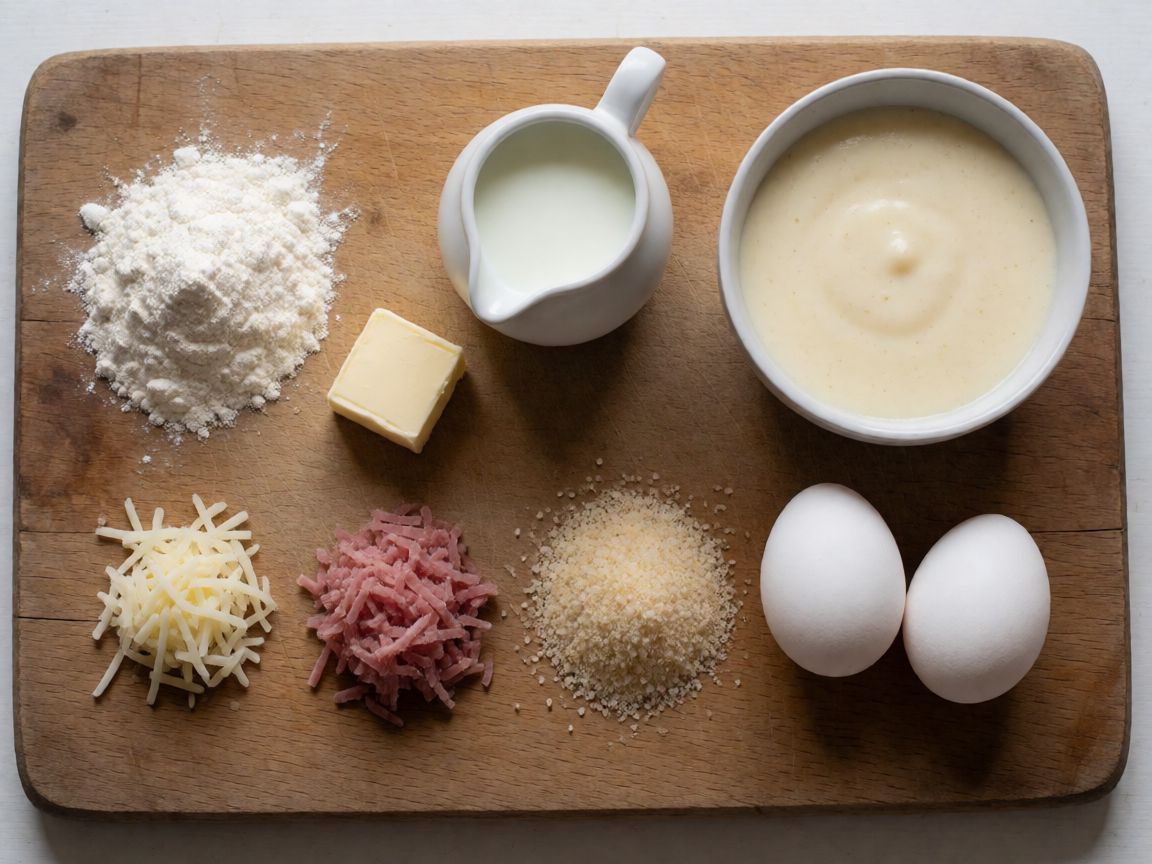
- 200 g Plain flour
- 20 g Butter
- 200 ml Milk
- 1 tsp Salt
- 200 ml Béchamel sauce
- 200 g Provolone
- 200 g Ham
- 2 pcs Eggs
- 1 pcs Breadcrumbs to taste, dried









Steps
Combine the milk, butter and salt in a small saucepan and bring to the boil.
Remove from the heat, add the sifted flour and mix with a wooden spoon until smooth.
Dust the work surface with flour, tip out the dough and knead by hand until a smooth ball forms.
Wrap the dough in cling film and leave to cool completely.
Roll out the cooled dough with a rolling pin to a thickness of 3-4 millimetres.
Cut out circles from the dough using a round cutter.
On each circle place a spoonful of béchamel, a few pieces of provolone and ham.
Fold the circles in half and crimp the edges with a fork.
Dip the parcels in lightly beaten eggs, then coat in breadcrumbs.
Place the parcels on a lined baking tray and bake at 180°C for about 20 minutes.
20 minServe hot.
This is choux pastry pretending to be a pasty — a hot-water paste, boiled and beaten, wrapped round béchamel, ham and provolone, then breaded and baked until the outside is dry and crackling and the inside has gone to molten cheese sauce. It's the inverse of a Cornish pasty logic: instead of a raw dough case that bakes as it cooks, you cook the dough first, boiling the water out of it so it sets quickly and holds its shape without going soggy from the filling sitting inside it raw for twenty minutes.
What decides whether it works is the paste, not the filling. Milk, butter and salt come to the boil, you pull it off the heat and beat in sifted flour hard — this is the choux move, the one that makes profiteroles possible. The boiling water gelatinises the starch instantly, so the dough is already half-cooked before it ever sees an oven. Skip the full boil, or add the flour while it's merely hot, and the starch never sets properly: you get a gluey, elastic dough that tears instead of folding, and a parcel that splits its seam in the tray.
Cooling is not optional admin, it's the second mechanism. A warm dough won't roll — it sticks, stretches back, won't take a clean cut from the cutter. Give it the time to go properly cold; wrapped in film so it doesn't skin over and crack. This is the "patience ingredient" bit: fifty-five minutes of prep is mostly this dough sitting there doing nothing visible while you do the washing up, and if you rush it you'll know within the first roll.
Flour: plain, nothing stronger. Bread flour's extra gluten fights you here — you want the dough pliable for folding, not springy and resistant, so leave the strong flour for your Sunday loaf and keep this one ordinary.
Butter in the boil is there for fat and flavour, not structure — any neutral, flavourless fat does the technical job, but butter's the one that doesn't announce itself as "oil" in a savoury parcel, so don't swap it for something with a smell of its own, like olive oil, or you'll taste it under the cheese.
Milk instead of water is the usual choux-adjacent trick for a savoury version — it gives you a slightly richer, less raw-tasting paste and a better colour once baked, because milk sugars help the crust brown. Water works, the dough just comes out paler and blander.
Béchamel is doing structural work as much as flavour work: it's the glue that stops the melted provolone running straight out through the crimped seam. Make it properly thick — more roux-to-milk ratio than you'd use for lasagne — because a loose sauce will leak under heat and you'll get a dry parcel with a puddle under it on the tray.
Provolone: pick it for how it melts, not for the name on the label. You want a cheese that goes stretchy and liquid under heat without splitting into oil and curd — a young provolone dolce does this; a very aged, hard one behaves more like parmesan and won't flow the same way. If you can't get provolone, any semi-firm, good-melting cheese does the same job — mozzarella, a mild gouda — judge it by whether it strings when pulled, not by its country of origin.
Ham: thinly sliced, cooked ham, the kind that's already basically ready to eat cold — it's there for salt and savour, not for cooking, since it only needs to warm through alongside the cheese. Leftover Sunday roast ham works exactly as well as a packet from the deli counter; this is a good use for the end of a joint that's gone a bit dry, since the béchamel round it fixes that.
Eggs and breadcrumbs are the shell, and the sequence matters: egg first so the crumb has something to grip, dried breadcrumbs rather than fresh because fresh ones hold too much moisture and go soft under the heat instead of crisping. This egg-then-crumb coat is also your seal against blowouts — it's a second skin over the fork-crimped edge, so even if the crimp isn't perfect, the crumb coat buys you some insurance the dough alone wouldn't give.
Crimping with a fork isn't decoration — it's mechanical closure. The béchamel inside will want to expand slightly as it heats and the trapped air pushes; an uncrimped or thinly-sealed edge is exactly where it finds its way out, so press that seam properly before you breadcrumb it, not after.