
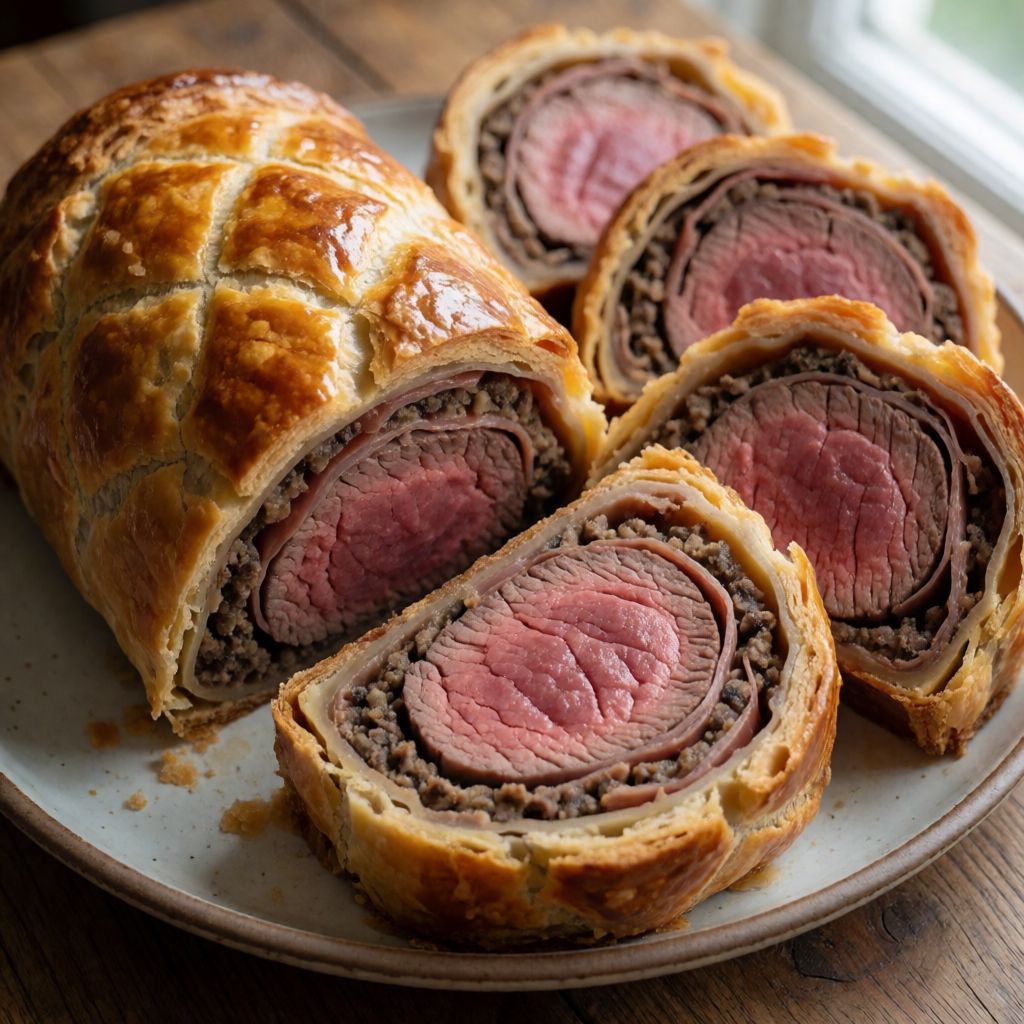
 AI photo
Beef Wellington
A classic beef fillet wrapped in mushroom duxelles, prosciutto and puff pastry, baked until golden.
Labels are worked out automatically from the ingredients and can be wrong. Check the packaging if it matters to you.
Ingredients
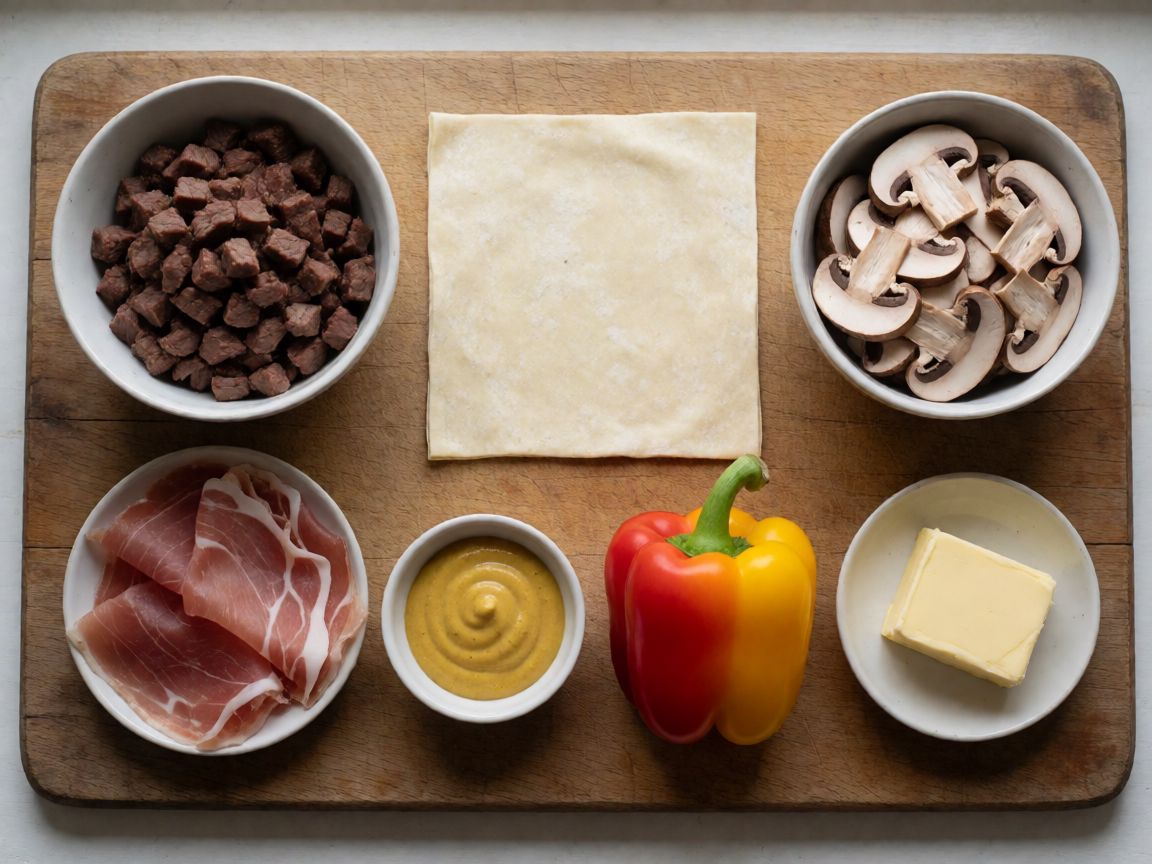
- 800 g beef fillet
- 1 pcs puff pastry
- 300 g mushrooms
- 150 g prosciutto
- 1 pcs bell pepper
- mustard to taste
- olive oil to taste
- 1 pcs butter
- salt to taste
- black pepper to taste









Steps
Take the beef fillet, add a pinch of salt and black pepper, and massage the meat.
Pour olive oil into a frying pan and heat it up.
Place the fillet in and sear on both sides with butter, taking care not to pierce the meat.
Transfer the meat to a plate and brush with mustard.
Wash the mushrooms, slice them, then blitz in a food processor with salt, pepper and olive oil to make a duxelles.
Transfer the mushroom duxelles to a pan and simmer on low heat to evaporate excess moisture.
On cling film, lay out the prosciutto slices, forming a rectangle.
Spread the mushroom duxelles evenly over the prosciutto, then place the beef fillet in the centre.
Using the film, wrap the fillet tightly and place it in the fridge.
15 minRemove the wrapped fillet, place it on rolled-out puff pastry and wrap it in the pastry.
Place on a baking tray lined with baking parchment.
Beat the egg yolk, brush it over the pastry surface and make shallow criss-cross cuts.
Bake in an oven preheated to 200°C for about 30 minutes. Doneness: 63°C at the centre (medium).
30 minLet the finished dish rest for 5-6 minutes, then slice and serve.
6 min
This is a fillet of beef insulated from the oven by three jackets, one inside the other: mustard, a mushroom paste, ham, and finally pastry. Nothing here is decoration — each layer solves a problem the next layer would otherwise create. The whole dish is really a fight against moisture: meat juice, mushroom water and the fat in cured ham all want to migrate outward into the pastry and turn it to wet cardboard. Everything in the method exists to stop that migration, or slow it down long enough for the oven to finish its separate job.
What decides whether this works is not luck with timing, it's sequence. The duxelles has to be cooked down dry before it ever touches the meat — raw mushroom is mostly water, and skip that reduction and you're wrapping your fillet in a wet sponge instead of a paste. The beef has to carry colour from the frying pan before it goes anywhere near the oven, because by the time the pastry is done, the meat inside has had nowhere near enough direct heat to brown on its own. The crust you taste is built in the pan, not under the pastry.
Some say searing "seals in the juices." No — meat isn't a bag with a zip, juice moves by heat and pressure, not by surface colour. You sear for flavour and colour, full stop; the real reason it matters here is that the oven afterwards is working almost entirely for the pastry's sake, giving its butter layers time to puff and set without roasting the meat past medium. If the beef relied on the oven for its colour too, by the time the outside looked right, the middle would be grey through.
Fillet is the right cut here for a reason that has nothing to do with status and everything to do with speed. It has almost no connective tissue and very little fat running through it, so it cooks fast and stays tender without the long, slow heat a Sunday joint like rib or topside actually needs to break its fat and sinew down. That's also why fillet never became the Sunday roast cut in this country — it's pricier and gives you less back for a low, patient oven. Here the logic flips: you want a cut that's done its toughening work already, because everything that follows — the chill, the pastry, the bake — is fast by comparison. If you haven't got fillet, any quick-cooking, sinew-free centre cut will do; it just won't forgive overcooking quite as gently.
The duxelles is mushroom cooked twice: once raw-processed to a paste, once simmered to drive the water back out of it. That second stage is the one people skip when they're short on patience, and it's the one that decides whether your pastry stays crisp. Chestnut or button mushrooms work well because they're meaty enough to hold some texture once reduced; a few dried porcini, rehydrated and chopped in, add depth without adding more moisture, since dried mushroom concentrates flavour rather than diluting it.
Prosciutto's job is to be a dry barrier, not a flavour afterthought — thin, salty, air-cured, rendering almost no fat of its own when it sits next to warm meat. That's the real criterion for substitution: any thin, dry-cured ham does the job, Parma or Serrano both fine. Streaky bacon looks similar but fails the job completely — it's wet-cured and fatty, and it would add exactly the moisture this layer is meant to keep out.
Mustard here isn't seasoning in the usual sense, it's a cut-through — something sharp enough to stand up against beef fat, ham fat and pastry butter all layered on top of each other. English mustard gives you more bite, Dijon a rounder one; either earns its place. A sweet, mild mustard won't, because it has nothing to push against the richness.
Puff pastry needs real butter in its lamination, because that's what lifts and sets its layers at oven heat — vegetable-fat puff will still puff, technically, but flatter and paler, a compromise rather than a disaster. The egg yolk brushed over the top isn't there for shine alone: a domestic oven at 200°C browns more gently than the dish wants, and the yolk gives the surface colour it wouldn't otherwise reach in the time the meat can spare. The shallow cuts matter for the same reason steam vents matter on any pastry case — score them and steam escapes evenly; skip them and the pastry can split wherever it likes, usually along the seam where it's weakest.
And don't skip the fifteen minutes in the fridge wrapped in film. Warm meat softens the duxelles-and-ham jacket around it, and if you go straight into the pastry from there, the whole log slumps instead of holding a clean round shape — the pastry won't wrap tight, and a loose wrap is exactly what lets juice pool and soak through later. It's an ordinary flat kitchen's answer to what a proper mould would otherwise do: the fridge is your shaping tool here, and fifteen minutes is the minimum, not a target to beat.