
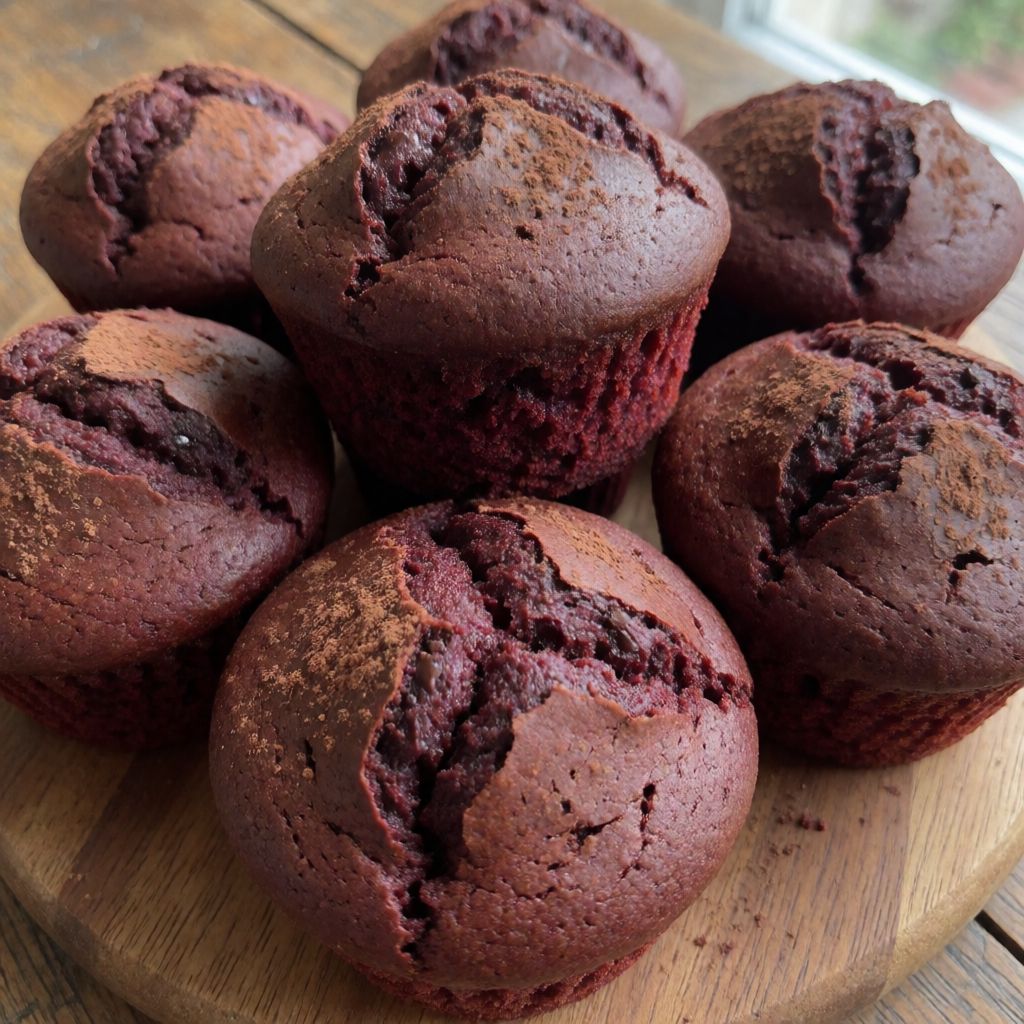
 AI photo
Beetroot and Chocolate Muffins
Rich chocolate muffins with grated beetroot, topped with a cream cheese frosting.
Labels are worked out automatically from the ingredients and can be wrong. Check the packaging if it matters to you.
Ingredients
- 75 g Butter
- 100 g Dark chocolate
- 175 g Caster sugar
- 3 pcs Eggs
- 125 g Plain flour
- 1 tsp Cocoa powder unsweetened
- 1 tsp Vanilla powder
- 1 tsp Baking powder
- 1 pinch Salt
- 175 g Beetroot finely grated









For the frosting
- 150 g Icing sugar
- 150 g Butter room temperature
- 150 g Cream cheese full-fat
- 1 pinch Red food colouring



Steps
Melt the butter over low heat, remove from the heat and stir in the chocolate.
5 minBeat the eggs with the sugar until light and fluffy.
5 minSlowly pour in the butter and chocolate mixture, stirring continuously.
3 minMix the flour, cocoa, vanilla powder, baking powder and salt, then fold into the batter together with the grated beetroot.
5 minDivide the batter into muffin cases and bake in a preheated fan oven at 175°C for about 18 minutes.
18 minLeave to cool on a wire rack.
15 minBeat the icing sugar with the butter using a mixer until light and fluffy, then add the cream cheese.
5 minTransfer the frosting to a piping bag fitted with a nozzle and decorate the muffins before serving.
5 min
Twelve muffins, dark on the outside, damp in the middle, with a knob of cream cheese frosting sitting on top like a dollop of clotted cream that forgot its colour. The beetroot is not there for flavour — grated raw and folded in, it mostly reads as sweetness and moisture, not earth. Nobody at the table will identify it blind. What they'll notice is whether the crumb is dense-wet or dense-dry, and that's decided by one thing: how much the beetroot's water got cooked out of it before it set.
Some say beetroot in a chocolate bake is a health trick, a way to sneak vegetables past children. No — it's a moisture trick. Beetroot is mostly water held in cell walls that collapse under heat, releasing it slowly into the crumb as the cake bakes, the way courgette does in a loaf or carrot does in carrot cake. That's the whole mechanism. Treat it as a vegetable garnish and you'll either underbake the centre chasing a wet look that's actually unset batter, or overbake it dry trying to firm up what was never going to firm up the way a dry batter does.
The frosting is the part that actually tastes of anything distinct — butter, sugar, and cream cheese for tang and body, so it doesn't just melt into sweet grease the second it meets a warm muffin. Pipe it only once the muffins are properly cool, not "cool enough": warm muffin plus soft frosting equals a puddle, and that's a structural failure, not a cosmetic one.
Butter and dark chocolate melted together first is doing structural work, not just flavour work. Melting low and slow, off the heat the second it's liquid, stops the chocolate seizing — chocolate grabs and goes grainy if it meets sudden high heat or any stray drop of water, which is also why you never melt it in a pan still wet from washing up. Any dark chocolate above roughly 60% cocoa solids works; milk chocolate won't, it's too soft and sweet and the batter will end up cloying rather than rich.
Eggs beaten with sugar until "light and fluffy" means you're whipping air into the mixture — that trapped air is your rise, since this batter leans on beaten eggs more than it leans on the baking powder. Skip this stage or rush it and the muffins will be flatter and denser, no amount of extra baking powder fixes a rise you didn't build mechanically. Pour the warm butter-chocolate mix in slowly, still stirring: dump it in cold-batter-fast and you knock the air straight back out, or worse, you half-cook the egg on contact with hot butter and get streaks of scrambled egg in your muffin.
Flour, cocoa, vanilla powder, baking powder and salt get mixed dry before they meet the wet mixture — that's not fussiness, it's so the baking powder is distributed evenly through the flour rather than landing in one lump that fizzes in one spot and leaves you with a muffin that's domed on one side. Beetroot, finely grated, goes in at the same stage folded gently rather than beaten — folding keeps the air you worked for; beating here deflates it. Grate it yourself rather than buying pre-cooked beetroot in vinegar — that comes packed in acidic liquid you don't want anywhere near your batter, and it tastes of vinegar, not beetroot.
Icing sugar and butter beaten until light and fluffy is standard buttercream technique — you're again building air, this time for a frosting that pipes cleanly instead of sitting as a flat smear. Cream cheese goes in after, not before, and should be full-fat, cold from the fridge is fine but not warm: warm cream cheese turns the whole frosting runny and it won't hold a pipe shape. The red food colouring is a pinch, doing cosmetic work only — it nudges the frosting from cream-white toward a blush pink that nods at the beetroot inside, nothing more. Leave it out and the muffins taste identical.
175°C in a fan oven, "about 18 minutes" is the floor, not the target — the real cue is the top springing back when you press it lightly, and a skewer coming out with a few moist crumbs, not wet batter, not bone dry. A fan oven circulates heat round every muffin case evenly; if you've only got a conventional oven, expect the back row to colour first and either rotate the tray partway through or just accept it and check each muffin individually before pulling the tray.
Cooling fully on a wire rack before frosting is the one step people skip because they're impatient, and it's the one that ruins the finish fastest — a rack lets air move underneath so the base doesn't go soggy from trapped steam, and fifteen minutes is genuinely the minimum, not a suggestion you can shave down because you're keen to see it iced. Patience here isn't a virtue, it's an ingredient: skip it and you're not serving a finished muffin, you're serving a slightly collapsed one with frosting sliding off the side.