
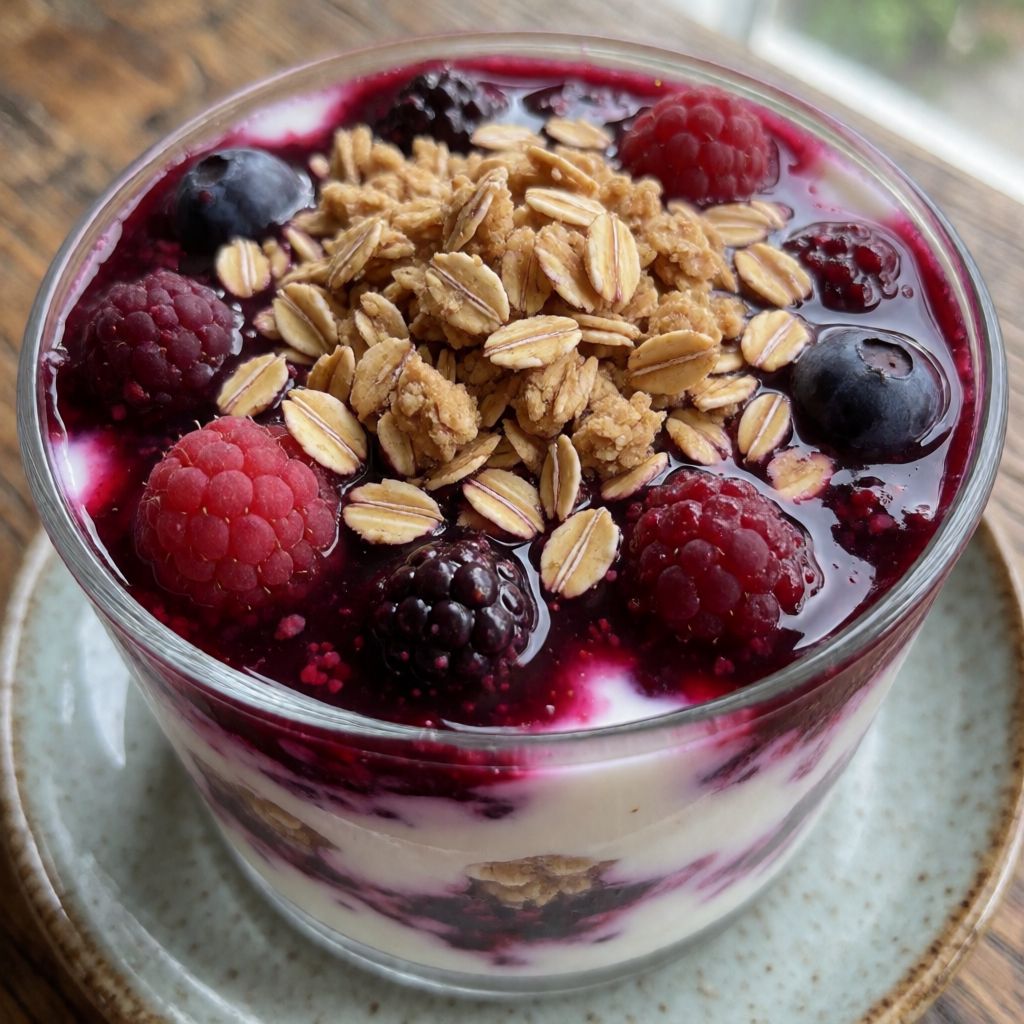
 AI photo
Creamy Forest Berry Dessert with Crunchy Oats
A layered yoghurt and forest berry dessert topped with crunchy oats.
Labels are worked out automatically from the ingredients and can be wrong. Check the packaging if it matters to you.
Ingredients
- 450 g Yoghurt
- 250 g forest berries raspberries, blackcurrants, blueberries
- 20 g brown sugar
- 2 tsp cornflour
- 1 tbsp honey
- 100 g crunchy oats
- 50 ml water




Steps
Heat the water in a small saucepan, add the forest berries and brown sugar, and simmer.
10 minDissolve the cornflour in a small amount of water.
Add the berries to the dissolved cornflour, then press through a sieve for a smooth sauce.
Pour the berry sauce into glasses, filling them a third full, and chill in the refrigerator.
20 minStir the honey into the yoghurt and mix well.
Form a second layer with the yoghurt mousse, then a third layer with the crunchy oats.
Decorate the dessert with a few berries.
This is a parfait, not a cooked pudding — three textures stacked in a glass and only one of them ever sees heat. A jammy berry sauce on the bottom, honeyed yoghurt in the middle, crunchy oats on top. Nothing fuses. The glass is doing the opposite of a stew: it's keeping its ingredients apart so your spoon finds a different thing on every pass.
What actually decides whether this works isn't the cooking, it's the cooling. The berry sauce has to drop from hot-and-runny to cold-and-set before you dare pour yoghurt on it — cornflour needs the chill to finish its job of gelling, and a warm or loose sauce just slides sideways under the next layer and you get marbled sludge, not layers. And the oats go on last, as close to serving as you can manage, because yoghurt is mostly water and oats are a sponge: give them ten minutes together and 'crunchy' becomes 'soggy', which rather defeats the name of the dish.
Some say frozen berries are a compromise, a step down from fresh. No — for this job they're often better. Freezing already ruptures the cell walls that heat would otherwise have to break down; a frozen berry collapses into juice and syrup faster and more evenly than a fresh one, which can still be holding its shape stubbornly when the sugar's already starting to catch at the bottom of a small pan. And a 'forest berry' mix — raspberry, blackcurrant, blueberry — out of a UK season is frozen anyway, so you're not losing anything by reaching for the bag in the freezer.
Yoghurt is the layer that holds everything up, so its thickness matters more than its flavour. A thin, watery yoghurt will weep into the berry sauce below it and blur your clean lines into something closer to a smoothie. Go for a thick, Greek-style yoghurt — strained, not runny. If what's in your fridge is the thinner sort, tip it into a sieve lined with a clean tea towel or muslin, let it sit over a bowl for twenty minutes, and it'll firm up enough to hold a layer.
The berries want a mix of tart and sweet for a reason, not just prettiness — blackcurrant is sharp, raspberry and blueberry are sweeter, and cooked together they balance each other so the sauce isn't just jam, it still has some bite. No forest berries to hand? Any soft fruit that collapses under heat and has some acidity will do the same job — a bag of frozen mixed berries, or even rhubarb with a touch more sugar, since the mechanism is the same: tart fruit, sugar, heat, until it slumps and turns glossy rather than watery.
Brown sugar over white is a flavour choice, not a structural one — a faint molasses note that sits well against blackcurrant's sharpness. The sugar's real job is pulling moisture out of the berries by osmosis and dissolving into syrup as they cook; white sugar does that exactly the same, you'll just lose a shade of colour and a whisper of that toffee note.
Cornflour is the one place people get caught out, and it's worth saying why you dissolve it separately first. Tip dry cornflour straight into a hot liquid and the outside of each little granule gelatinises on contact, sealing a pocket of dry powder inside — that's where lumps come from. Mix it into a splash of cold water first so the starch disperses as a smooth liquid, then it swells evenly once it meets the hot berries, and you get a sauce that thickens into something silky rather than something full of little white knots.
Honey goes into the yoghurt rather than sugar for a plain practical reason: it's already liquid. Stir sugar into cold yoghurt and it mostly stays grainy — yoghurt's too cold and too thick to dissolve it properly. Honey disappears in one stir and brings a little extra body with it, keeping the mousse velvety instead of watery. Maple syrup or golden syrup would do the same trick if that's what's in the cupboard.
Crunchy oats are, honestly, just granola by another name — oats toasted with a little oil and sugar until they turn from pale and dry to golden and fragrant, which is the Maillard reaction doing the same work it does on a roast potato. That browning is where the crunch and the flavour both come from, not from the oats being dry. Britain already has the oat habit from porridge; this dish just borrows the breakfast granola-and-yoghurt pairing and turns it into pudding. If you're making your own, toast them properly — pale oats on top of yoghurt aren't crunchy, they're just oats. Buy a bag of good granola if you'd rather skip the step; the mechanism doesn't care who did the toasting.
Use clear glasses or small jars if you have them — jam jars work fine, and a domestic kitchen rarely has proper verrine glasses lying about. The layers are the point of the dish; a solid mug hides the thing you're actually making. And give the sauce its full chilling time before you pour anything on top — rushing that step is the single fastest way to turn three layers into one.