
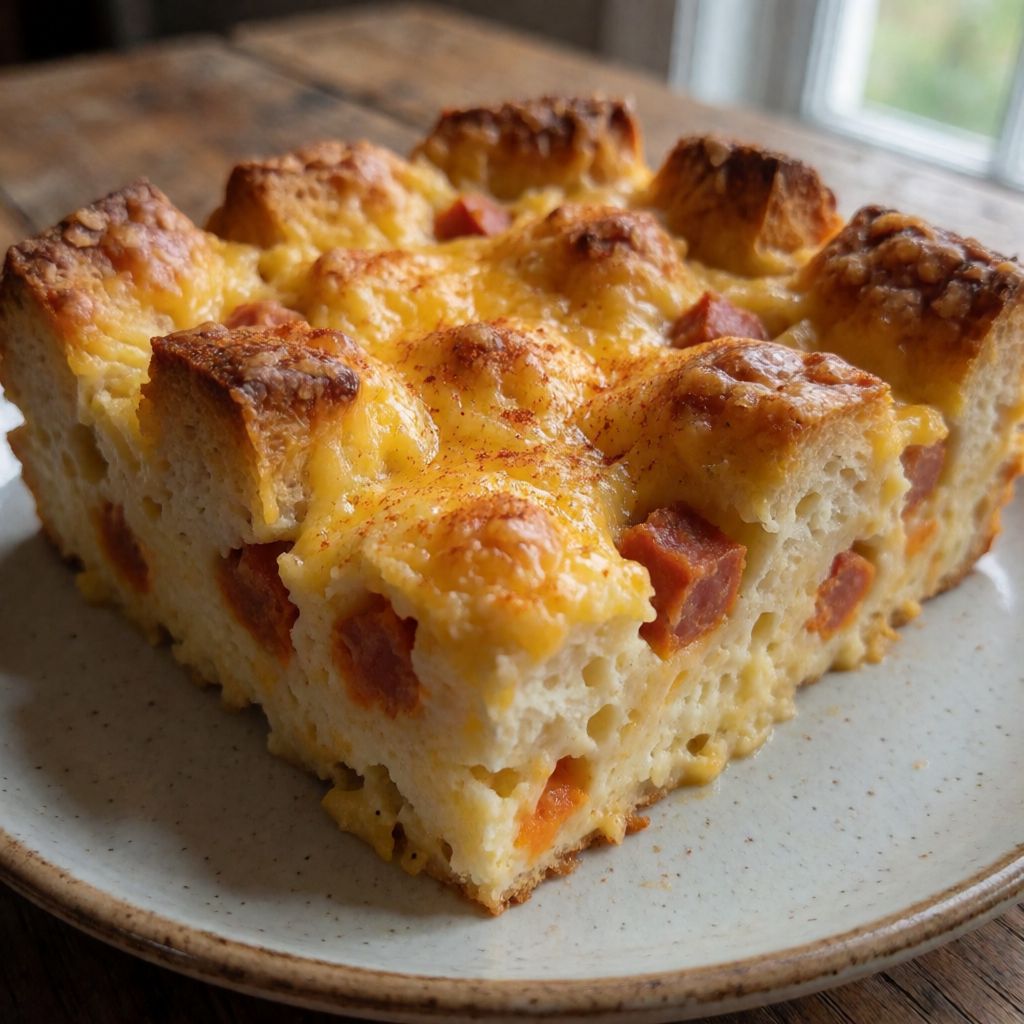
 AI photo
Bread, Egg and Chorizo Bake
A comforting savoury bake of bread, eggs, chorizo and melted cheddar, baked until golden and set.
Labels are worked out automatically from the ingredients and can be wrong. Check the packaging if it matters to you.
Ingredients
- 7 pcs Eggs
- 300 ml Milk
- 1 tsp Paprika
- 400 g Bread
- 100 g Chorizo
- 150 g Cheddar freshly grated
- 1 tbsp Sun-dried Tomatoes finely chopped
- Salt to taste
- Black Pepper freshly ground
- 1 bunch Thyme fresh









Steps
Whisk the eggs, milk, paprika, salt and pepper together in a bowl.
In another bowl, combine the cubed bread, sun-dried tomatoes, chorizo and cheese, and mix well.
Pour in the egg mixture and mix thoroughly until well combined.
Cover and leave to rest in the fridge, ideally overnight or for at least 1 hour.
60 minTransfer the mixture to a greased springform tin, cover with a heatproof plate and bake in a preheated fan oven at 180°C for about 25–30 minutes.
27 minServe generously sprinkled with thyme or finely chopped parsley.
What was changed
The oven temperature was rounded to to match how ovens are set in local kitchens.
This is a savoury bread pudding — the English kind, not the pudding with custard and raisins, but a relative all the same. Stale bread works as a sponge, egg and milk work as a custard, and the oven turns that soaked sponge into something you can slice. Cheddar, chorizo and paprika are what make it dinner rather than dessert.
What decides whether it works has nothing to do with the oven and everything to do with what happens before it. Bread cubes left in a bowl with egg and milk do not become one thing instantly — the liquid has to travel into the crumb, cell by cell, and that takes hours, not minutes. Skip the rest and you bake a tray of wet bread sitting in raw egg, with the egg cooking around cubes that are still dry at the core. That is the one step people are tempted to shortcut because it looks like nothing is happening. Nothing visible, yes. Everything important, also yes.
Some say fresh bread makes a better bake, because fresh bread is nicer to eat on its own. No — fresh bread is already full of its own moisture and has a tight, elastic crumb. Push egg and milk into that and you get paste, not a sponge. Bread that is a day or two old, or bread you have dried out a little in a low oven, has lost that moisture and opened up — it drinks the custard instead of fighting it.
Seven eggs and 300ml milk is your custard, and the ratio matters more than either ingredient alone. Egg protein is what sets — it tightens from a liquid network into a solid one somewhere around 70–80°C, and milk is there to dilute it so the bake stays tender rather than turning into a rubbery omelette brick. Too little milk for the amount of bread and you get dry pockets; too much and the bread drowns and the custard never firms. 400g bread to this ratio is the balance the recipe is built on — if you're using denser sourdough, you may find it drinks less, so don't force extra liquid in just because the bowl looks dry; the overnight rest will even it out.
Bread is the real engine of this dish, and its whole history is thrift, not flavour. Bread puddings — sweet or savoury — exist because bread goes stale fast and throwing out food has never been a luxury most households could afford. A loaf a day or two old, crusty on the outside, slightly dry inside, is exactly what you want: it has structure to hold its shape as a cube, and enough open crumb to take on custard without collapsing. Soft white sandwich bread, fresh from the bag, will turn gluey rather than soaking evenly — if that's all you have, dry it out in a low oven for ten minutes first and let it cool before you cube it.
Chorizo brings fat as much as flavour. A cured, paprika-spiced sausage renders fat as it bakes, and that fat bastes the bread around it from the inside — which is also why the paprika in the egg mixture isn't an arbitrary spice choice, it's an echo of the paprika already curing the chorizo, so the whole bake reads as one flavour instead of two competing ones. If you haven't got chorizo, any cured, smoky sausage that renders fat under heat will do the same job — good bacon lardons, for instance; leave it out altogether and you lose that basting, so add a spoon more oil to the bread mixture to compensate.
Grate the cheddar yourself. Bagged pre-grated cheese is coated in starch so the shreds don't clump in the bag, and that same coating stops it melting into a smooth layer in the oven — you get little resistant granules sitting in your bake instead of cheese that's actually married into the bread. A mature cheddar earns its place through sharpness; a mild one will mostly just add salt and stretch.
The sun-dried tomatoes are there for acid, not bulk — a small sharp note cutting through egg, cheese and rendered fat, all of which are rich and none of which are sharp on their own. A chopped roasted red pepper or even a spoon of tomato paste worked through the custard does the same job if that's what's in your cupboard.
And the thyme at the end is not cooked into anything — it goes on after baking because its fragrance lives in oils that bruise and fade under heat. Scatter it, or parsley if that's what you've got, right before it goes to the table, while the bake is still hot enough to release the scent but no longer hot enough to cook it away.