
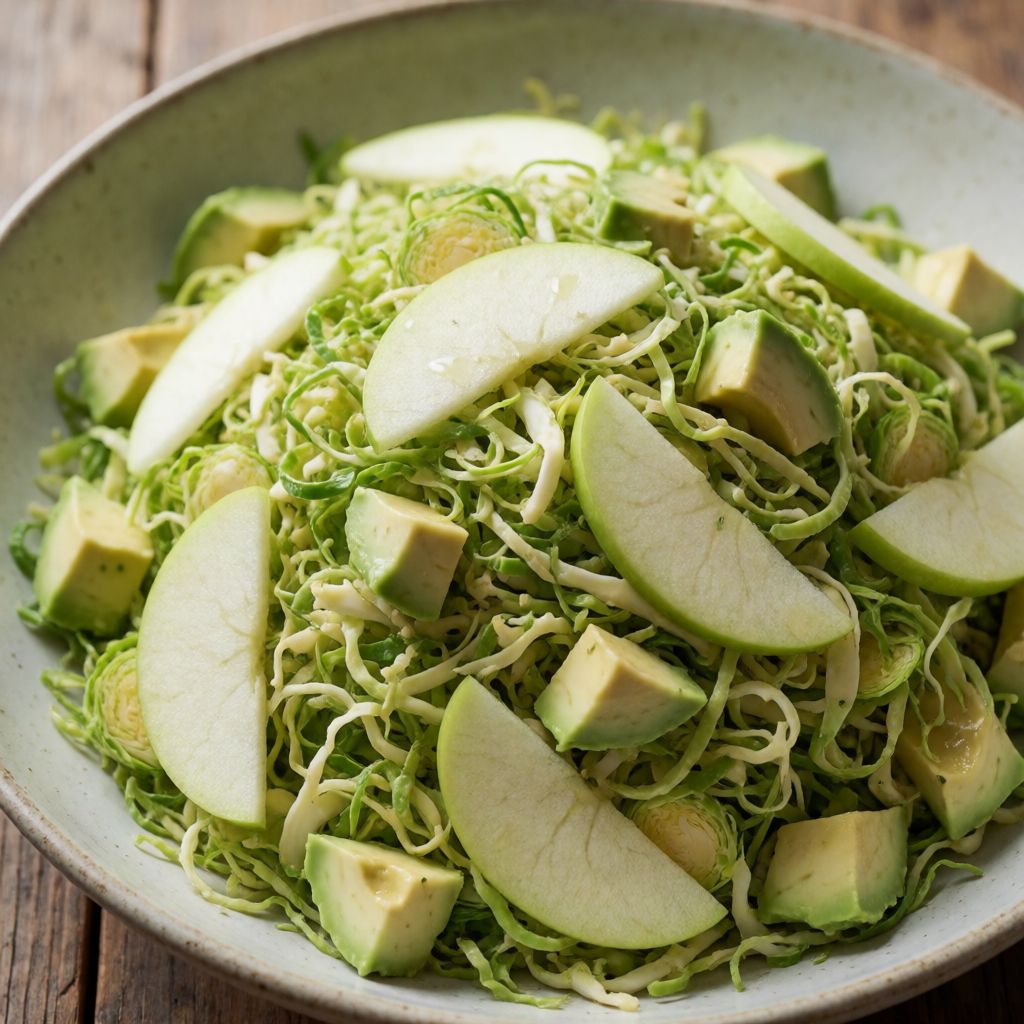
 AI photo
Brussels Sprouts, Avocado and Apple Salad
A fresh Brussels sprouts, avocado and apple salad finished with toasted pumpkin seeds and a Dijon-maple dressing.
Labels are worked out automatically from the ingredients and can be wrong. Check the packaging if it matters to you.
Ingredients
- 250 g Brussels sprouts halved
- 1 pcs Avocado diced
- 1 pcs Apple thinly sliced
- 50 ml Pumpkin seeds
- 1 bunch Thyme fresh
- 1 tbsp Olive oil for frying
- 1 pcs Lemon juice and finely grated zest


For the dressing
- 1 tsp Dijon mustard
- 3 tbsp Olive oil
- 1 tsp Maple syrup
- Salt to taste
- Black pepper freshly ground, to taste


Steps
For the dressing, mix the Dijon mustard, olive oil, maple syrup, lemon juice, lemon zest, salt and pepper, adjust the seasoning and let it sit for a little while.
2 minToss the Brussels sprouts with the dressing and arrange on a plate together with the avocado and apple.
Fry the pumpkin seeds in a hot pan with a little olive oil and season with salt.
3 minSprinkle the salad with the pumpkin seeds and fresh thyme.
This is not a cooked salad pretending to be fresh — it is a raw salad that uses the dressing itself as a very gentle, very short pickle. The Brussels sprouts never see heat. What softens them from squeaky-raw to something you'd actually want to eat is acid and salt from the dressing, working on the cut surface for a couple of minutes before anything else happens. Halving them isn't decoration — it's what gives the dressing a flat, open face to work on instead of a round, sealed one.
Some say Brussels sprouts are a boiled, slightly bitter, slightly sulphurous vegetable you endure once a year next to the roast potatoes — no, because that's what happens when you cook them to death, and the bitterness you're remembering is overcooked cabbage chemistry, not the vegetable itself. Sliced thin and dressed, raw, they're closer to a crunchy cabbage slaw with a peppery kick. Different food, same plant.
What actually decides whether this salad works is timing of assembly, not cooking skill. The sprouts can sit in their dressing and improve. The avocado and apple cannot — cut surfaces start browning the moment air touches them, so they go on last, close to serving, and the lemon zest and juice in the dressing are doing double duty: flavour, and a thin acid coat that slows the browning down. If you plate everything at once and let it sit, you'll get a grey-edged, weeping salad and blame the recipe instead of the clock.
Brussels sprouts: look for small, tight heads with no yellowing or loose leaves — a loose head means it's been sitting too long and the leaves inside have gone soft and sulphurous on their own, no cooking needed to make them smell that way. Halve them so the dressing has a flat cut face to sit against; whole, the dressing just slides off the round outside and does nothing.
Avocado: ripeness is felt, not timed — it should give slightly under a gentle thumb press at the stem end, not cave in. Underripe and you get crunchy, grassy cubes with no point to them; overripe and it turns to paste the moment you cut it. Dice it last, straight before plating, for the browning reason already covered.
Apple: you want sharpness here, not sweetness — a Granny Smith or anything with real acidity, because the avocado brings fat and the sprouts bring bitterness, and the apple's job is to cut through both. A sweet, soft apple just adds mush and sugar where you need a clean edge.
Pumpkin seeds: raw, unsalted ones you toast yourself give you control over colour and salt — pre-toasted bagged seeds are often already past their best by the time you buy them, soft and stale rather than crisp. In a domestic pan, without a lid, in a thin single layer so they toast rather than steam each other — crowd them and the ones underneath go soft instead of golden.
Dijon mustard: its job isn't just heat, it's holding the dressing together — mustard's own mucilage acts as an emulsifier, keeping oil and lemon juice from separating back into two layers the way they would on their own. A milder mustard will emulsify the same way but give you less bite; don't swap in a sweet or wholegrain one expecting the same backbone.
Two different olive oils are doing two different jobs, and that's worth noticing. The oil in the dressing is there to be tasted — use something with real character. The oil for frying the seeds is there to be a heat-carrier and nothing more, so any oil with no smell of its own works fine and is the place to save money — sunflower or a plain vegetable oil does the same job as fried olive oil, because once olive oil gets hot enough to toast seeds, its fruitiness is gone anyway, burned off, wasted.
Maple syrup here is a counterweight to the lemon's acid, nothing more mystical than that — any sweetener with body does the same work: honey, a pinch of brown sugar dissolved in, even a dab of jam if that's what's in the cupboard. The dressing should taste balanced, not sweet.
Thyme goes in raw, right at the end, because its aromatic oils are what you're after, not its cooked flavour — rub a sprig between your fingers before scattering it and you'll smell the difference cooking would have driven off.
And give the dressing its two minutes before you touch the sprouts with it — that's not a formality, that's the mustard and oil actually becoming one thing instead of two. Skip it and you're tossing sprouts in a thin, separated liquid that coats unevenly. Patience, here, is doing real work, not just filling time.