Vegetables
Brussels Sprouts
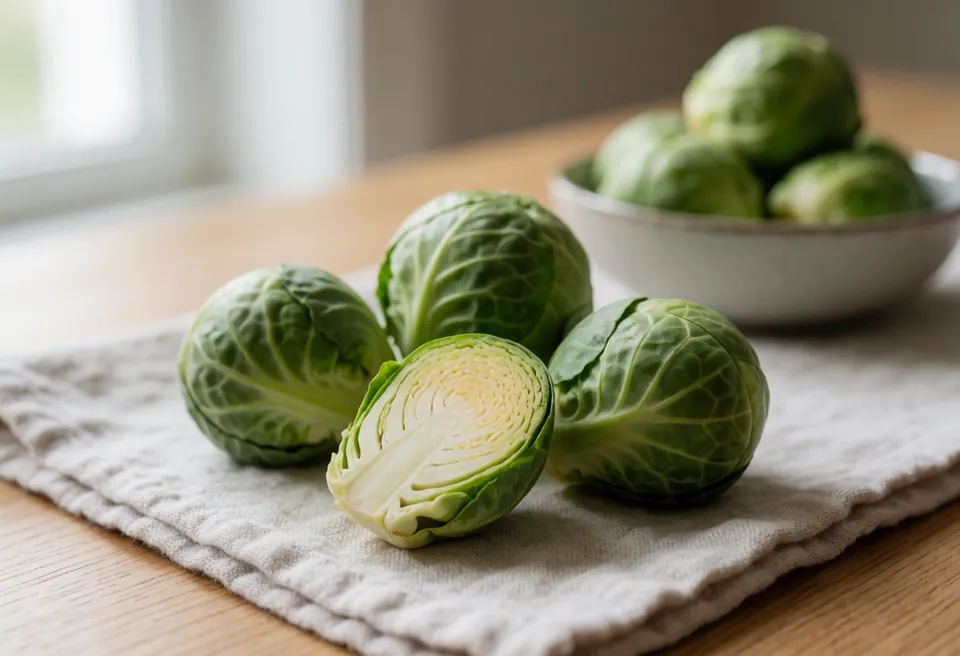
Brussels sprouts are tiny cabbage heads that grow in clusters on a stalk. They're roasted, braised, or sautéed whole or halved.
59 kcal per 100 g
Nutrition per 100 g
59 kcal
| Protein | 4 g |
|---|---|
| Fat | 0.6 g |
| Carbs | 9.6 g |
| Fiber | 4.8 g |
Source: USDA FoodData Central, 2026-09-21. Per 100 g raw (per USDA FDC).
Good to know: Brussels Sprouts
Let me tell you about Brussels sprouts, and why so many people get them wrong before they even try them.
These are not baby cabbages, though they look like them. They grow in tight rows along a thick stalk, each one a small bud doing exactly what cabbage leaves do — folding in on themselves, layer upon layer. That tight folding is why they cook the way they do: the outer leaves soften fast, the heart stays firm a little longer. Cook them whole and evenly, and you get a firm bite in the center, tenderness outside. That's not a flaw. That's the point.
Choose them tight and heavy for their size, bright green, no yellowing at the base. Small ones cook more evenly than large ones. A sprout that feels loose in your hand has already started to let go of itself — skip it.
Some people say Brussels sprouts are only ever bitter, that there's no saving them. No! Yes, they carry a little bitterness of their own — that's just what they are. But the sulfurous smell and the gray mush people remember, that's not the sprout's nature. That's what happens when they're boiled too long, forgotten on the stove until they give up their color and their shape along with it.