
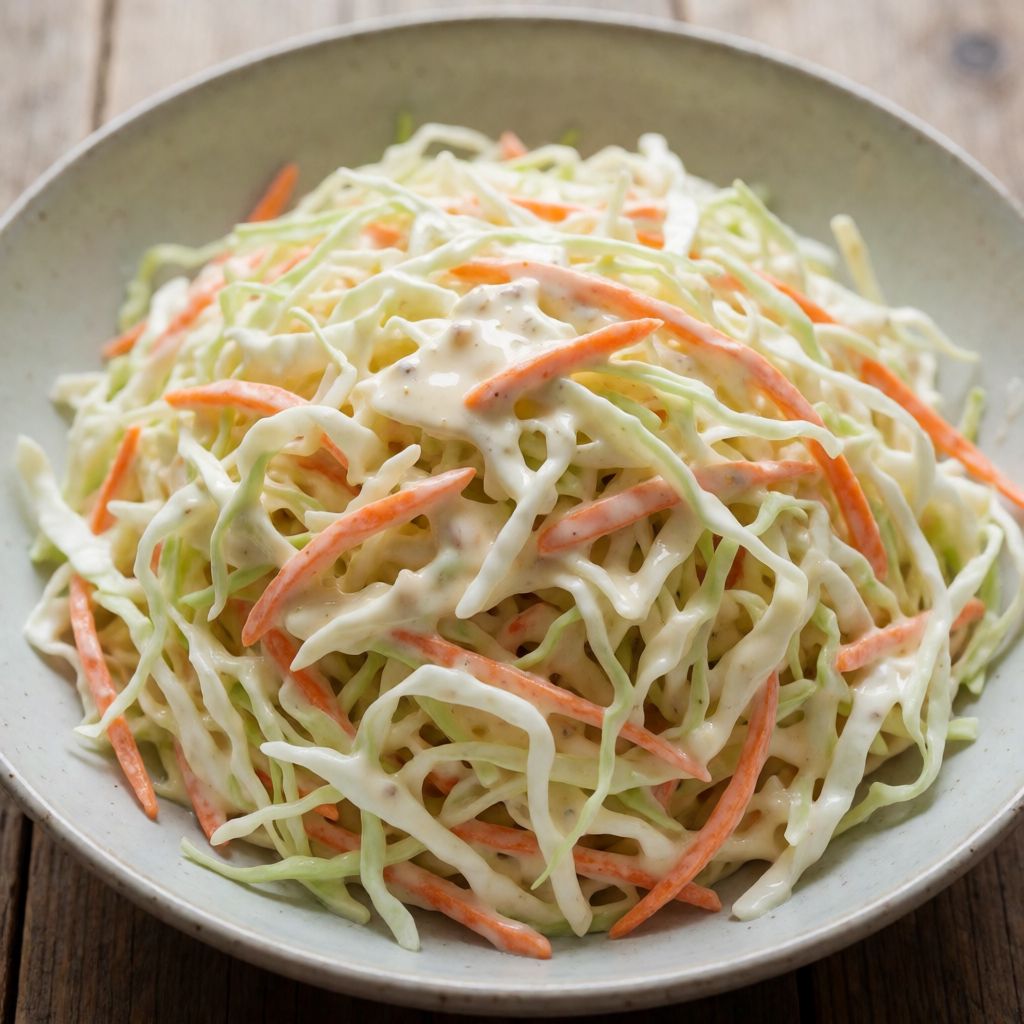
 AI photo
Creamy Coleslaw
A creamy coleslaw of shredded cabbage and carrot tossed in a tangy mustard-honey dressing.
Labels are worked out automatically from the ingredients and can be wrong. Check the packaging if it matters to you.
Ingredients
- 1 pcs Cabbage small, finely shredded
- 5 pcs Carrot coarsely grated
- 300 ml Crème fraîche
- 100 ml Mayonnaise
- 1 tsp Honey
- 2 tbsp Dijon mustard add more to taste if you like
- 50 ml Apple cider vinegar
- 3 tsp Sugar
- 1 tsp Cumin ground
- Salt to taste
- Black pepper freshly ground











Steps
Place the crème fraîche and mayonnaise in a bowl together with the Dijon mustard, honey, apple cider vinegar, salt, sugar, ground cumin and freshly ground black pepper. Mix the dressing well and taste.
5 minIn a large bowl, mix the cabbage with the carrot and stir in the dressing thoroughly.
5 minLet the coleslaw rest in the fridge for about 1 hour before serving.
60 min
This is not really a salad you make — it's one you start and then leave alone. Raw cabbage and carrot don't combine with a creamy dressing just by stirring; what makes coleslaw is osmosis, and osmosis needs the thing this recipe asks for and nothing else: time in the cold.
Salt in the dressing pulls water out of the cabbage cells. That's the whole mechanism. Fresh-cut cabbage is stiff, almost squeaky, and a dressing poured on it just sits on the surface, sliding off every time you lift a forkful. Give it an hour in the fridge and the salt has drawn the water out, the cabbage goes slightly limp and pliable, and that same water — now carrying salt, mustard, vinegar — moves back in. The dressing isn't coating the cabbage anymore, it's inside it. That's why step three, the one that looks like nothing is happening, is the step that decides whether this dish works.
Some say coleslaw should be made just before serving, like a green salad, so it stays crisp. No — because that crispness you're protecting is exactly the problem: raw, undressed crunch with sour cream sitting on top of it. The hour of rest isn't a loss of texture, it's a trade of one texture for a better one — cabbage that bends under the fork instead of shattering, dressing that tastes seasoned all the way through instead of only on the outside.
Cabbage is the main ingredient and the only one worth being fussy about. Pick one that feels heavy and tight for its size — loose, puffy heads have more air and less structure, and they'll go watery under the salt instead of just softening. A small white or green cabbage, finely shredded, gives you the surface area osmosis needs; cut it in thick wedges and the water has nowhere to go, so the middle of each piece stays raw while the edges turn to mush. Red cabbage works too, but it's tougher and wants closer to the long end of resting, not the short one.
Crème fraîche and mayonnaise are doing two different jobs, not the same job twice. Crème fraîche is cultured cream — it arrives already slightly sour, and that's what keeps the dressing from tasting like a tub of mayo with vegetables in it. Mayonnaise is an egg-and-oil emulsion, and what it brings is cling: without it the dressing is thinner and runs off instead of coating. If you've only got soured cream or thinned yoghurt, use that in place of the crème fraîche — the criterion is a cream that's already acidic, not a sweet one. Don't try to run the whole dressing on mayonnaise alone; you'll get richness with none of the lift.
The mustard isn't there for heat so much as to hold the dressing together — it's a natural emulsifier, keeping the fat and the vinegar from separating back out in the bowl, the way oil and water always want to. Any smooth, sharp mustard will do the same job; a sweet American-style mustard won't, because you'll lose the edge the dish needs against all that cream.
Honey and sugar together give you two different kinds of sweetness, not twice the sweetness — sugar is flat and clean, honey carries its own floral note and rounds off the vinegar's sharpness instead of just dulling it. If you've only got one of the two, use it, just taste as you go, because honey varies a lot in how strong it is. The apple cider vinegar should be mild and a little fruity; reach for malt vinegar out of habit — it's what's on the table for chips, after all — and you'll get a dressing that tastes aggressive rather than bright. Any vinegar with a gentle sourness and no harsh smell of its own will stand in fine.
Cumin here is raw, not toasted — there's no pan, no heat step anywhere in this recipe, so it's added as ground spice straight into the dressing for warmth rather than toasted for aroma. That's honest about what a cold salad can and can't do for a spice; if you want more from it, that's a different recipe.
Salt does double duty, and it's worth saying plainly: it seasons, and it's also the engine behind the whole resting step. Season the dressing properly before it goes anywhere near the cabbage, because under-salting here isn't just a taste problem, it's a texture problem — not enough salt means not enough water drawn out, means a drier dressing sitting on stiffer cabbage.
Cabbage as a salad base is cheap and durable for a reason that has nothing to do with flavour — it's a storage vegetable, bred and grown to survive a British winter in a cold shed with no refrigeration at all, long before coleslaw had a name here. That's why it ended up on the Sunday roast table as the cold, sharp thing cutting through the fat of the meat and the gravy: it was what was reliably in the larder, and it happened to work. No magic in that, just a vegetable that keeps and a cook who noticed what it needed next to rich food.
For the fridge rest, a bowl with a plate set over the top does the same job as a lid — you're not sealing in freshness so much as keeping the fridge's own smells out and the surface from drying. Give it the hour the recipe asks for as a minimum, not a target; taste a forkful at that point, and if the cabbage still squeaks a bit, it can sit longer. Ten people, one small cabbage, five carrots — that's the ratio worth remembering if you're scaling it up or down, not the exact weights.