
 AI photo
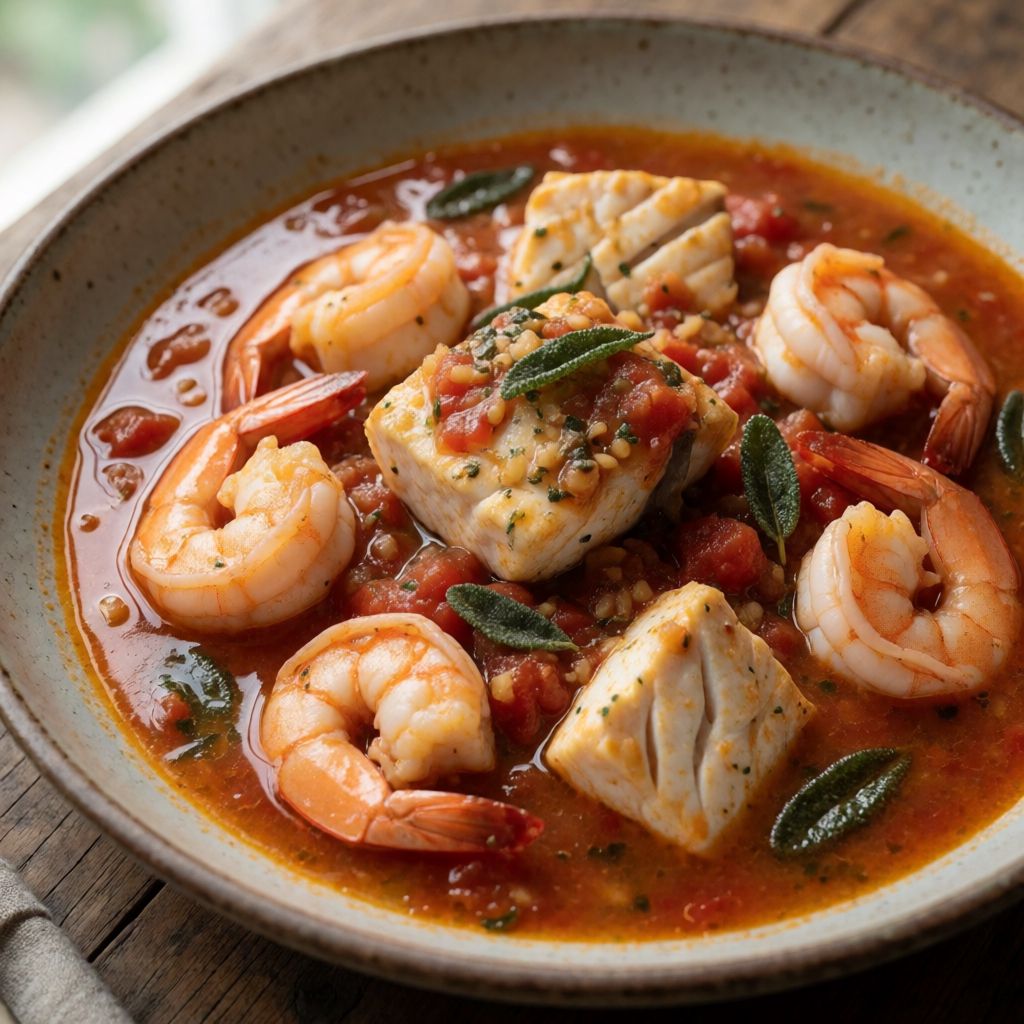
Cacciucco
A hearty Tuscan fisherman's fish stew, simmered with tomato and red wine and served over garlic-rubbed bread.
Labels are worked out automatically from the ingredients and can be wrong. Check the packaging if it matters to you.
Ingredients
- 1.5 kg Mixed white fish a mix of varieties
- 500 g Raw king prawns
- 2 pcs Sage
- 2 clove Garlic
- 100 ml Red wine
- 200 g Tomato canned
- 4 tbsp Olive oil
- Salt to taste
- Black pepper to taste
- Bread sliced, for serving









Steps
In a pot, heat the olive oil with the garlic and sage.
Chop the peeled tomatoes and add them to the oil and garlic, cover and cook for a few minutes.
Clean the fish of guts and scales, rinse and add to the pot, factoring in the cooking time of each type.
Sear the fish for a good while, then pour in the red wine and leave the pot uncovered until the wine evaporates.
Add water and salt to taste, cover and cook for about an hour. Doneness: 63°C at the thickest point.
60 minAdd the king prawns towards the end.
Remove from the heat and let the stew rest for about half an hour.
30 minToast the bread slices on a hot cast-iron grill on both sides until golden, then rub with garlic.
Serve the cacciucco with the bread.
Cacciucco is a fisherman's stew from Livorno, and the "c" sound five times in the name is apparently how many kinds of fish the old story demands — one hand short of a full count, because the fifth finger got cut off hauling nets. Nice story. The real rule is simpler: use what didn't sell at the market that day, the bony, ugly, cheap fish nobody wanted for the table, because they give the broth more gelatine and flavour than a fillet of something expensive ever will. This is not a dish that asks for the best fish in the shop. It asks for the fish the shop couldn't shift.
What decides whether it works is sequencing, not timing. You're building a pot where several things with wildly different cooking speeds — firm white fish, soft white fish, prawns — all finish at the same moment, which means they don't all go in at the same moment. Thick chunks and tougher-fleshed fish go in first; anything delicate or already pre-cooked-tender, like the prawns, goes in last, barely before you take the pot off the heat. Get this wrong and you get one perfect piece of fish sitting next to a rag of overcooked mush, and you'll blame the recipe instead of the order.
The sear before the wine matters more than it looks. You're not browning for colour here — there's barely time — you're building a layer of fond on the bottom of the pot that the wine will then lift and dissolve, carrying that flavour back into the broth. Skip the sear, and the wine just boils off clean and you've lost the whole point of using it.
On the fish: "mixed white fish" is not vague laziness in the recipe, it's the whole economic logic of the dish. In Livorno this was made from the bycatch and the unsellable bits — gurnard, weever, small octopus, whatever was left in the boat after the good stuff went to buyers. In an ordinary UK kitchen, that translates to: go to the fishmonger counter, not the pre-packed fillets, and ask what's cheap and firm-fleshed that day — gurnard, pollock, coley, monkfish tail, hake frames and cheeks if they'll sell them to you. You want a mix of textures: something that holds its shape under an hour of simmering, and something softer that will start to break down and thicken the broth a little. One kind of fish alone gives you a soup. A mix gives you a stew. If you can only get one or two varieties, that's fine — the mechanism still works, you just lose some of the layering of texture.
The prawns are not there for bulk. Raw, shell-on if you can get them, because the shells leach sweetness and a faint iodine note into the broth in the last few minutes — that's worth more than the convenience of pre-peeled ones. They go in last because they're already tender and cook in minutes; anywhere earlier and they turn to rubber, and rubber prawns are the single fastest way to make a guest think you've ruined the dish, even if the fish is perfect.
Sage with garlic and oil at the start is doing aromatic groundwork, not seasoning in the final-dish sense — the sage's resinous edge mellows the whole pot over the long simmer and you won't taste it as "sage" at the end, just as roundness. Don't swap it for something leafier like basil here; you want an oil-soluble herb that can take heat without turning bitter or grassy, and sage and bay are the two that do that reliably. If you've no sage, a bay leaf does a similar steadying job, just quieter.
The olive oil should be decent but doesn't need to be your finest bottle — any oil with no smell of its own that can carry garlic flavour into the broth will do; extra virgin olive oil is traditional because it was what was in the house, not because anything else actively fails.
Tinned tomato, not fresh, and that's not corner-cutting — it's consistency. Tinned tomatoes are picked and canned at ripeness and give you a reliable acidity and body every time; fresh ones in a British supermarket in February would be watery and underripe and would thin your broth instead of backing it. Chop them roughly rather than puréeing — you want bits of tomato breaking down slowly into the sauce, not a smooth base.
The red wine isn't for flavour on its own — you're meant to cook it off entirely, uncovered, until the sharp alcohol smell is gone and what's left is just acidity and depth folded into the fond from the sear. If you rush this step and add water before the wine's properly reduced, you'll taste raw alcohol sitting on top of the broth, and no amount of simmering afterwards fully fixes that — it needs to happen now, open, with the smell as your guide, not a clock.
The bread at the end is not garnish. It's doing the job a kazan lid or a second pair of hands might do elsewhere — it's there to be dunked, to soak broth, to turn a stew into a meal that needs no rice or potatoes alongside it. Toast it hard enough that it holds its shape against wet broth for a minute or two, rub the garlic on while it's still hot so the clove's oils actually transfer onto the surface, and don't skip the toasting and think a raw slice will do the same job — raw bread just goes soggy and falls apart in the bowl, toasted bread survives being a spoon.