
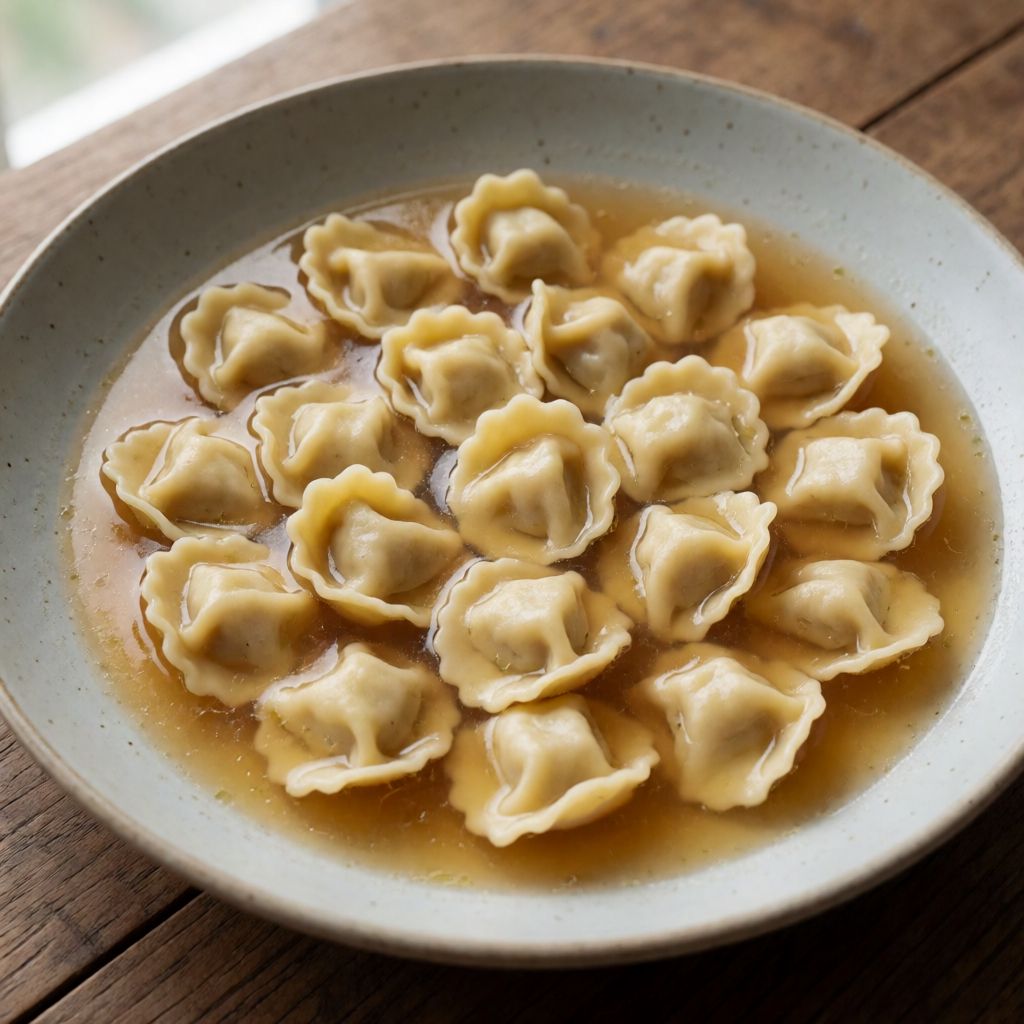
 AI photo
Cappelletti in Broth
A classic Italian dish of small meat-filled pasta parcels served in a clear homemade beef broth.
Labels are worked out automatically from the ingredients and can be wrong. Check the packaging if it matters to you.
Ingredients
- 6 pcs Eggs
- 2 pcs Egg yolk
- 600 g Plain flour
- 150 g Beef mince
- 150 g Pork mince
- 100 g Parmesan
- 50 g Butter
- Salt to taste
- Black pepper to taste
- Nutmeg to taste
- 2 l Water
- 600 g Beef
- 1 pcs Carrot
- 1 pcs Onion
- 1 pcs Celery stalk
- Salt to taste












Steps
Peel the vegetables, place the beef in a pot with 2 l of cold water and bring to the boil.
Add the carrot, onion and celery stalk to the broth.
Simmer for about 2 hours, salting and skimming the fat from the surface.
120 minStrain the broth, separating out the meat and vegetables.
Fry the beef and pork mince in butter until heated through to 71 °C inside.
Add the Parmesan, salt and nutmeg to the mince and mix well.
Tip the flour onto the work surface, make a well and pour in the eggs and yolks.
Knead the dough until smooth, then wrap it in cling film.
Leave the dough to rest at room temperature for 30 minutes.
30 minRoll out the dough with a pasta machine or rolling pin on a lightly floured surface.
Cut the dough into 4x4 cm squares and place a portion of filling in the centre of each.
Shape the cappelletti: fold the squares into triangles, join the ends and fold them upwards.
Lay the finished cappelletti on a plate dusted with flour.
Reheat the beef broth.
Drop the cappelletti into the hot broth and remove them as soon as they are cooked.
Divide the cappelletti among bowls and serve with the broth.
Cappelletti in broth is Emilia-Romagna's answer to what you do with a Sunday roast's leftover logic, except here you build the roast and the dumpling in one go, on purpose, not as leftovers. "Little hats" of egg pasta, pinched shut around a filling of fried mince, Parmesan and nutmeg, swimming in the broth that cooked the beef that sits inside them. It is a dish that eats its own tail — nothing wasted, nothing separate.
What decides whether this works is not the shaping, though that's the fiddly bit. It's the broth and the dough, because everything else depends on them being right before the mince or the folding even start. A thin, watery broth makes expensive little parcels taste of not much. A dough that's too wet won't hold a seal, and the filling leaks out into your broth as grey silt — which is the actual reason cappelletti fall apart in the pot, not "bad luck" or "cheap flour".
Some say you need a kazan-sized pot and a nonna's thumb for this. No — you need a wide, heavy pan you'd normally use for a stew, two hours you're not watching, and patience while the dough rests. The shaping takes practice, not magic hands; your first batch will look lumpy and taste exactly the same as a neat one.
The broth itself is the whole dish wearing a disguise. Everything that happens to the beef over those two hours — the slow give of connective tissue, the fat rising so you can skim it, the vegetables surrendering their sweetness — is what you're tasting when you spoon up a cappelletto. Skip the skimming and the broth turns cloudy and heavy, tasting of fat rather than of beef.
Start with the beef for the broth: a stewing cut, something with connective tissue — shin, brisket, the sort of thing that would go in a Sunday pot roast and come out tough if you rushed it. Lean prime cuts give you less flavour for more money, because the collagen that melts into gelatine over two hours is what gives broth its body; a quick-cook steak just hardens and sits there. Cold water at the start matters too — it lets the proteins release slowly instead of seizing up, which is why you never drop meat into already-boiling water if you want a clear broth rather than a muddy one.
The carrot, onion and celery stalk are not seasoning in the herb-and-spice sense — they're structural. Carrot gives sweetness, celery gives a green backbone, onion gives depth; take one away and the broth tastes thinner, not wrong, just less itself. If you're out of celery, a bay leaf or a stick of leek does the job of "something green and savoury" well enough. Salt goes in during the simmer, gradually, because salting at the start concentrates as the liquid reduces and you'll overshoot.
For the filling, beef and pork mince together is an economic habit as much as a flavour one — pork brings fat that beef mince (especially the leaner stuff sold here) often lacks, so you don't dry out the filling when you fry it off. Fry it in butter, not oil, because at this small a quantity you want the milk solids browning gently for flavour, not just heat transfer — but watch it, because butter burns faster than any neutral oil once the water's cooked out of it. Any fat with no notable smell of its own would substitute for the oil step elsewhere in the kitchen, but here the butter's flavour is the point, so don't swap it for something flavourless.
Parmesan and nutmeg in the filling are a Northern Italian habit that goes back to using what rich dairy and spice-trade regions had on hand — Bologna and Modena were wealthy trading towns, and nutmeg was an available luxury, not a mystical pairing with meat. A hard, well-aged cheese with some bite is what you're after if you haven't got Parmesan — a strong aged Cheddar won't taste the same but will do the structural job of salt and savoury depth. Nutmeg should be a background hum, not a flavour you can name; grate it fresh if you can, because pre-ground nutmeg loses its oils fast and starts tasting of cardboard.
The pasta dough — flour, whole eggs, extra yolks — is rich because it has to hold its shape thin, unfilled dried pasta can afford to be leaner. The extra yolks add fat and colour without adding the water that extra whole eggs would, which keeps the dough from turning slack. Resting it for thirty minutes isn't a ritual — it lets the gluten you've just developed by kneading relax, so when you roll it out it doesn't spring back and fight you, and doesn't tear at the edges when you fold your little hats.
Some say you must use a pasta machine for proper cappelletti. No — a rolling pin and a flat surface and some arm work does exactly the same job, just slower and less evenly; the machine only buys you consistency, not a different pasta. What actually matters, by hand or machine, is rolling the dough thin enough that it cooks through in the time the filling needs to just heat through, without going gummy — too thick and you get raw-tasting dough around a filling that's gone cold by the time the middle's done.
When you cook them, drop the cappelletti into broth that's properly hot, not a gentle simmer, and take them out the moment they float and look swollen rather than flat — that's the dough cooked through, the filling warmed, not a fixed number of minutes you can set a timer to and walk away from. Leave them too long and the seams start to give, which is the same seam-failure logic as a badly sealed dumpling, just finished off by overcooking instead of caused by it.
This feeds eight as a modest first course, which is how it's meant to be eaten — not a main course stew, a small bowl before whatever comes next, in the old sense of a dish meant to open the stomach rather than fill it.