
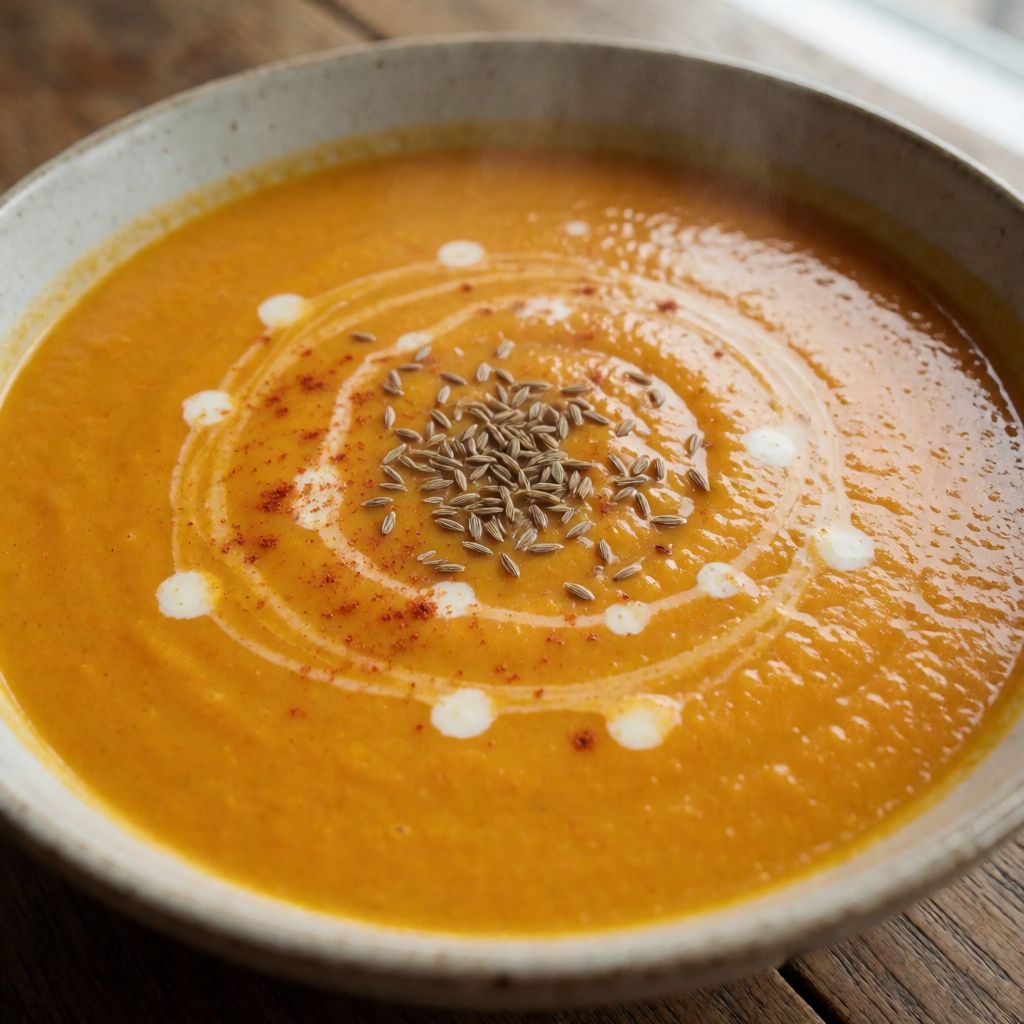
 AI photo
Carrot Soup
A warming carrot soup finished with coconut milk, spices and fresh parsley.
Ingredients
- 3 pcs Onion finely chopped
- 4 clove Garlic
- 2 tsp Cumin
- 3 tsp Ground Coriander
- 2 tsp Paprika
- 1 kg Carrot diced
- 1.5 l Stock
- 200 ml Coconut Milk
- 1 tsp Olive Oil for frying
- Salt
- Black Pepper freshly ground
- 2 tbsp Coconut Milk for serving
- 1 bunch Parsley leaves












Steps
Heat the oil in a pot and fry the onion over medium heat until soft.
6 minAdd the garlic, cumin, coriander, paprika and carrot. Stir for about a minute.
1 minPour in the stock, starting with 1.3 litres, so you can adjust the consistency to taste later.
Let the soup simmer gently until the carrot is soft.
9 minAdd the coconut milk and blend until creamy and light.
2 minIf needed, add more stock to reach the desired thickness.
1 minSeason with salt and pepper to taste.
Serve drizzled with a little coconut milk and sprinkled with parsley leaves.
A carrot soup is really a question about what a kilo of root vegetable can become once you stop thinking of it as a side dish. Here it becomes the whole meal: sweetness from the carrot, warmth from cumin and coriander, and a coconut milk finish that rounds the spice off instead of fighting it. Nothing exotic in the method — onion softened, spices woken up in the fat, carrot and stock simmered down, then blended. The whole trick is in two places: how far you take the onion, and how far you take the carrot.
Onion first. "Soften" is not "brown". You want it to go from sharp and white-edged to translucent and sweet, no colour change worth mentioning — six minutes is a start, not a stopwatch. Push it further into caramel and you've added a bitterness that no amount of carrot sweetness will talk its way out of. This is the one place people rush, because medium heat in a thin domestic pan runs hotter at the edges than in the middle, and an onion left unstirred there catches before the centre has even gone soft.
Then the spices go into the same hot fat for a minute, not into the liquid. Cumin and coriander and paprika are oil-soluble — their flavour sits in fat-soluble compounds that unlock with heat and fuse into whatever's greasy in the pan. Dump them straight into stock and you get mostly their dust, not their perfume. A minute, stirred constantly, is there to toast them without burning — go longer and paprika in particular turns from warm to acrid, sitting bitter on the tongue instead of rounding out.
Start the stock at 1.3 of your 1.5 litres on purpose — this isn't stinginess, it's that a blended soup is much easier to loosen than to thicken. Add liquid, blend, and judge; add more if it's gluey, hold back if it already pours properly off the spoon. Try to fix a too-thin soup afterward and you're boiling off water and concentrating everything else out of balance, including the salt.
Carrot: buy it firm, not limp, no green shoulder near the top (that's bitterness, from sun exposure while it sat in the ground). Diced evenly so it cooks evenly — a few oversized chunks will still be stubborn when the rest has given up. You can swap in parsnip for some of the weight if you want more sweetness and less crunch resistance, since it collapses faster; swede works too, with a more vegetal, slightly peppery note.
Onion: go for a standard yellow or white onion, nothing fancy, because its whole purpose here is sweetness and bulk, not personality. Red onion will work in a pinch but brings a sulphurous sharpness that lingers longer than you'd like in a soup that's meant to taste rounded.
Garlic, cumin, coriander, paprika: this combination is less "authentic" anything and more just a reliable warm, earthy base — the kind of spice shelf most people already have rather than a trip to a specialist shop. If you're missing one, the soup survives; missing all three, you've made carrot purée, not this soup. Paprika specifically can be smoked instead of sweet if you want a different register — closer to bonfire than to simple warmth.
Stock: use what you'd make a gravy with on a Sunday — chicken, vegetable, whatever's in the cupboard as a cube or carton. A stronger, more gelatinous homemade stock will give the soup more backbone; a stock cube version is thinner and leans more heavily on the carrot and spice for flavour, so taste before you salt, because cubes are often salty on their own.
Coconut milk, split in two: most goes in during blending, for body and a faint sweetness that calms the spice down rather than disguising it; the rest is a drizzle at the end, purely for the eye and for the cold-fat contrast against a hot bowl. Any oil with no flavour of its own works for frying the onion — sunflower, groundnut, a neutral vegetable oil — olive oil's only there because it's what most kitchens have open already, not because the dish demands it. Parsley at the end for the bite of green it gives against all that soft orange — a bit of patience chopping it finely pays you back more than people expect from a garnish.