
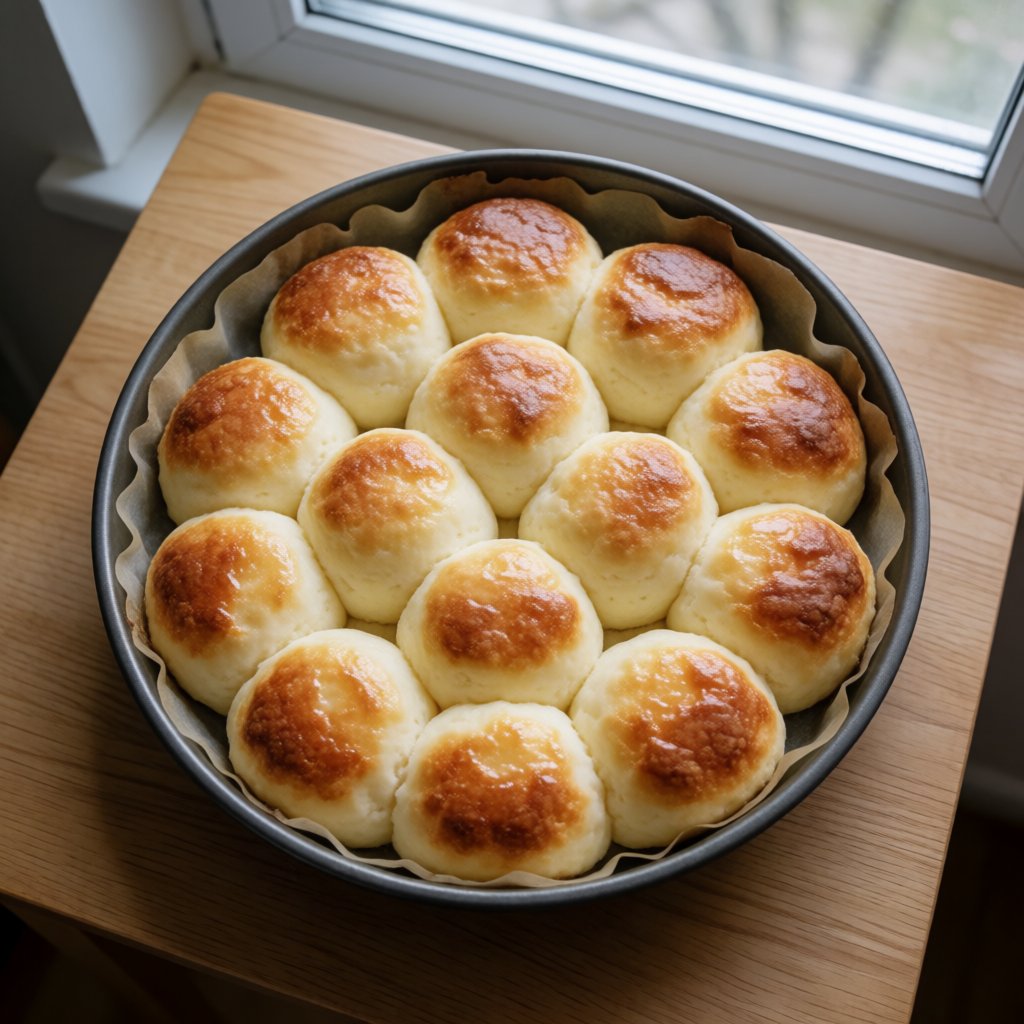
 AI photo
Baked Ricotta Balls
Soft baked cheese balls, ready in well under an hour.
Labels are worked out automatically from the ingredients and can be wrong. Check the packaging if it matters to you.
Ingredients
- 250 g ricotta well-drained
- 1 pcs egg
- 3 tbsp plain flour
- 1 tbsp sugar
- 0.25 tsp vanilla extract





Steps
Mix everything into a thick dough, dampen your hands, and roll into balls about 3–4 cm across.
Place on a baking tray lined with baking paper, leaving space between the balls.
Put the tray in the oven and bake at 200°C for 20–22 minutes, until golden.
22 minTake the tray out of the oven.
What was changed
Swapped the cheese for ricotta, as UK cottage cheese is too wet for this dough; vanillin was replaced with vanilla extract, the usual choice in UK kitchens.
These aren't doughnuts and they aren't cheesecake — they sit in between. Ricotta held together by one egg and a spoon or two of flour, rolled into something the size of a walnut, baked until the outside goes gold and faintly cracked while the inside stays soft, almost spoonable. Two bites, maybe three if you're slow about it.
What decides whether this works is not the oven, it's the drainage, and it happens before you touch the mixing bowl. Ricotta out of the tub still carries whey in it. Leave that whey in and your dough is slack — and slack dough doesn't hold a ball, it holds a puddle, which spreads flat the second it hits a hot tray and never develops a crust, just a damp pale top. The ball you shape with wet hands is only ever as round as the cheese lets it be.
The 200°C does one job and one job only: it sets a crust fast, before the moisture inside has time to just quietly evaporate and leave you with a dry little pebble. Hard heat on the outside traps steam on the inside, so what you end up with is crackle on top and something close to baked custard underneath. Judge it by colour, not the clock — gold with a bit of crack, not pale. Pale isn't gentle, pale is underdone.
Some say any soft white cheese does the same job — no, because cottage cheese is a different curd, looser and wetter, and it won't hold its own shape on a tray, baked or not. Ricotta works because the curd is already fairly dry and fine-grained before you even start pressing more whey out of it.
Start with the ricotta itself. Buy the firm block kind if you can find it, not the loose, almost pourable one sold in tubs for spreading — that one is halfway to being a sauce already. Whichever you get, drain it again yourself: paper towel or a clean tea towel in a sieve, cheese on top, something flat and heavy on the cheese, and leave it. An hour minimum, overnight in the fridge is better. This is the one place patience actually earns you something — rushed drainage means wet dough, wet dough means flat balls, and no amount of extra flour fixes that properly, it just toughens what should be soft. If you've got no ricotta, drained cottage cheese pushed through a sieve to break up the curds works, or quark, which is already drier — start with a little less flour than the recipe says if you use quark, and add only if the dough won't hold.
The egg is the binder. Its protein sets when it meets heat and that's what actually holds the ball together once the crust forms — not the flour, the flour just gives the protein something to grip onto. It also carries a little water of its own, which turns to steam inside and gives you that faint lift rather than a flat dense centre. One egg is right for 250g of properly drained cheese; if your cheese came out wetter than expected, don't reach for a second egg, reach for a bit more flour instead — egg loosens, flour tightens.
Flour here is structure, not flavour. Three tablespoons for 250g of drained ricotta is a tight fit — enough to let the dough hold a round shape under damp hands, not so much that it turns into something you'd call bread. Every extra spoonful past what the dough actually needs makes the inside denser and less like melting cheese and more like a bun. Plain flour is fine because you're not after rise, you're after scaffold — no need for anything stronger.
Sugar does two jobs at once: it sweetens, obviously, but it's also most of why the surface goes gold rather than staying the colour of raw dough. Sugar caramelises under that 200°C heat; without it the crust would set but stay pale, and pale crust tells you nothing about doneness because it isn't browning, it's just drying.
Vanilla is there to take the edge off the slight tang that whey leaves behind even after good draining — ricotta always has a little of that dairy sharpness, and vanilla rounds it rather than masking it. A quarter teaspoon of extract is plenty; if you've got a pod, scrape a few seeds in instead for flecks, but don't double the extract thinking more is kinder, it just turns boozy-bitter at that quantity.
On a domestic hob and in an ordinary UK oven, the one thing worth knowing is whether yours is fan-assisted. Fan ovens run genuinely hotter at the same dial setting, so if yours has a fan, knock the temperature down by about 20°C and keep the same golden-and-cracked cue for doneness rather than trusting the timer blindly. And if you've just had the oven on for a Sunday roast, this is a good thing to slide in while it's resting under foil — the oven's already hot, you're not spending a second lot of energy heating it from cold, and these come out just as the tea's brewed.
·