
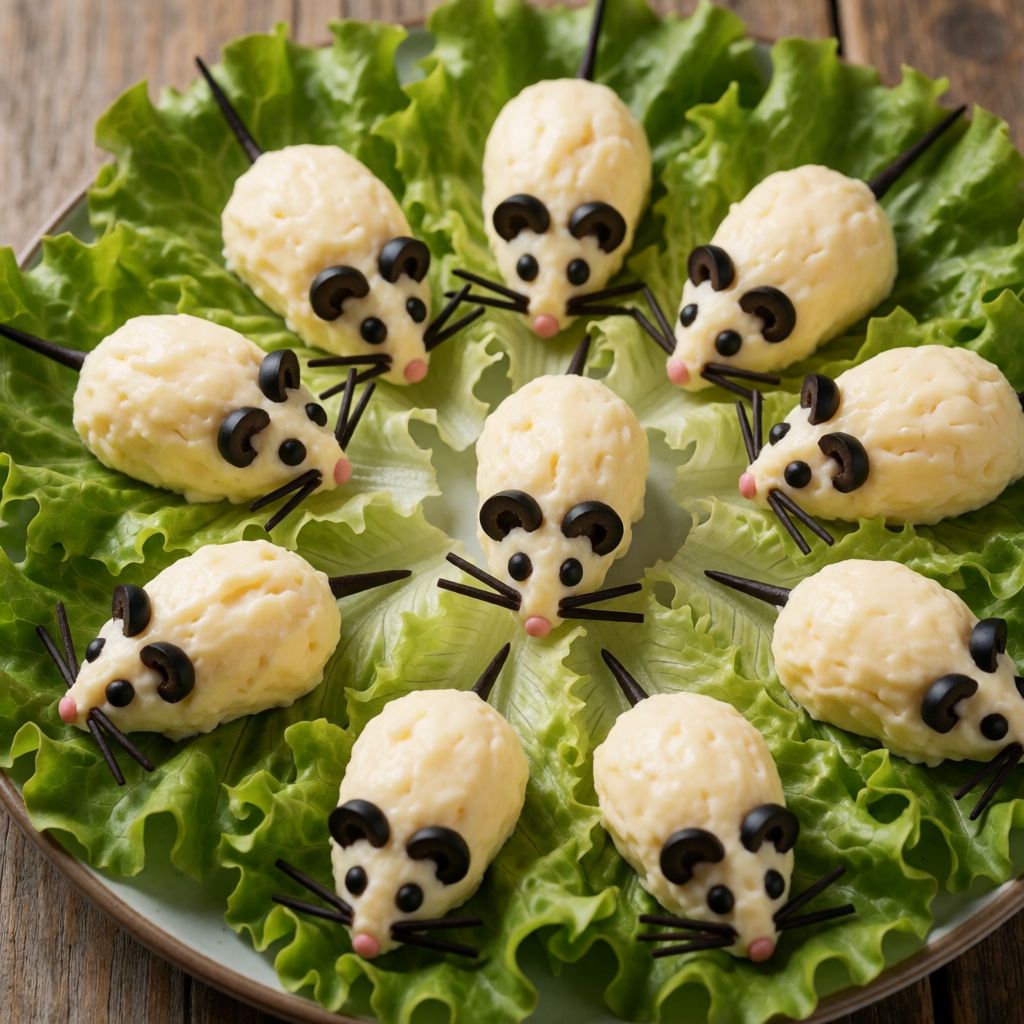
 AI photo
Cheese Mice
A playful party snack: little cheese mice made from processed cheese, served on a bed of lettuce.
Labels are worked out automatically from the ingredients and can be wrong. Check the packaging if it matters to you.
Ingredients
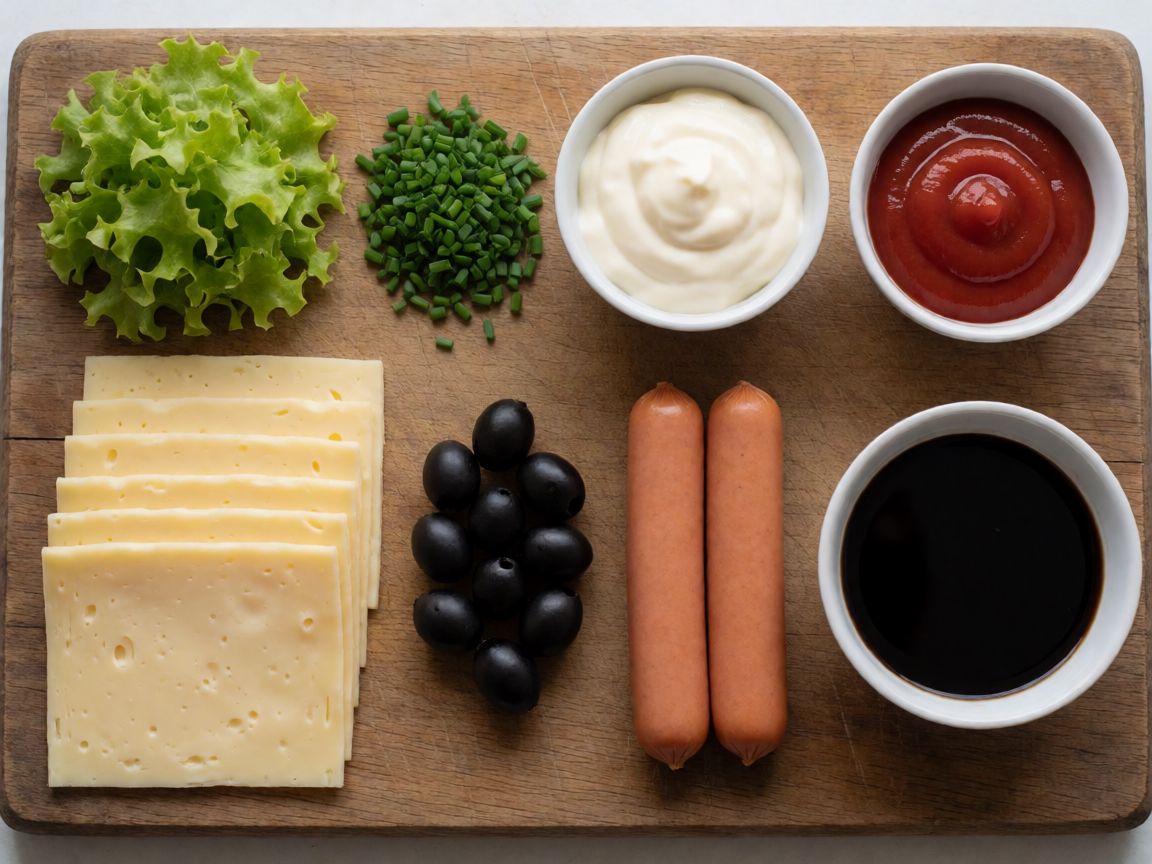
- 7 pcs Processed cheese
- Lettuce to taste
- Chives to taste
- Mayonnaise to taste
- Ketchup to taste
- Black olives to taste
- 2 pcs Frankfurter sausages
- Olive oil to taste
- Salt to taste
- Balsamic vinegar to taste









Steps
Place a black olive on top of each piece of processed cheese to make the mouse's nose.
Slice the sausage into thin rounds to make the ears.
Use chives to make the tail.
Using a piping bag, pipe mayonnaise for the eyes and ketchup for the pupils.
Arrange the lettuce on a plate and place the cheese mice on top.
Mix the olive oil, balsamic vinegar and salt, and drizzle over the dish.
This isn't cooking, it's assembly — there's no heat here beyond what your hands bring to softening the cheese. The whole trick rests on one idea: a wedge of processed cheese is already mouse-shaped. It has a point (the snout), a wide back (room for ears and a tail), and a flat base (so it sits still on the plate). You're not building a mouse, you're noticing one that's already there in the shape of the cheese, then adding the bits that make a brain read it as a face.
What decides whether this works is temperature of the cheese, not of a pan. Straight from the fridge, those wedges are stiff and dry at the surface — push an olive or a sausage round into cold cheese and it either won't grip or it cracks a little white seam along the edge. Let the cheese sit out until it gives slightly under a fingertip, like the skin of a ripe plum. That's the whole 'cook' step: patience, not fire.
Some say you need fresh mozzarella or cream cheese for this kind of canapé because 'fresh is better.' No — fresh cheeses are too wet, they won't hold a shape or an olive nose without sliding. Processed cheese is firm, dry-surfaced, and cuts clean; that's precisely why it was invented, and precisely why it's the right tool here, not a compromise.
The dressing at the end isn't for the mice — it's for the lettuce underneath. Drizzle it on the mice themselves and you'll wash the mayonnaise eyes off their faces within a minute. Dress the bed, sit the mice on top, and the oil and vinegar do their job from a distance: cutting the richness of cheese and mayonnaise without touching the decoration.
Go through this like you're laying out tools, because that's what it is.
Processed cheese, one wedge per mouse: choose it for the triangular shape and the dry, slightly rubbery surface — that surface is what lets a sausage slice or an olive stay put without a dab of anything sticky. Any firm, foil-wrapped cheese wedge sold for lunchboxes works; what you're avoiding is anything soft enough to need a spoon.
Black olives, for the nose: the criterion is small, dark, roughly round, with enough contrast to read as a nose from across a table. A caper works. A single black peppercorn pressed in works for a smaller mouse. Don't reach for green olives dyed black for pizza toppings — the brine taste is sharper and it bleeds colour into the cheese if the two sit together too long.
Frankfurter sausages, sliced thin, for the ears: thin is the whole point — a thick round sits flat and stubborn, a thin one has a slight curl to it that mimics the fold of a real ear. Frankfurters are already cooked and cured, so you're not heating them, just cutting them — any pre-cooked cylindrical sausage or even a thick slice of ham rolled tight will do the same job if that's what's in the fridge. If you want a version without meat, a thin disc of cucumber skin, dark side out, gives you the same curved dark fleck.
Chives, for the tail: you want a stalk that bends without snapping, because a snapped tail just looks like a cheese splinter. Chives do this naturally when fresh — if yours have gone limp and floppy in the salad drawer, that's actually fine here, floppy bends easier than crisp. A fine strip of spring onion green or a parsley stem is the same idea if you've no chives.
Mayonnaise and ketchup, piped for eyes and pupils: the failure here is always the same — too thin a mayonnaise spreads into a blob instead of holding a dot. Use a full-fat mayonnaise, not a 'light' one loosened with extra water, and a thick ketchup rather than a runny one. You don't need a proper piping bag — a small food bag with one corner snipped off a few millimetres is the same tool, and it's what most kitchens actually have.
Lettuce is the plate, essentially — pat it dry with a paper towel first, because wet leaves won't hold the dressing and the mice will skate around on them instead of sitting still. Olive oil, balsamic, and salt whisked together is a plain vinaigrette; any neutral oil with no smell of its own will do if you've no olive oil, but the balsamic matters more than people think — its sweetness and acidity are what stop the whole plate tasting like cold fat.
Worth saying plainly: this is party food in the British sense — cheese-and-pineapple-stick, cocktail-sausage, kids'-tea-table food. It exists because processed cheese and frankfurters are cheap, keep without refrigeration for ages, and portion themselves. The whimsy of a mouse face is doing real work — it's what makes a child eat cheese and a sausage slice without negotiation. There's no magic in the tradition, just a good trick for getting protein into a five-year-old.