
 AI photo
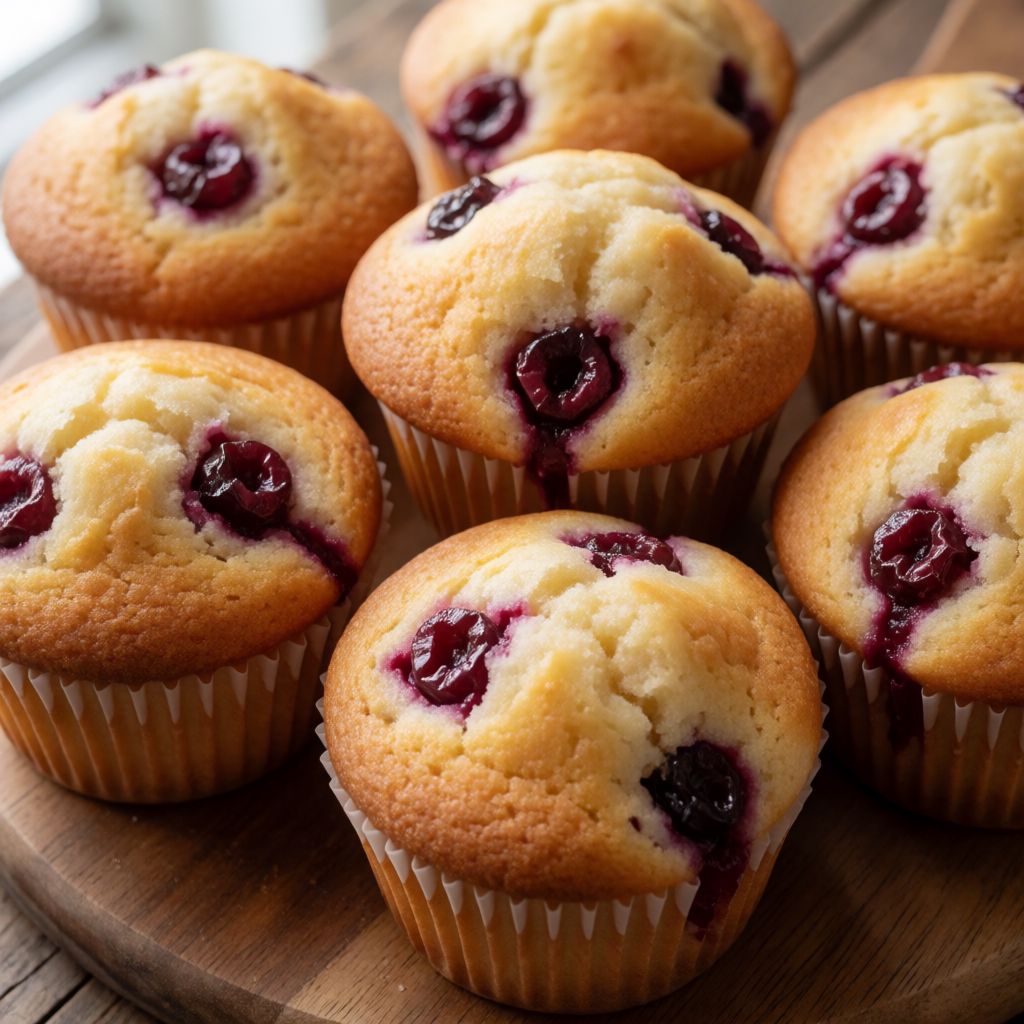
Cherry Muffins
Soft muffins packed with fresh cherries, lightly spiced with cinnamon and vanilla.
Labels are worked out automatically from the ingredients and can be wrong. Check the packaging if it matters to you.
Ingredients
- 300 g Cherries
- 200 g Plain flour
- 2 pcs Eggs
- 120 g Caster sugar
- 1 pcs Baking powder
- 1 pinch Salt
- 80 g Butter
- 300 ml Milk
- 0.5 tsp Cinnamon
- 1 pcs Lemon juice only
- 1 pcs Vanilla pod seeds only











Steps
Remove the stones from the cherries.
Sprinkle the cherries with lemon juice, add one tablespoon of sugar and mix.
Sift the flour with the baking powder, vanilla seeds and cinnamon.
Beat the eggs with the remaining sugar until smooth and creamy, add a pinch of salt and the milk.
Quickly fold in the flour mixture, the cherries and the melted butter.
Grease the muffin tins with butter and fill them halfway with the batter.
Place the tins in the oven, preheated to 200°C, and bake for 15-20 minutes.
18 minCheck doneness with a toothpick: if it comes out wet, the bake needs more time.
A muffin is not a cupcake and it is not a sponge cake either — it's a quick bread held together by gluten that never got the chance to develop. That's the whole mechanism: you mix wet into dry just long enough for the flour to disappear, and then you stop. Stop too late and the gluten strands tighten into something chewy and tunnelled with holes — that's the famous "tough muffin" problem, and it has nothing to do with the oven, it happens at the mixing bowl.
What decides whether this batch works is restraint, twice over. First with the batter — fold the flour, cherries and melted butter in with a spatula, a dozen strokes, streaks of flour still visible is fine, a smooth batter is not the goal, it's the warning sign. Second with the cherries — pit them properly, because a missed stone in a muffin is the one thing a guest remembers, however good the crumb was.
The lemon juice and sugar on the raw cherries aren't decoration. Cherries are mostly water, and water leaking into batter during baking is what gives you a soggy ring around the fruit. A few minutes of maceration draws some of that juice out early, on your terms, so less of it escapes mid-bake and turns the crumb gluey right at the spot you most want it light.
Flour: plain, not self-raising, because you're already controlling the rise with baking powder measured by hand — self-raising flour hides its own quantity from you, and in a batter this small that's not a detail you want hidden. Any plain wheat flour works; there's no reason to chase anything fancier here.
Eggs and sugar beaten together until "smooth and creamy" is doing a job, not just a description — you're dissolving the sugar and trapping a little air before the flour ever meets the bowl, which gives the crumb its first lift, cheaply, before the baking powder even wakes up in the oven's heat. Skip this and the sugar stays grainy inside the baked crumb; nobody likes finding that.
Butter, melted, not softened: this is a quick-bread method, not a creaming-method cake, so the butter's job is to coat flour particles and keep them tender, not to be whipped with sugar for structure. Any neutral fat with no smell of its own will do the same coating job — a flavourless vegetable oil, say — but butter also browns the crust and crust flavour matters more in something this small and plain.
Milk brings the batter to a pourable thinness and, with its slight acidity, helps the baking powder do its work evenly rather than in one burst at the oven door. Whole milk, since you're in a tea-with-milk kitchen anyway, gives a softer crumb than skimmed — the fat in it is doing quiet work alongside the butter.
Baking powder is listed as "1 pc", which really means one sachet — in Britain that's usually around 2 teaspoons; measure by teaspoon if you're buying loose, because too much lifts the batter fast and then it collapses as it can't hold its own structure, which is the other classic cause of a sunken, dense muffin that people blame on the oven when it was the tin of powder all along.
Cinnamon and vanilla seeds aren't there to announce themselves — half a teaspoon and one pod's seeds is a background note, meant to sit behind the cherry, not compete with it. If you can't get a vanilla pod, a good splash of real vanilla extract does the same quiet job; the paste kind is the next best thing, the clear synthetic essence the last resort.
On stones: some say you can leave them in "for flavour" — no, because a cherry stone cracks a tooth long before it releases any flavour worth the risk, and there is no mechanism by which baking a pit improves a muffin. Pit them, even though it's the slowest part of the whole seven minutes of prep; that patience is the ingredient nobody lists but everyone tastes the absence of if you skip it.
Your tin takes the place of the dariole moulds and paper cases this recipe might assume — any standard UK muffin tray, buttered well in the cups, works fine; paper cases are an easier clean-up if you'd rather not scrub butter off metal after a Sunday roast has already claimed the oven's good will. Check with a toothpick near the end rather than trusting the clock alone — "15 to 20 minutes" is a window, not a verdict, and the crumb clinging wet to the pick is the only honest answer about whether it's done.