
 AI photo
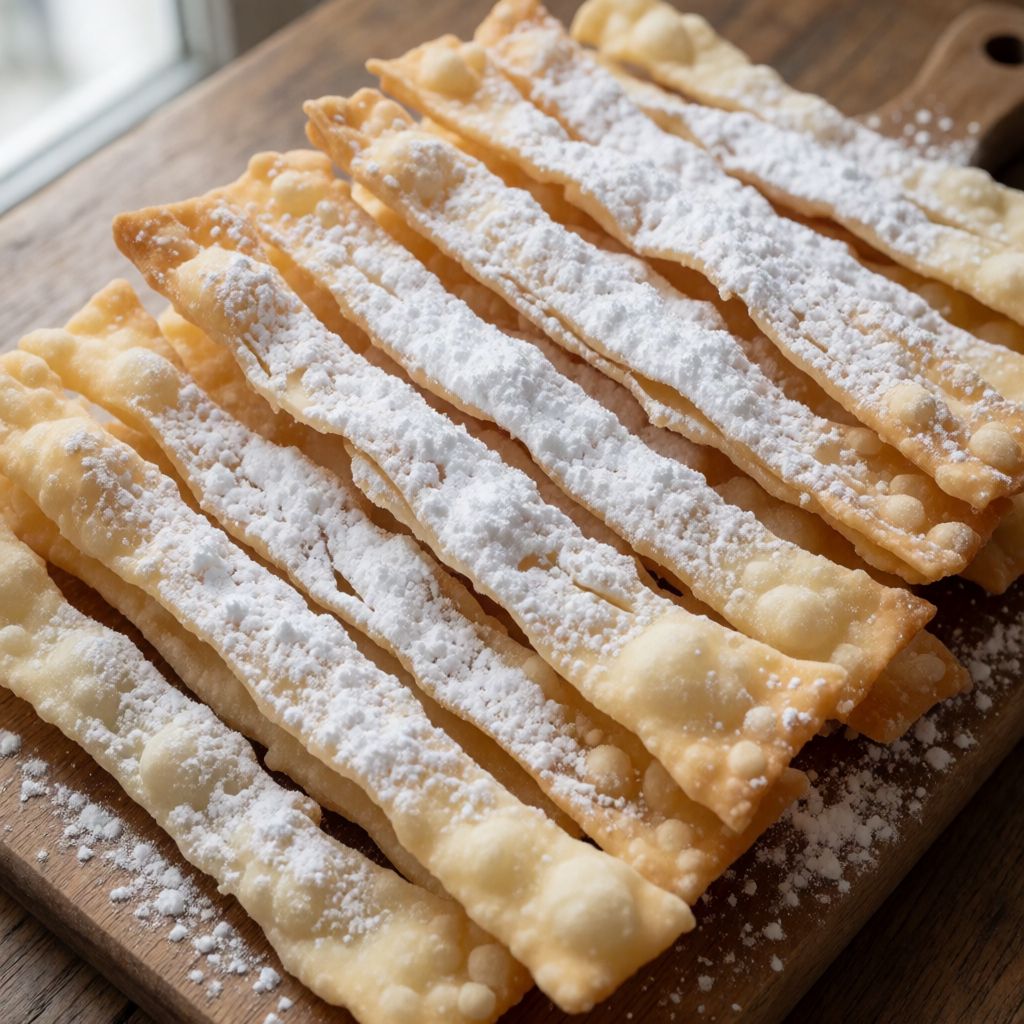
Carnival Chiacchiere
Crisp fried ribbons of sweet pastry dusted with icing sugar, made for Carnival celebrations.
Labels are worked out automatically from the ingredients and can be wrong. Check the packaging if it matters to you.
Ingredients
- 300 g Plain flour
- 15 g Caster sugar
- 1 pcs Eggs
- 30 g Butter melted
- 0.5 pcs Baking powder
- 1 pcs Vanilla extract
- 0.5 pcs Lemon zest
- 20 g Rum
- 70 g White wine
- Icing sugar to taste
- Vegetable oil for deep-frying








Steps
Sift the flour into a mound on your work surface, make a well in the centre and add the sugar, vanilla extract, egg and baking powder.
Add the lemon zest and the melted butter, and mix the ingredients together lightly.
Pour in the rum and white wine and knead by hand into a smooth ball of dough.
Wrap the dough in cling film and let it rest in the fridge.
20 minRoll out the dough with a pasta machine or a rolling pin, dusting with flour, until it is 2-3 millimetres thick.
Using a ravioli cutter, cut the dough into long rectangular strips — you can tie them into knots or cut a slit down the middle.
Heat the vegetable oil in a pan to 170°C.
Fry the chiacchiere on both sides until golden.
Lay the cooked chiacchiere on a paper towel to remove excess oil, and dust with icing sugar.
Serve the chiacchiere immediately.
What was changed
Peanut oil was replaced with Vegetable oil for frying, and vanillin was replaced with Vanilla extract, as these are more commonly used in British kitchens.
Chiacchiere means "chatter" — and that's exactly what these are: thin, crisp sheets of fried dough, fragile enough to shatter like gossip the moment you bite in. Carnival food, built for the week before Lent when every bit of butter and sugar in the house had to go before the fasting started. No filling, no fuss — just dough, hot oil, and a dusting of sugar snow on top.
What decides whether this works is not the frying, it's the dough beforehand. You want a dough that's smooth but not elastic — because elastic dough means gluten that's been worked up and wants to shrink back the instant you roll it thin, giving you lumpy, uneven strips instead of flat, blistered sheets. That's why you rest it in the fridge: the gluten relaxes, the butter firms up a little, and rolling becomes easy instead of a fight.
The rum and wine aren't there for flavour alone — the alcohol in both evaporates fast in hot oil and interferes with gluten development, which is part of why this dough fries up brittle rather than bready. Some say you can skip the alcohol and just add more flour or milk — no, because then you lose that shatter and get something closer to a doughnut, soft inside instead of glass-crisp through and through.
Rolled to 2-3mm, cut into ribbons, fried until gold — that's the whole trick. The sugar goes on only after frying, never before, because sugar on raw dough in hot oil just burns rather than melts.
Flour is the only structural ingredient here, so use a plain flour with modest protein — strong bread flour will fight you with elastic dough that won't roll thin without snapping back. 300g plain flour, English "plain" is exactly right, no need to hunt for Italian 00 unless you already have it; 00 just gives a slightly silkier roll, nothing more.
The egg and melted butter bring fat, and fat is what makes the fried dough crisp rather than tough — it coats flour particles and limits how much gluten can link up. Butter melted, not softened, so it blends in without lumps; if you're out of butter, any flavourless oil works as a straight swap by weight, though you lose the faint dairy note.
Baking powder here is a "0.5 pcs" measure, which tells you it's a small amount relative to the rest — think a flat half-teaspoon, not a measuring cup. It's not for rise in the usual sense; chiacchiere don't puff like a doughnut. It just lightens the structure enough that the strips blister and bubble a little in the oil rather than frying flat and leathery.
Lemon zest and vanilla are perfume, not substance — leave either out and the dough still works, you just lose a layer of smell that cuts through the fried-oil richness. Orange zest is the obvious swap if that's what's in your fruit bowl.
Rum and white wine do double duty: liquid to bring the dough together, and alcohol to keep gluten short so the sheets stay crisp rather than bready, as I said above. No rum in the house — brandy or even a splash more wine will do; you're after alcohol content and a bit of acidity from the wine, not a particular taste, since most of it cooks off anyway.
For deep-frying on a UK domestic hob, forget a kazan — a wide, heavy pan with 4-5cm of oil and a thermometer is what you've actually got, and that's fine. 170°C is where egg-wine dough blisters and browns in roughly a minute without the centre staying raw or the outside scorching before the inside sets; too cool and the dough just sits there soaking up oil and turning tough, which is the real cause of greasy chiacchiere, not the frying itself. Use oil with no smell of its own — sunflower, vegetable, groundnut — because the chiacchiere's whole appeal is lemon and vanilla, not whatever the oil was doing a batch ago. Drain on paper towels for the fat, not for show, then dust with icing sugar only once they've cooled enough that the sugar sits rather than melts into a wet smear. And don't rush the fridge rest — patience there is what saves you the fight at the rolling pin later.