
 AI photo
Chicken Breast and Courgette Skewers
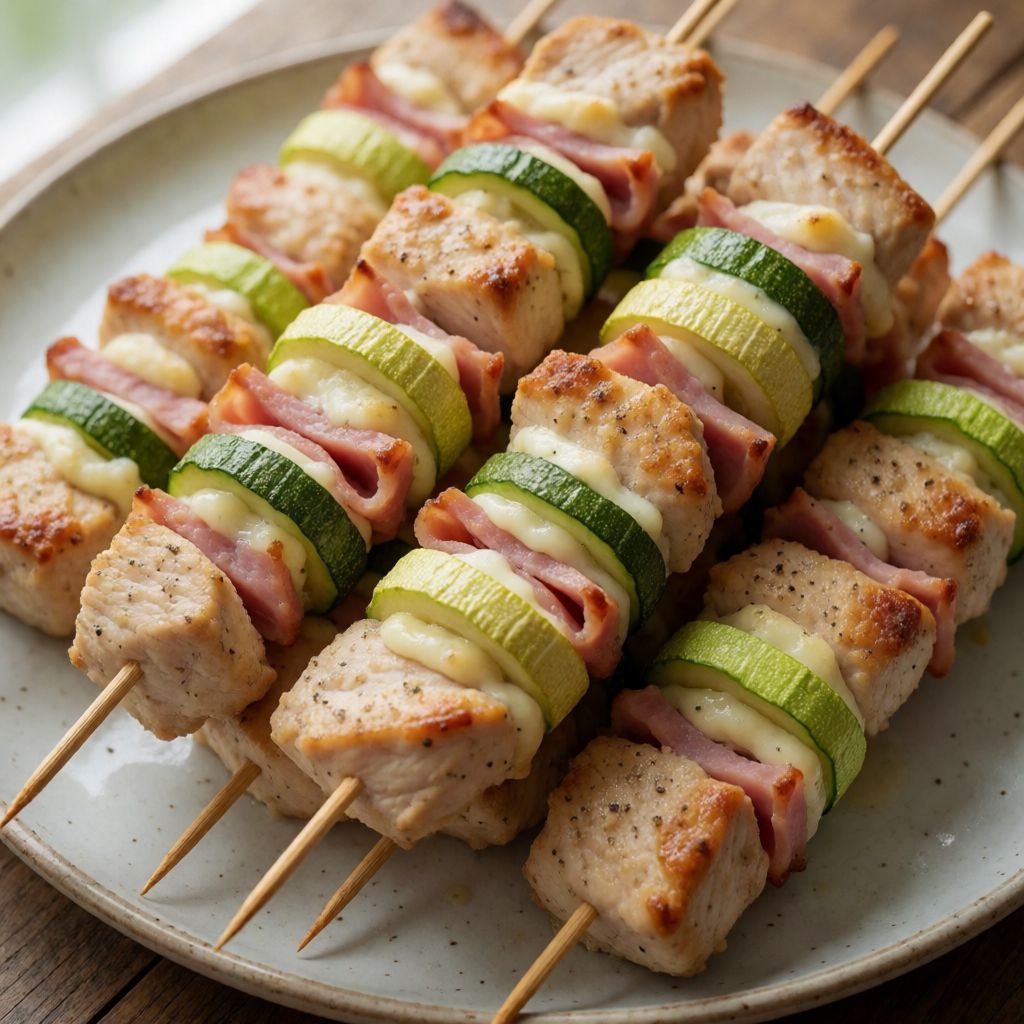
Tender chicken breast and courgette skewers, wrapped in ham and melting cheese, baked until golden and juicy.
Labels are worked out automatically from the ingredients and can be wrong. Check the packaging if it matters to you.
Ingredients
- 6 pcs Chicken breast
- 1 pcs Courgette
- 100 g Ham
- 100 g Smoked scamorza or another cheese
- Maize flour to taste
- Salt to taste
- Olive oil to taste





Steps
Lay the chicken breast slices on a board and flatten them slightly to make them thinner, then brush with olive oil.
Coat the slices in maize flour for a crisp coating, adding salt and other spices to taste.
Place ham, scamorza and sliced courgette on each slice.
Roll three slices together and thread them in parallel onto skewers.
Using a long knife, cut between the skewers to form individual kebabs.
Place the kebabs on a baking tray lined with parchment paper and bake at 170°C for about 30 minutes, until the internal temperature reaches 74°C.
30 minAlternatively, fry the kebabs in a pan, turning occasionally, until the internal temperature reaches 74°C.
This is an involtino wearing a skewer's clothes. You take a flattened chicken breast, roll it around ham, melting cheese and a strip of courgette, crust it in coarse maize flour, then slide a couple of skewers through a row of these rolls so you can slice them apart into neat little kebabs. It's a way of making a dry, lean cut of meat behave like something richer — the filling does the work the breast can't do on its own.
What decides whether this works is evenness, not timing. Chicken breast is thick at one end and thin at the other; if you don't flatten it to one thickness, the thin end is dry sawdust by the time the thick end is actually cooked. That's the real fault behind "one piece perfect, the next one raw in the middle" — it's never the oven's fault, it's the knife's.
The second thing that decides it is the coating. Maize flour has no gluten, so it never turns into paste against the oil — it stays grainy and fries to a proper crust. Wheat flour, under the same oil, goes gluey and slips off in sheets. If your crust has ever vanished into the pan, that's why.
Some say chicken is done when the juice runs clear. No — because clear juice can sit at 60°C just as easily as at 80°C, and one of those will make you ill and the other will be dry as a biscuit. A thermometer reading 74°C in the centre of the roll is the only honest marker here, and it costs you nothing but patience to check it.
Start with the breast itself. Flatten it under clingfilm with the flat of a knife or a rolling pin — not to tenderise anything mystical, just to make the thickness even across the slice, so the whole roll reaches 74°C at the same moment instead of in stages. Any thin, flat cut of white meat will take this trick: turkey breast, pork loin bashed out the same way.
The oil brushed on before the flour isn't for flavour — it's glue. Maize flour needs something to cling to, and oil gives it an even film without the faff of an egg wash. Any flour with no gluten to form a paste will crisp the same way; polenta flour, rice flour, even very fine cornmeal all do this job. Ordinary wheat flour will fight you — it bonds with the oil into a soft skin that steams rather than crisps.
Ham and scamorza exist because breast meat alone is lean to the point of being boring under heat — it has almost no fat of its own to keep it moist or interesting. The ham brings salt and a little fat, the cheese melts and binds the roll from inside, giving you something to pull apart rather than just chew. Scamorza is cured and lightly smoked precisely because that's how farmhouses once kept cheese edible without refrigeration — the smoke was preservation first, flavour second. Any cheese that melts into a stretch rather than weeping out as oil will do: a mild mozzarella, a small amount of a cheese that holds its shape under heat.
The courgette is there for moisture, not crunch — sliced thin, it cooks through in the same stretch of heat the chicken needs and releases just enough water to keep the inside of the roll from drying while the outside firms up. Cut it thick and it will still be raw and squeaking when the chicken is already at temperature. Any quick-cooking vegetable with a similar water content — a thin strip of pepper, a slice of aubergine — can stand in.
The double skewer through a row of rolls isn't decoration, it's mechanics: one skewer lets the roll spin the moment you try to turn it in a pan, so one side browns and the other stays pale; two skewers hold it still. Cutting between the rolls afterwards is just an economy of motion — thread three at once, slice once, and you've made three kebabs instead of fiddling with one skewer at a time three separate times.
As for heat: 170°C in a domestic oven is low enough that the maize crust doesn't scorch before the centre of the roll climbs to 74°C — push the oven hotter and you'll colour the outside while the middle is still cool, which is the defect people usually blame on "the oven running hot," when really it's impatience. If you fry instead, keep the heat low enough that the coating crackles steadily rather than spits and darkens fast, and turn the kebabs often — the thermometer, not the clock, tells you when to stop.