
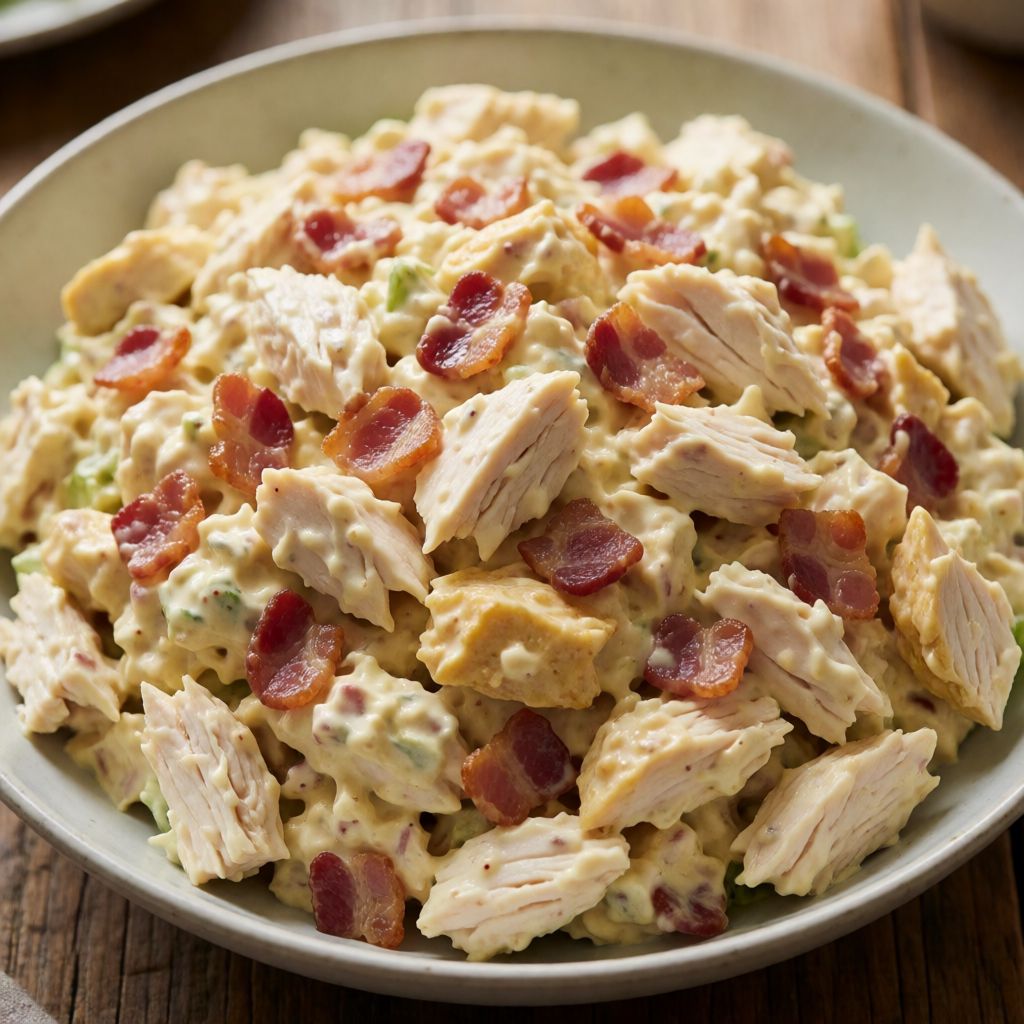
 AI photo
Chicken Salad with Bacon
A creamy chicken salad with crispy bacon, chives and chervil.
Labels are worked out automatically from the ingredients and can be wrong. Check the packaging if it matters to you.
Ingredients
- 300 g Chicken breast cooked
- 70 g Bacon sliced
- 3 tbsp Mayonnaise
- 100 ml Crème fraîche 18%
- 1 tsp Dijon mustard
- 0.5 tsp Wholegrain mustard
- 0.5 pcs Red onion
- 1 bunch Chervil
- 1 bunch Chives
- Salt to taste
- Black pepper freshly ground










Steps
Dice the chicken into small cubes and fry the bacon in a pan with a little oil until crispy.
Drain the bacon on paper towel, then chop it finely.
Make the dressing by mixing the mayonnaise, crème fraîche, Dijon mustard, wholegrain mustard, red onion, chives and chervil, then season with salt and pepper.
Let it rest for a few minutes, then season well with salt, freshly ground pepper and mustard to taste, adding more mayonnaise if needed.
Add the chicken and finely chopped bacon to the dressing and mix well.
Serve in a bowl and sprinkle with chervil, chives and bacon.
This isn't a salad you dress — it's a salad you bind. The chicken and bacon are just carriers; the thing that decides whether it works is the sauce, because everything sits in it cold, and cold sauces hide their faults badly. Too sharp, too flat, too watery — you'll taste it in the first spoonful, no fat and heat to cover for you.
Two things decide the outcome. First, the bacon: it has to go from flabby to crisp by losing its water before its fat scorches, which means giving it room in the pan and a heat you can watch, not blast — crowd the slices and they steam each other soft instead of browning. Some say crank the heat to get it crispy fast — no, because by the time the fat has rendered out, the sugars in the cure have already burned, and you get char on the outside with a raw, gristly middle.
Second, the dressing needs to sit. Mayonnaise and crème fraîche numb your tongue a little — cold fat coats the taste buds — which is why you season, wait a few minutes, then season again. In that pause the raw red onion also loses its sting: salt and the acidity in the mustard and crème fraîche pull water and sulphur compounds out of it, so it goes from sharp to just present. Skip the rest and you'll oversalt trying to fix a flavour that was never going to show itself yet.
This is also, quietly, an economics dish. Cooked chicken breast means leftover chicken — this is what a Sunday roast becomes on Monday, when nobody wants to carve again and the bird's already paid for. Bacon and a spoonful of mustard turn cold meat from a chore into lunch.
The chicken itself only has one job: stay moist enough to dice, not shred. Poached or roasted gently, it holds together in small cubes; boiled hard or left too long in the oven, it dries and strings, and no amount of dressing brings that back — the moisture a mustard-mayo sauce can carry is surface moisture, not internal. If you're using Sunday's roast, pull it from the parts that stayed juicy — thigh if you have it, breast if that's what's left — rather than the driest edge pieces.
Bacon here is about fat, not just flavour: streaky, smoked, sliced thin, because that's the ratio of fat to meat that renders properly and gives you crisp with something to chew against. Pancetta or lardons work on the same logic. Draining it on paper afterwards isn't fussiness — bacon fat that's still liquid when it meets a cold salad sets waxy on your tongue later; drain it while hot and you lose that coating before it has the chance to set.
Mayonnaise and crème fraîche are doing two different jobs, not one. Mayonnaise is the structure — an emulsion that holds its shape and clings to the chicken. Crème fraîche loosens that structure and brings acidity, so the whole thing isn't just heavy fat sitting on your tongue. The 18% matters because it's fat enough to stay thick and not split or water the dressing down; a thin soured cream or runny yoghurt won't hold the same way, though a thick Greek yoghurt will stand in reasonably if that's what's in the fridge.
The two mustards aren't doubling up by accident. Dijon brings a smooth, vinegar-sharp heat that disappears into the sauce; wholegrain keeps its seeds whole, so you get little bursts of bitterness and a bit of crunch that the Dijon can't give you. If you only have one, lean on whichever you have and accept the sauce will be either smoother or rougher for it — English mustard can sub for Dijon in a smaller amount, since it's hotter and has no sweetness to throw the balance off.
Chervil is the one ingredient you might not find on an ordinary UK shop shelf — it's delicate, faintly aniseed, and bruises if you chop it too early or let it sit dressed too long, which is why it goes in twice: folded into the sauce where its flavour can dissolve, and scattered fresh at the end where you still see and taste the leaf. If you can't get it, flat-leaf parsley with a small pinch of tarragon gets you close enough; otherwise just lean harder on the chives, which are sturdier and don't mind the wait.
Salt and pepper go on last, and twice, for the same reason the dressing rests: a cold, fatty sauce needs a moment before it tells you the truth about how seasoned it actually is. Taste it cold, straight from the fridge if you can manage the patience, because that's the temperature it'll be eaten at — tasting it while your hand is still warm from the pan will lie to you.