
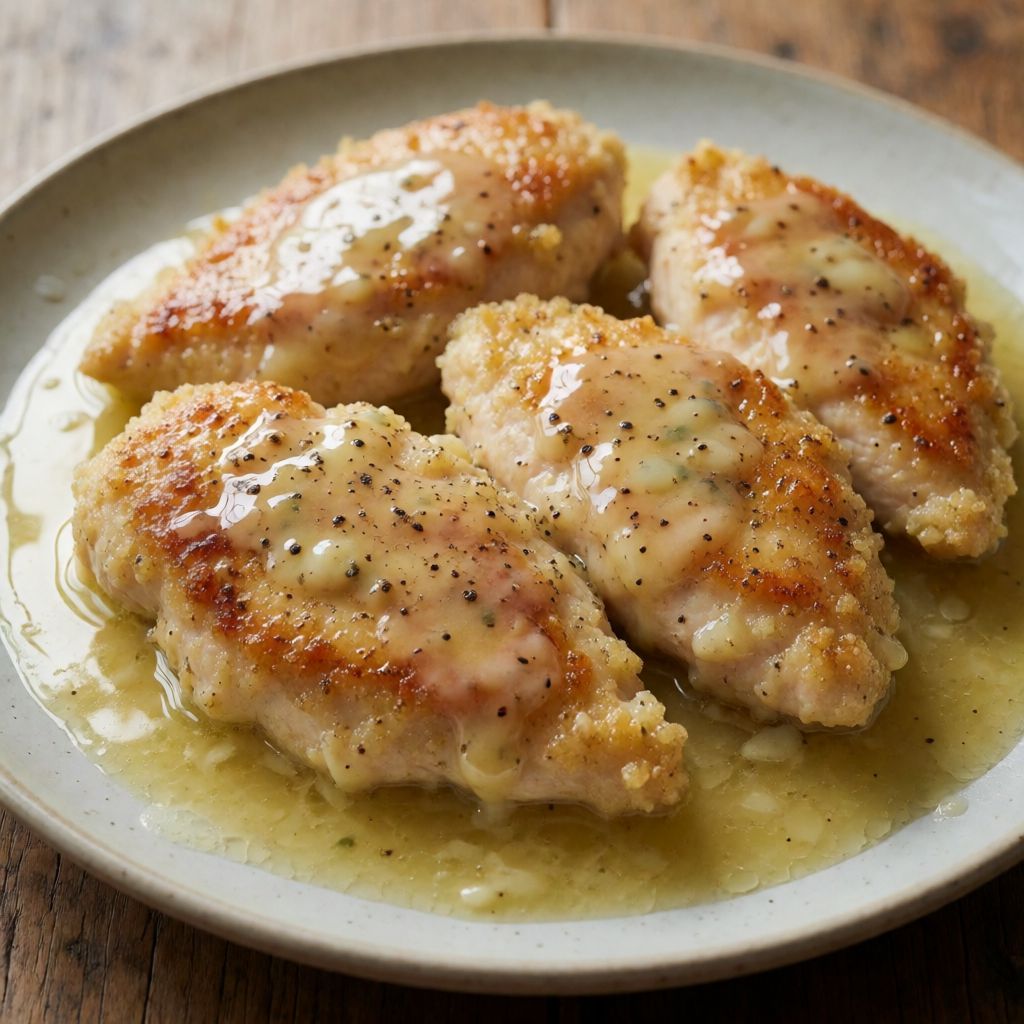
 AI photo
Chicken Breast in Lemon Sauce
A quick pan-fried chicken breast finished in a light, tangy lemon sauce.
Labels are worked out automatically from the ingredients and can be wrong. Check the packaging if it matters to you.
Ingredients
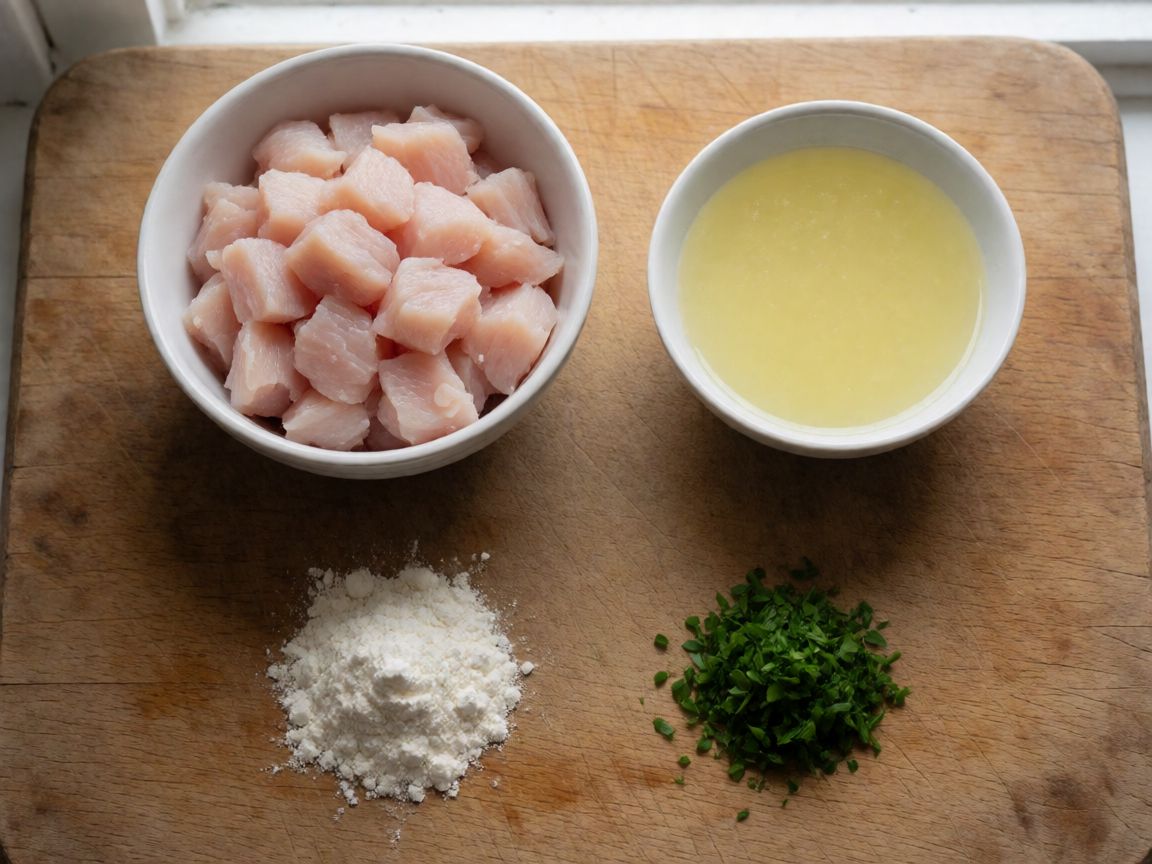
- 600 g Chicken Breast
- 2 pcs Lemon Juice juice of 2 lemons
- Olive Oil to taste
- Plain Flour for dusting (or rice flour or potato starch)
- Salt to taste
- Black Pepper to taste
- Parsley to taste
- 1-2 tbsp Water as needed








Steps
Cut the chicken breast into strips about 1.5 cm wide.
Put the strips into a food bag with the flour, shake well, then tip into a sieve and shake off the excess flour.
Heat the olive oil in a frying pan and add the chicken strips.
Fry the meat evenly over high heat.
2 minAdd salt and black pepper to taste.
Pour in the lemon juice and water.
Cook over low heat, stirring, until the sauce thickens and the chicken is cooked through.
Serve, garnished with black pepper and parsley.
This is a pan sauce built right on the chicken, not alongside it — the same idea behind French piccata and Italian scaloppine, just simpler, and cheaper to make at home than either name suggests. Lean breast meat, cut into strips so it cooks through before it has time to dry out, gets a thin coat of flour, a hard sear, then a splash of lemon juice and water that the flour itself thickens into a sauce. No stock, no cream, no fuss — the economics of this dish are exactly that: a bird that's already in your fridge and a lemon from the fruit bowl.
What decides whether it works is the order of two things: heat first, acid second. The flour on the meat isn't just a crust for browning — it's your thickener, sitting there waiting. Fry it hard while it's dry, and it sets into a crisp, pale-gold shell. Pour lemon juice onto that shell too early, or let the pan go lukewarm first, and the acid stops the browning reaction cold — you get grey, steamed meat under wet flour, no sauce at all, just sour water. The sear has to happen before the acid arrives, not after.
Some say you should cover the pan while the chicken fries, to "keep it juicy." No — cover it and the steam that comes off wet meat has nowhere to go. It sits under your plate-lid, condenses, and drips straight back down, so the strips poach in their own damp air instead of browning. A lid, here, is the enemy of the crust you're trying to build. Fry uncovered, and accept that your kitchen will smell of hot oil for ten minutes.
Chicken breast is the wrong cut to be patient with and the right one to be quick with — it has almost no fat to protect it, so once it's past done, it's dry, full stop. Cutting it into strips about a finger-width wide is the whole defence against that: thin pieces cook through in under two minutes of hard contact with the pan, so you're never asking the breast to survive five or ten minutes of heat waiting for a thick centre to catch up. If you've only got breasts that are oddly thick, slice them thinner rather than cook them longer.
The flour does the job for both ends of the recipe. Shake the strips in a bag of plain flour, then tip them into a sieve and shake again — you want a veil, not a coat. Too much flour and you get patches that stay raw-tasting and gummy once the sauce hits them, and a sauce that goes gluey rather than glossy. Rice flour or potato starch work as a substitute and actually thicken a touch more cleanly — no gluten to go stringy — useful if you want this gluten-free. Either way, the test is sight: you should still see the pink of the meat faintly through the dust.
Lemon juice from two lemons is a direction, not a measurement — lemons vary a lot by season and by how long they've sat in the fruit bowl, and a dry, thick-skinned one gives you half the juice of a fat, thin-skinned one. Taste the sauce before you plate it: it should be sharp enough to cut through the richness of the oil, not sharp enough to make you wince. If it overshoots, that's what the water in the recipe is for — it's not padding, it's your dial for how sour this gets.
Olive oil here is doing a plain job: a fat with enough body to carry heat for a proper sear without itself burning before the chicken browns. If you haven't got olive oil, anything with no smell of its own and a reasonable tolerance for heat will do — sunflower, groundnut, rapeseed. Keep the showier, cold-pressed extra virgin oils for finishing a salad, not for this; their flavour compounds are the first thing to scorch under hard heat, and you'd be burning off the very reason you bought the expensive bottle.
One real limit worth naming for a domestic hob: it won't hold the ferocious, instant heat of a professional burner, so don't crowd the pan. Six hundred grams of strips tipped in all at once will drop the oil's temperature, release their water, and you'll be stewing them in their own juice rather than browning them. Fry in two batches if your pan's on the smaller side — it costs you two extra minutes and buys you an actual crust instead of a boiled one.
Salt and pepper go on after the sear, not before — salted raw chicken pulls moisture to its own surface while it sits, which is exactly what works against a good crust. Parsley is stirred in or scattered at the very end, off the heat if you can manage it; cooked parsley turns a flat, tired green and loses the brightness it's there for. Six hundred grams, cut this way, feeds four properly alongside rice or new potatoes — this isn't a dish that needs much company on the plate, the sauce is doing the talking.