
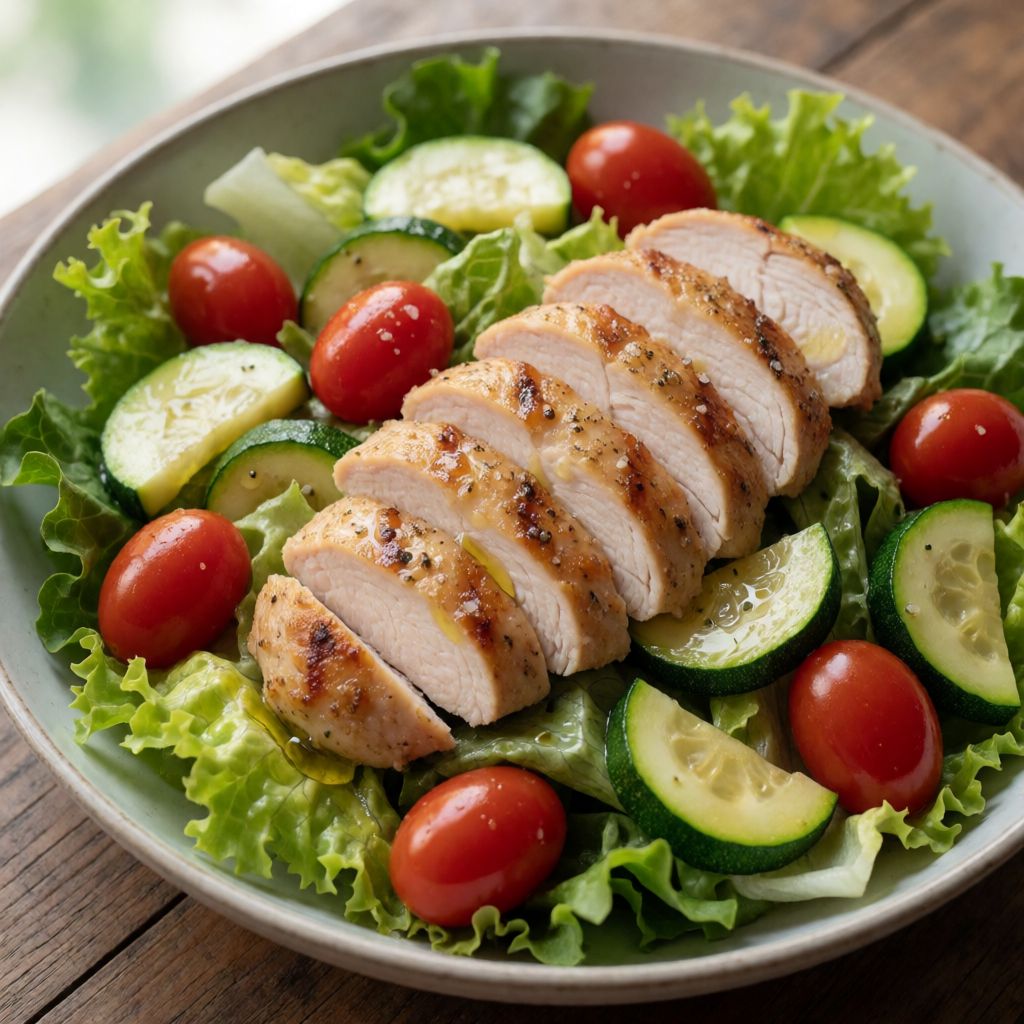
 AI photo
Chicken Breast Salad
A light salad of grilled chicken breast with courgettes, cherry tomatoes and lettuce.
Ingredients
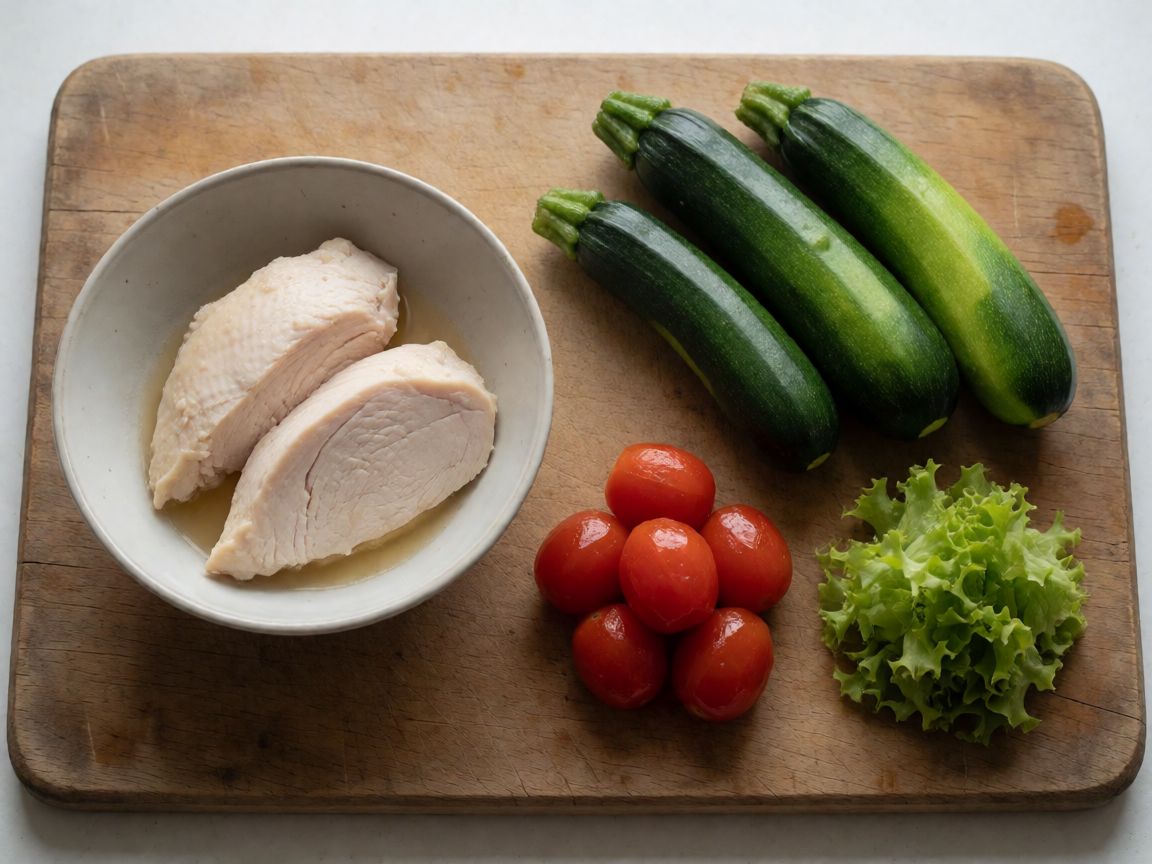
- 300 g Chicken breast
- 3 pcs Courgette
- 100 g Cherry tomatoes
- Lettuce to taste
- Olive oil to taste
- Salt to taste
- Black pepper to taste






Steps
Wash and dice the courgettes, put them in a frying pan with olive oil and cook, stirring, for about 15 minutes.
15 minAdd salt and black pepper to the courgettes and cook for a few more minutes until done.
On a grill pan, fry the sliced chicken breast on both sides until it reaches an internal temperature of 74°C.
Let the chicken cool completely.
Transfer the chicken to a bowl, add olive oil, salt, cherry tomatoes, courgettes and lettuce leaves.
Mix everything together and chill in the refrigerator so the flavours combine better.
30 min
This is three cooked things meeting cold in a bowl, not one dish cooked together. The chicken is cooked and cooled on its own, the courgette is cooked and cooled on its own, and the tomato and lettuce never go near heat at all. Nothing here is complicated, but it is unforgiving in two particular places, and it's worth knowing where before you start.
First place: the chicken. The recipe gives you a number, 74°C, and that number isn't decoration — it's the point at which the meat is reliably clear of salmonella and campylobacter, which is why poultry gets its own, higher rule than a steak ever needs. Some say you can tell it's done because the juice runs clear. No — juice colour depends on how much pigment happens to be left in it, not on bacteria, and it lies to you often enough that a cheap probe thermometer earns its place in a kitchen drawer.
Second place: the courgette. It's mostly water held in a loose net of cell walls, and your job with the heat is to get that water out as steam before it pools and turns your frying pan into a stew pan. Dice it even, keep it moving, and only season once most of that water is already gone — salt it at the start and you pull the liquid out faster than a domestic hob can boil it away, and you end up poaching courgette in its own juice instead of browning it.
Then there's the cooling, which isn't fussiness either. This is a packed-lunch dish at heart, the same logic as Monday's cold chicken after a Sunday roast: cook it properly once, eat it cold, nothing to reheat and nothing to worry about overnight in the fridge.
Choose a breast of fairly even thickness, or slice it so the pieces are roughly the same size — a grill pan only treats you fairly if the geometry is fair. A piece thick at one end and thin at the other will have one half dried past 74°C before the other even gets there. Turkey breast follows the same rule and the same number; a fattier cut like thigh is more forgiving because fat buffers against drying, lean meat has nothing to hide behind.
Letting the chicken go properly cold before it meets the bowl is where the texture actually gets decided. Heat pushes juice toward the surface of the meat, and while it's still warm, that juice is still on the move. Drop it in hot and it floods out into the bowl, wilts the lettuce and waters down the one dressing you've got. Give it time to cool and the fibres relax and pull some of that juice back in, so the slices hold together on the fork instead of leaking onto the plate.
For the courgette, look for a firm one with tight, shiny skin — a soft or wrinkled courgette has already begun losing its water before your knife ever touches it, and it won't hold shape or brown properly either. If you've none in the house, aubergine or mushrooms do the same job, because the thing you're really after is any vegetable whose trick under heat is shedding water while trying to keep its shape — dice it even, stir it the same way.
Olive oil is doing two separate jobs here, worth telling apart. In the pan, frying the courgette, you just need something that can sit at a gentle sauté heat without smoking or sulking — any oil with no strong character of its own will do that, sunflower or a mild rapeseed included. In the bowl, though, there's no sauce to hide behind — the oil is the whole seasoning, so there you want one that actually tastes of something, a decent fruity, slightly bitter olive oil.
The cherry tomatoes and lettuce both go in raw, and for the same reason: something has to break the dish's dryness with a bit of juice and crunch once everything else has gone soft and cold. Pick the smallest, sweetest tomatoes you can find, or chop a regular one fine enough that its juice spreads through the bowl rather than sitting in one corner; for the leaf, go for something that still has bite left after half an hour under oil and salt — a romaine or little gem holds its crunch where a soft butterhead just goes limp and gives up the contrast the whole thing's built on.
The thirty minutes in the fridge at the end is doing real work, not just chilling the bowl down. Salt and oil need that time to move across cut surfaces by plain diffusion — courgette and tomato giving a little liquid back, chicken taking in a little oil and salt in return. Skip it or rush it and you've got correctly cooked ingredients sitting politely next to each other, not a salad. That wait is the last ingredient, and it costs nothing but patience.