
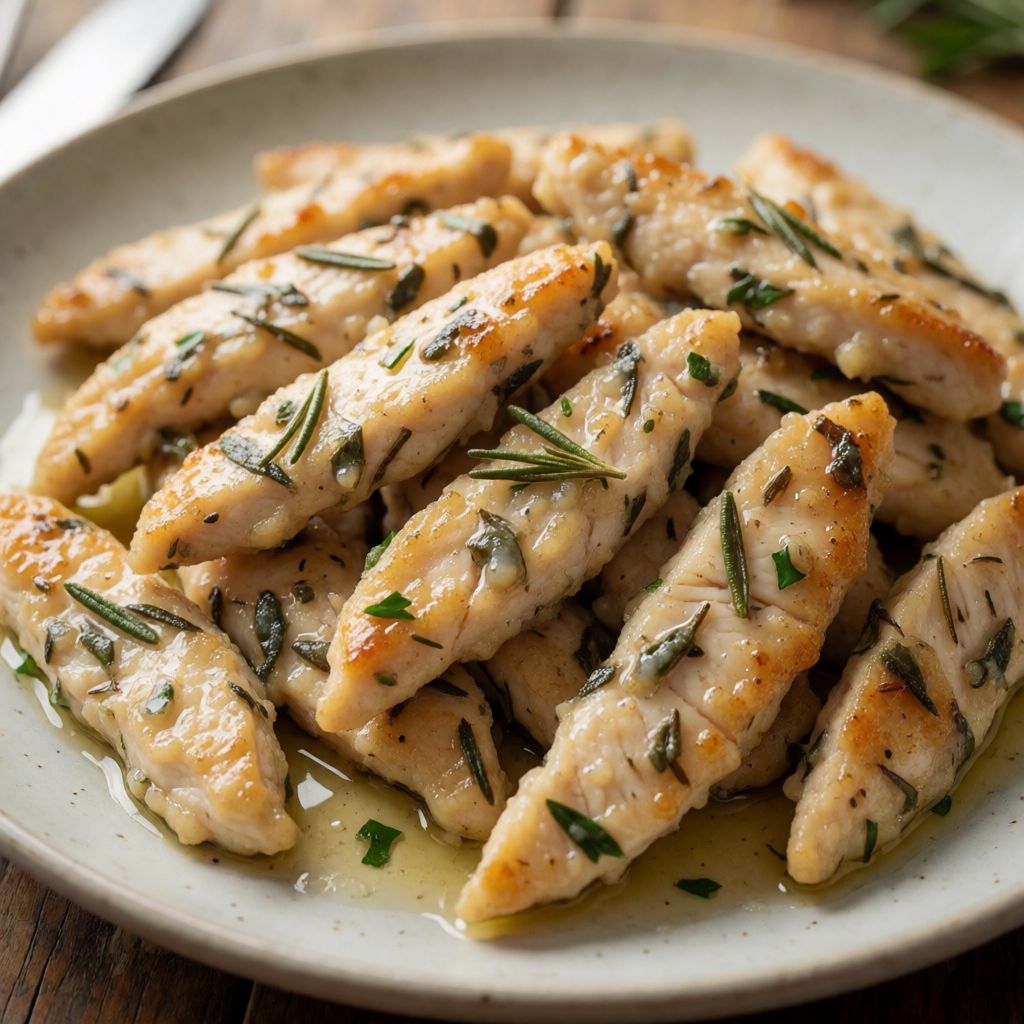
 AI photo
Chicken Breast Straccetti
Thin strips of chicken breast quickly pan-fried with onion, herbs and white wine.
Labels are worked out automatically from the ingredients and can be wrong. Check the packaging if it matters to you.
Ingredients
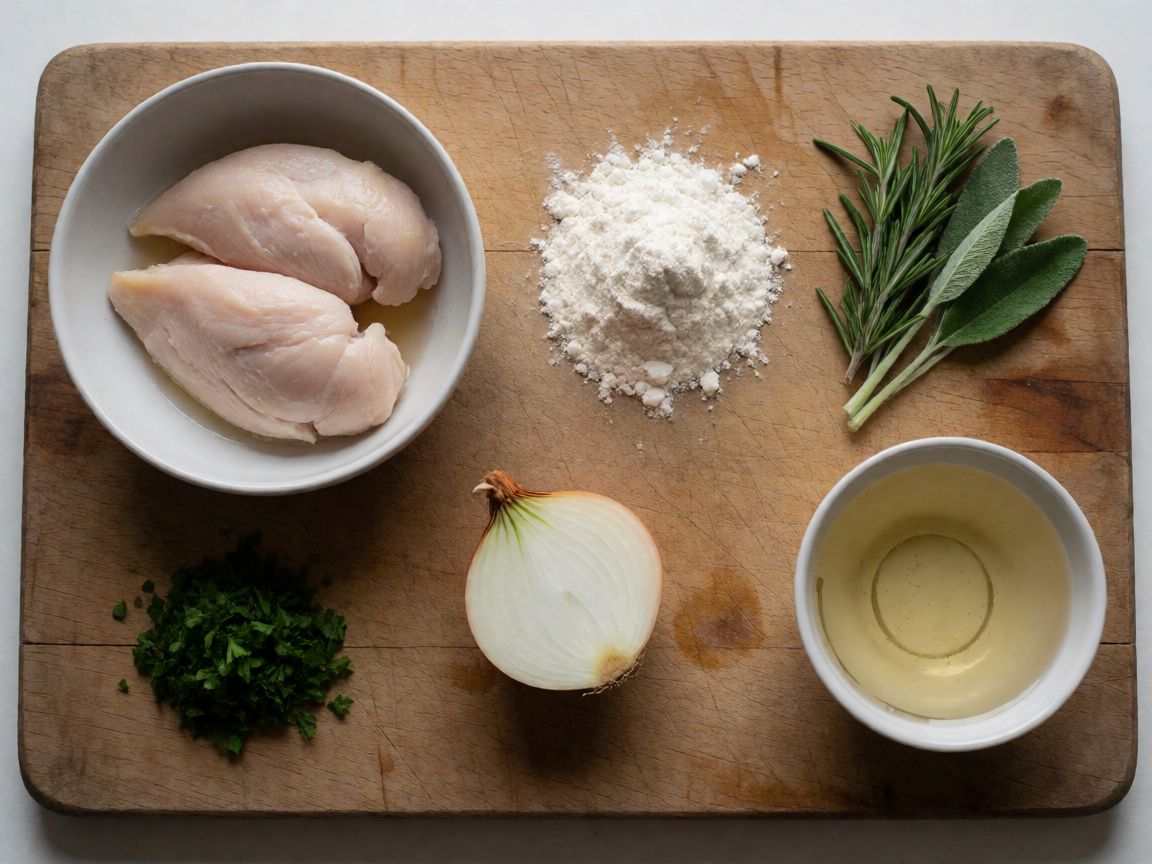
- 300 g Chicken breast
- 2 tbsp Plain flour for dredging
- 2 tbsp Olive oil
- 2 pcs Rosemary sprigs
- 4 pcs Sage leaves
- 1 bunch Parsley
- 0.5 pcs Onion
- 50 ml White wine
- 1 pinch Salt to taste
- 1 pinch Black pepper to taste










Steps
Cut the chicken breast into thin strips.
5 minCoat the chicken strips in flour on all sides and set aside.
3 minIn a frying pan, lightly sauté the finely chopped onion in olive oil with the rosemary and sage until golden.
5 minAdd the floured chicken and fry for a few minutes, turning with a fork, until golden brown.
5 minPour in the white wine and continue cooking until it evaporates.
3 minSeason with salt and pepper to taste, stirring occasionally and adding a little water if needed. Cook until fully done (74°C).
5 minServe immediately, garnished with parsley leaves.
1 min
Straccetti means "little rags" — that's the whole method in one word. You cut the chicken into thin, ragged strips so it has no business behaving like a joint of meat; it's not roasted, it's flashed. Flour goes on, not for a crust you'll admire, but because flour left on the strips and loose in the pan is what turns fifty millilitres of wine into a sauce that clings instead of pooling uselessly at the bottom. That's the mechanism people miss: the dredge is a thickener in waiting, not a coating for crunch.
What decides whether this works is heat and space, in that order. The onion goes in with the rosemary and sage so the fat has time to pull the oil-soluble aromatics out of those two woody herbs before anything else happens — sage and rosemary are stubborn, their flavour sits in resins, not water, and resins only move into fat, never into a dry pan on their own. Cook this stage until the onion turns from white to gold, not further; gold means sweet, ginger-brown means bitter starting to creep in.
Then the chicken, and this is where a domestic hob punishes impatience. Your pan is a wide frying pan, not a kazan with a roaring flame underneath — it can't shed heat the way a restaurant burner does. Put too much chicken in at once and the strips release water before they brown; that water has nowhere to go, the pan temperature drops, and you get grey simmered chicken, not gold seared chicken. Fry in batches if your pan is small rather than crowd it. It costs you two extra minutes and saves the whole point of the dish.
Doneness here isn't a guess and it isn't a cut-and-peek either. 74°C is the actual number at which chicken breast is safe, not a superstition — some people swear by "if the juices run clear it's done," but juices can run clear in meat that's still a touch under, and look pink in meat that's perfectly cooked, especially near where strips were cut close to connective tissue. If you've no thermometer, take the thickest-looking strip, press it — it should feel evenly firm with no give or wetness through its depth, not springy and glossy in the middle. A splash of water near the end, if the pan's gone dry before the meat's there, buys you the last minute without scorching the flour-thickened sauce.
Chicken breast: 300 g for two is generous as a main with rice or bread alongside, modest if you're eating it on its own with nothing to mop the sauce. Cut the strips with some width to them — pencil-thick, not shaved — because straccetti this thin disappear in seconds and you lose control of the browning stage entirely; too thin and you're reheating, not searing.
Flour: plain flour, the stuff already in your cupboard for a Sunday roast's gravy, does the job twice over — thin crust, then thickener. If you're out, cornflour works but gives you a slicker, less forgiving coating and thickens the sauce less generously, so you'd want less wine or a longer reduction.
Olive oil here isn't decorative — any oil with no smell of its own would carry the chicken fine, sunflower or rapeseed included, but olive oil's faint bitterness actually plays well against rosemary and sage, so don't swap it out of habit alone.
Rosemary and sage are both woody, resinous herbs — treat dried versions as concentrated, use less, and give them slightly longer in the oil since they've lost their moisture and need the fat to rehydrate the aromatics. Parsley goes in raw at the very end, off the heat or close to it, because its freshness is chlorophyll and chlorophyll breaks down fast under heat — cook it and you've just made bitter green confetti.
Onion: half a medium onion, chopped fine enough to melt rather than crunch — this is sweetness working in the background, not a textural feature.
White wine: dry, nothing sweet, since sugar would fight the acid's job of cutting the fat. No wine in the house — a splash of cider vinegar diluted in a little stock gets you the acidity and the deglazing liquid, though you'll lose the aromatic lift wine brings; it's a fix, not an equivalent.
This dish is Roman trattoria cooking at heart, originally made with thin-sliced beef flank because that was the cheap cut butchers had left over after the good steaks went out the door — quick fire, little fuel, fast turnover for a kitchen without time to braise. Chicken breast took over later simply because it got cheap and consistent everywhere, Britain included, and it cooks in the same few minutes the method was built around. Patience here isn't about long cooking — it's about not rushing the onion stage and not crowding the pan. Those two things, more than any ingredient, are what separate straccetti from stewed chicken strips in a wet pan.