
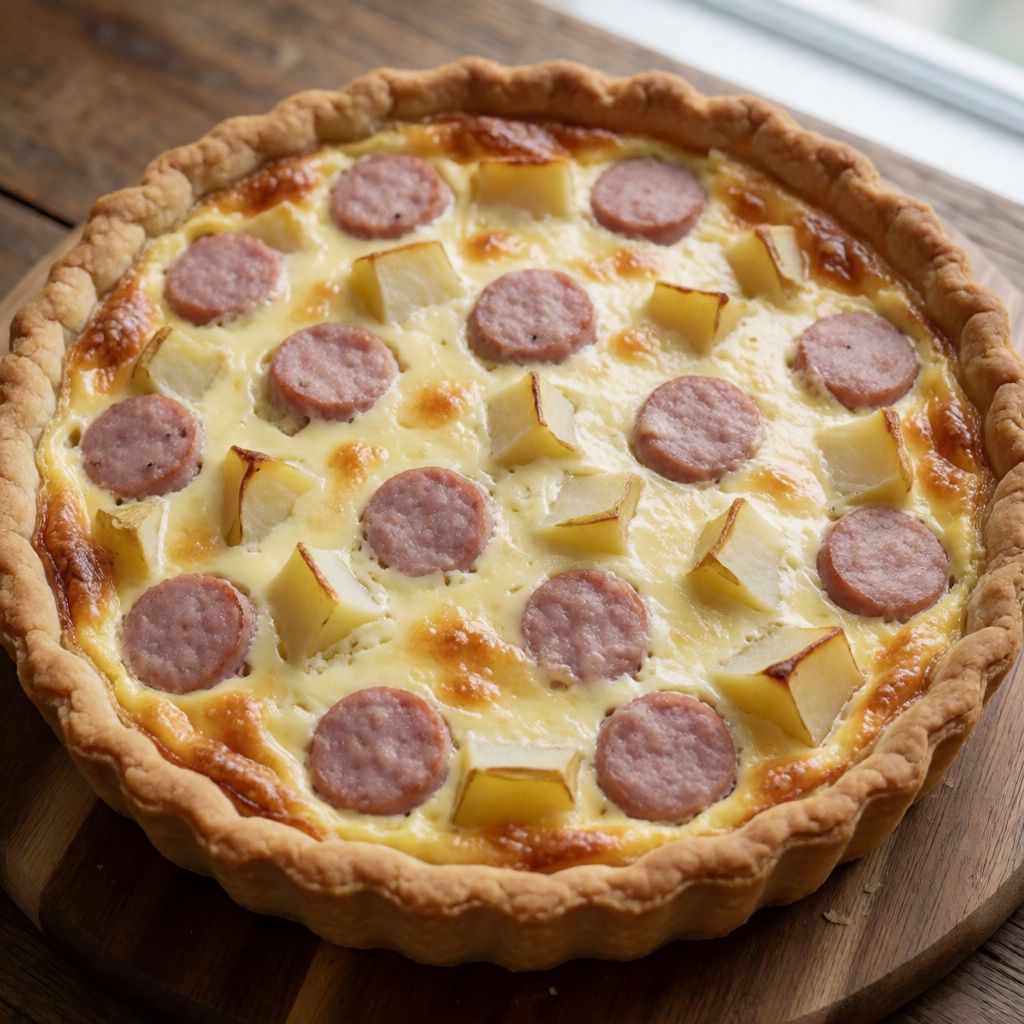
 AI photo
Quiche with Chicken and Turkey Frankfurters, Potato and Mozzarella
A savoury quiche with ready-rolled puff pastry, chicken and turkey frankfurters, potato and mozzarella, baked until golden.
Labels are worked out automatically from the ingredients and can be wrong. Check the packaging if it matters to you.
Ingredients
- 1 pcs Ready-rolled puff pastry
- 125 g Mozzarella (fior di latte)
- 4 pcs Chicken and turkey frankfurters
- 1 pcs Potato
- 3 pcs Eggs
- 200 ml Double cream
- Salt to taste
- Black pepper to taste
- 2 tbsp Parmesan
- 1 tbsp Breadcrumbs dried
- 1 tbsp Milk











Steps
Place the ready-rolled puff pastry together with its baking parchment into a baking tin. Prick the base with a fork and sprinkle with breadcrumbs.
Arrange the diced potato, the sliced chicken and turkey frankfurters, and the cubed mozzarella over the pastry.
In a bowl, whisk the double cream, eggs, milk, a pinch of salt, black pepper and Parmesan.
Pour the mixture over the filling, smooth the edges and bake at 180°C.
20 minLet cool slightly before serving.
What was changed
The plant-based cream in the custard has been replaced with Double cream, a dairy double cream commonly used in UK baking.
This is an open pie, not a stuffed one — the filling sits in a single layer and the custard has to climb through it, binding potato, sausage and cheese into one bite. Puff pastry instead of the usual shortcrust: lighter, flakier, but it panics under a wet filling and goes soft underneath if you don't protect it. The pricking and the dusting of breadcrumbs are exactly that protection — a small barrier so the custard soaks into crumb, not into butter layers.
What decides whether this works is not the oven timer, it's three things happening in the same twenty minutes: raw potato has to cook through, egg has to set without turning to scramble, and the frankfurters — already cooked — only need warming and a bit of colour. Dice the potato small and even, no bigger than a thumbnail cube, because that's the only thing standing between you and a crunchy centre nobody wants. A thick potato chunk simply will not cook in the time the custard needs to set — and if you wait for the potato, the custard overcooks and turns rubbery and weeping. So the cut of the potato is doing real work here, not decoration.
Some say quiche must be blind-baked first, shell and all, before anything goes in. No — not when the base is this thin and the fat content of puff pastry this high. Blind-baking a puff base for a filling that bakes in twenty minutes is wasted heat and a dried-out crust. The prick-and-crumb trick does the same job faster: it stops the pastry puffing up into a dome and keeps the bottom from turning to paste.
This isn't a dish with ceremony behind it — it's a fridge-clearing recipe built on supermarket shortcuts, and there's nothing wrong with saying so. Ready-rolled pastry, frankfurters instead of a joint of meat, one potato instead of a sack of them: it's a Tuesday pie, not a Sunday roast. If you want it to taste of more than convenience, buy the pastry with the highest butter content you can find — it says so on the box. An all-butter puff will flake and smell of itself; the cheaper vegetable-fat ones mostly puff and taste of nothing, which matters more here than usual because the filling itself is quite mild.
The mozzarella should be the firmer fior di latte, not the kind swimming in its own whey — pat it dry if it's wet, or you're adding liquid to a custard that already has cream and milk in it, and a loose custard never fully sets. The criterion for a substitute is simple: any cheese that melts without going oily or stringy and doesn't bully the other flavours — young Gouda or Edam both do the job. Leave sharp Cheddar out of this one; its tang fights the sausage instead of sitting quietly next to it.
The frankfurters are already cooked, so treat them as flavour and texture, not as something that needs doneness-checking — they just need to warm through and maybe brown a little where they catch the heat near the top. Any mild cooked sausage sliced into rounds works, and so does leftover ham from that Sunday roast, cubed instead of sliced — which is, if anything, the more honest use of this recipe: a second life for something already in the fridge.
The custard is the part that actually has rules. Three eggs to 200ml of double cream gives you a custard rich enough to set softly rather than bounce — go leaner, with milk instead of cream, and you'll need to watch it closer because a thin custard scrambles faster than it sets. The tablespoon of milk here isn't for brushing the top, it's loosening the cream slightly so it pours and settles evenly over the filling instead of sitting in a stiff dome. Parmesan goes in for salt and a little sharpness, and any aged hard cheese with a real bite — Pecorino, an old Gouda — will stand in for it without trouble.
On an ordinary oven, remember that fan and conventional settings at the same number are not the same heat — a fan oven moves hot air faster and can set the top before the centre is anywhere near ready. If yours is fan-assisted, check the wobble a little earlier than the time suggests; the twenty minutes is a floor, not a ceiling, and the pie will tell you itself when it's ready long before the clock does.