
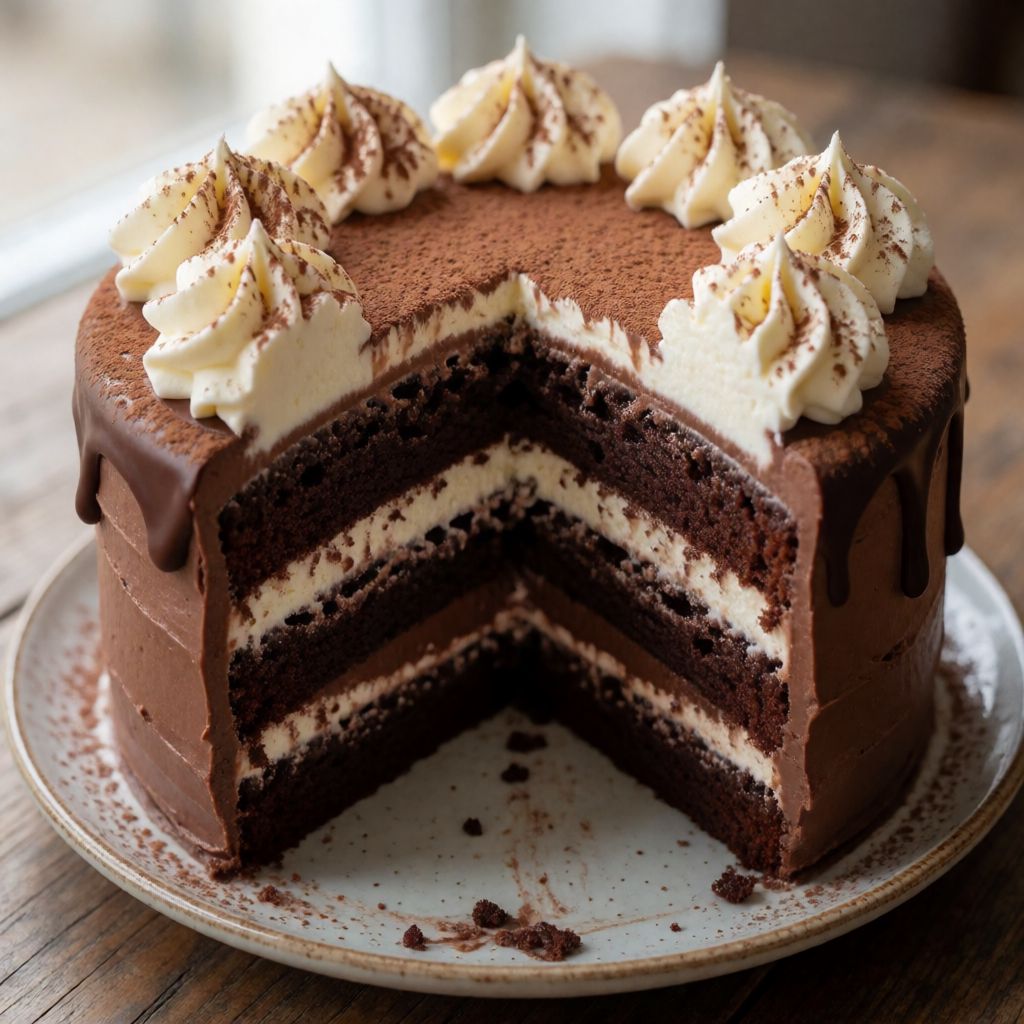
 AI photo
Chocolate Cake with Nutella and Mascarpone Cream
A rich chocolate sponge cake filled with a creamy Nutella and mascarpone filling, finished with a dusting of icing sugar.
Labels are worked out automatically from the ingredients and can be wrong. Check the packaging if it matters to you.
Ingredients
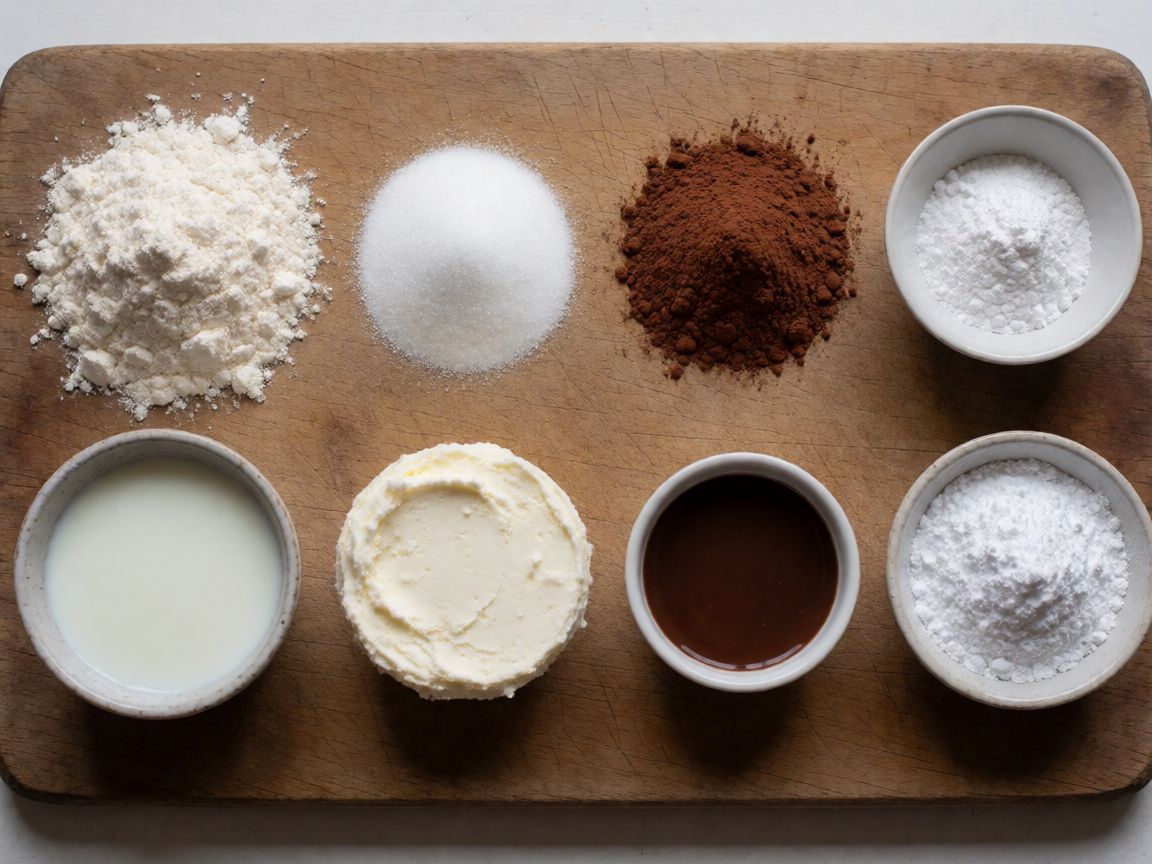
- 200 g Plain Flour
- 150 g Caster Sugar
- 50 g Cocoa Powder
- 1 pcs Baking Powder
- 250 ml Milk
- 1 pinch Salt
- 250 g Mascarpone
- 3 tbsp Nutella
- g Icing Sugar to taste
- g Butter for greasing










Steps
Combine the baking powder, flour, sugar and cocoa powder in a bowl.
Gradually pour in the milk, add a pinch of salt and mix well.
Grease the tin with butter and pour in the batter.
Bake at 180°C for 32 minutes.
32 minIn a separate bowl, mix the Nutella and mascarpone together thoroughly until smooth.
Let the cake cool, then slice it in half and fill with the cream.
Dust the top with icing sugar.
This is a cake built on an old trick: no eggs, no butter in the batter, just flour, sugar, cocoa and milk, lifted by baking powder alone. People sometimes call this kind of thing a "poor man's cake" and they're not wrong — it's descended from wartime and ration-book baking, when eggs and butter were the first things to vanish from a larder. The chemistry still works because baking powder doesn't need egg foam to do its job; it needs liquid and heat, and it has both.
What decides whether it works is the sponge itself, because there's nothing to hide behind. No butter means no fat to carry flavour or keep crumb soft if you overwork the gluten, so you mix the wet into the dry only until it's smooth — not beaten, not whisked for minutes. Beat it like you're angry and you'll get a cake that's dense and a bit rubbery, because you've built gluten strands with nowhere for steam to push through.
The cream is the other half of the argument. Mascarpone on its own is rich but mute; Nutella on its own is sweet but thin once it's cold. Together they balance — fat from the cheese holds the spread's sugar and oil in suspension so it doesn't weep onto the sponge, and the hazelnut flavour stops the mascarpone tasting like plain cream cheese spread thick.
Some say a chocolate cake needs eggs to be a "proper" cake. No — because what eggs give you is structure and richness, and here the baking powder gives structure, the cocoa and sugar give richness enough for a cake meant to be split and filled, not eaten plain by the slice.
Flour here is just flour — no need for a "strong" bread flour or a delicate sponge flour, because this isn't relying on gluten development for lift, it's relying on chemistry. Plain flour with a moderate protein content is exactly right; self-raising would double your lift and risk the cake collapsing in the middle once it cools, since you'd have two sources of rise fighting each other.
Cocoa powder is doing two jobs: flavour, obviously, but also absorbing liquid, since cocoa is mostly starch and fibre once the fat's pressed out. Sift it with the flour before the milk goes in — cocoa clumps stubbornly, and a lump that survives into the batter will still be a bitter, gritty lump once baked, because batter this thin doesn't have the force to break it apart on its own.
Baking powder — the recipe says "1 piece," which really just means one sachet, the standard UK 7g kind. Don't substitute bicarbonate of soda straight across; it needs an acid to react with, and there isn't one here beyond a trace in the cocoa, so you'd get a flat, soapy-tasting cake. If you're out of baking powder, you have no good workaround here — this is the one ingredient the whole structure depends on, so check the tin isn't half-spent before you start.
Milk brings everything together into a pourable batter and gives the baking powder the moisture it needs to start working the moment it's mixed in — which is also why you don't make this batter and then wander off; get it in the tin and into the oven, because the reaction is already running.
Butter for greasing is just that — a release agent, nothing more, so any flavourless fat does the job: a neutral oil, a baking spray, even a wipe of margarine. Don't use olive oil here; it has its own voice and this cake doesn't need a second one.
Mascarpone wants to be genuinely full-fat — the cheap, low-fat versions split when you beat anything into them, because there isn't enough fat to hold an emulsion together. If you can't get mascarpone, a full-fat cream cheese works, but it carries a tang mascarpone doesn't have, so taste as you go and add a little icing sugar to balance it. As for Nutella — any thick hazelnut-chocolate spread behaves the same; just check it's thick, not runny, or your filling will slide out the sides once you stack the layers. On the oven: 180°C is written for a conventional oven; if yours is fan-assisted, it runs hotter than the dial says, so start checking a few minutes before the lower bound, and judge by a skewer coming out clean rather than by the clock.