
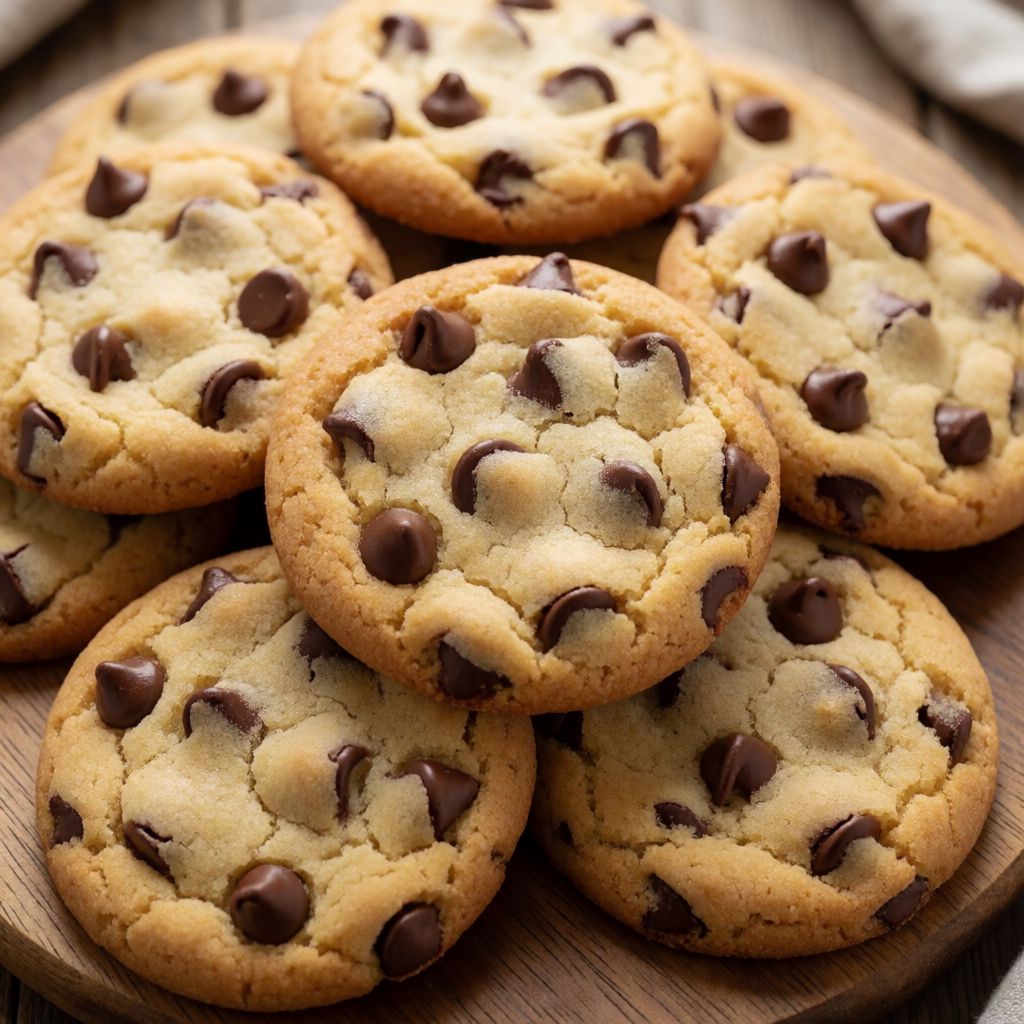
 AI photo
American Chocolate Chip Cookies
Soft, chewy American-style chocolate chip cookies with a golden, slightly crisp edge.
Labels are worked out automatically from the ingredients and can be wrong. Check the packaging if it matters to you.
Ingredients
- 150 g Butter
- 220 g Brown sugar
- 100 g Caster sugar
- 1 tsp Vanilla extract or vanillin
- 1 pcs Eggs
- 260 g Plain flour
- 0.5 tsp Salt
- 0.5 tsp Bicarbonate of soda
- 300 g Chocolate chips









Steps
Beat the softened butter with the brown sugar until smooth.
Add the caster sugar and beat again, then pour in the vanilla extract.
Add the egg and beat well.
Gradually mix in the flour, salt and bicarbonate of soda to form the dough.
Set aside the mixer, add the chocolate chips and gently fold them into the dough with a spatula.
Cover the dough and leave it in the fridge for 20 minutes.
20 minLine a baking tray with parchment paper. Shape the dough into balls of the desired size with your hands.
Place the balls on the tray, spaced apart from each other.
Bake at 170°C.
15 minTake the cookies out of the oven and let them cool.
What was changed
Removed , as this ingredient does not belong in a cookie recipe.
This is the cookie that argues with itself on purpose — crisp rim, soft middle, a slight chew where the two meet. That fight is not an accident. It comes from using two sugars that behave differently and from baking at a temperature low enough to let the edges set before the centre has finished moving. Get the balance of sugars and the fridge rest right, and the cookie holds its shape without going flat and sad, or puffing into a dense little bun.
Butter is the first decision, and it is made early, off the stage. "Softened" means it yields to a light push but does not shine with grease — if it's gone glassy and translucent at the edges, it's too warm, and air won't fold into it properly when you beat it with the sugar. Brown sugar first, on its own, because brown sugar carries molasses, and molasses is where the chew and the deep colour come from — caster sugar alone gives you a pale, crisp, rather one-note biscuit. Beating butter and brown sugar together before the caster sugar joins lets the coarser crystals do their work dissolving into the fat while there's nothing else competing for moisture.
Some say chilling the dough is just for "handling" — no, because the real job is temperature, not texture. A fridge-cold ball of dough hits a 170°C oven and spends longer getting warm enough to spread, which gives the edges time to set into a shell before the middle catches up and flattens. Skip the chill, or use a fridge that's really a drawer full of warm air behind a Sunday roast, and you get thin, greasy puddles instead of cookies with a dome.
Flour here is just plain flour — nothing self-raising, because the rise is being handled separately by the bicarbonate of soda, and self-raising flour would double up and leave you with a cakey, overinflated cookie instead of one that spreads and cracks properly. If you only have self-raising on the shelf, leave out the bicarbonate entirely and expect a slightly softer, puffier result — not wrong, just a different cookie.
Bicarbonate of soda does two things at once: it lifts, and it reacts with any acidity in the brown sugar's molasses to brown the cookie faster and deeper. This is why you can't swap it one-for-one with baking powder — baking powder already has its acid built in and won't interact with the sugar the same way, so the colour and spread change even if the rise looks similar.
The egg is the binder and the moisture — it's what turns a crumbly butter-sugar-flour mix into a cohesive dough that holds a ball shape. One egg for this amount of flour is a tight ratio; too much egg and the dough turns cakey rather than chewy, because egg sets firm in the oven the way fat and sugar don't.
Vanilla extract, not vanillin, if you can manage it — extract carries dozens of aromatic compounds pulled from the pod itself, vanillin is one isolated note, usually synthetic, and tastes thinner and more one-dimensional once baked. It's a fine stand-in when that's what's in the cupboard, just don't expect the same roundness of flavour.
Chocolate chips are folded in by hand with a spatula, not beaten in by the mixer, and that's a deliberate protection, not fussiness — the mixer will shear and melt the chips into streaks through the dough rather than leaving pockets of actual chocolate. If you only have a bar, chop it roughly into chunks rather than fine shavings; chunks hold their shape in the oven, shavings just disappear into the dough.
Spacing the balls apart on the tray matters because the dough genuinely spreads as it bakes — crowd them and you get one long chocolate-studded slab instead of individual cookies, which is a baking-sheet problem more than a dough problem.
Patience sits in two places here, and both are easy to skip when you're hungry: the fridge rest, which sets the fat enough to slow the spread, and the cooling on the tray afterwards, when the cookie is still finishing setting from residual heat and will fall apart if you lift it too soon. A cup of tea while you wait is not a bad use of the fifteen minutes.