
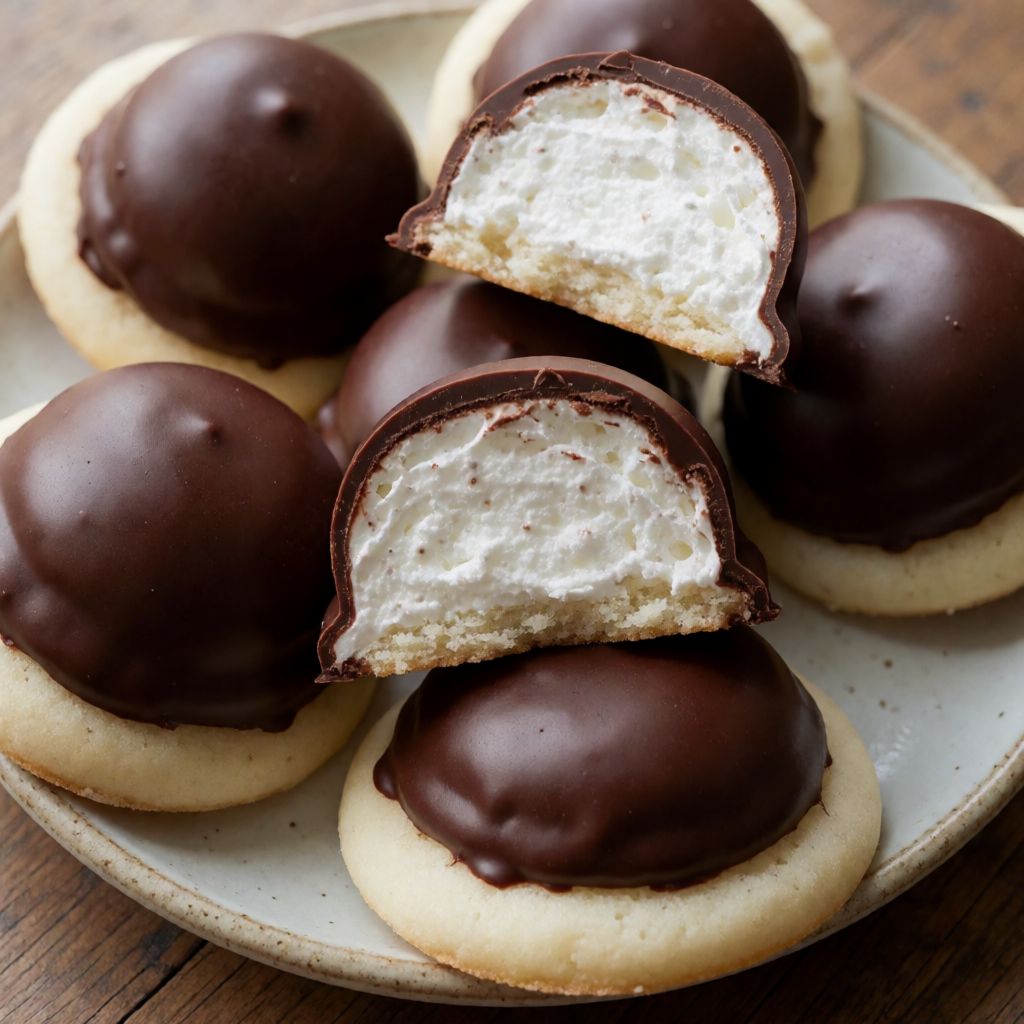
 AI photo
Chocolate Marshmallow Teacakes on Marzipan
Chocolate-coated marshmallow teacakes with a soft marshmallow filling on a marzipan base.
Labels are worked out automatically from the ingredients and can be wrong. Check the packaging if it matters to you.
Ingredients
- 40 g icing sugar
- 300 g marzipan
- 1 pcs vanilla pod
- 250 g caster sugar
- 70 g water
- 110 g glucose syrup
- 150 g egg whites
- 400 g dark chocolate






Steps
Dust the work surface with icing sugar and roll out the marzipan to about 5 mm thick. Cut out 12-14 rounds using a 6 cm round cutter.
Bake the bases for about 8-9 minutes in a fan oven preheated to 175°C, until the edges turn golden.
9 minLet cool on a wire rack on the kitchen counter.
Split the vanilla pod lengthways, scrape out the seeds and mix them with the sugar.
Put the vanilla, sugar, water and glucose syrup in a saucepan and bring to the boil, stirring regularly, until the temperature reaches exactly 117°C.
Whisk the egg whites to a stiff, glossy foam with firm peaks.
Slowly pour the hot sugar syrup into the egg whites in a very thin stream and whisk continuously for 8-10 minutes, until the mixture becomes a stretchy, glossy meringue.
9 minFill a piping bag fitted with a large round or star nozzle with the meringue and pipe domes onto the cooled bases.
Leave on the kitchen counter for about 1 hour, so the surface dries slightly.
60 minTemper the chocolate.
Set the domes on a wire rack with baking paper underneath and spoon the chocolate over them gradually, or dip each one in the chocolate, making sure it is completely coated.
This is a homemade teacake — the thing you'd otherwise buy in a yellow wrapper, built properly from three distinct layers: a marzipan disc that's basically a thin almond biscuit, a dome of Italian meringue that sets to a marshmallow bounce rather than a soft pillow, and a chocolate shell thin enough to crack cleanly when you bite it. What decides whether it works isn't any single step — it's whether each layer stays itself. The marzipan has to toast, not just warm through, so it gives a little resistance under the chocolate instead of going soggy. The meringue has to be an actual Italian meringue — syrup cooked to a precise point and whisked into egg white while scalding — because that's the only way you get a marshmallow that holds a piped peak and doesn't collapse into foam. And the chocolate has to be tempered, or it will never snap; it'll smear like fudge and bloom grey within a day.
Marzipan, 300 g rolled to 5 mm and baked at 175°C until the edges go golden: this is doing the job a normal biscuit base would do in a cheaper teacake — giving the marshmallow something to sit on and the eater something to bite through before the soft part. Baking it is what separates a teacake from a marshmallow-on-almond-paste; raw marzipan stays gummy and wet under the chocolate, baked marzipan dries at the surface and toasts at the edge, so you get a biscuit-like snap. Buy marzipan with a decent almond percentage — the cheap stuff is mostly sugar and barely tastes of almond at all, and on a layered sweet like this, where everything else is sugar and chocolate, the almond note is the only savoury anchor you've got. If you can't get marzipan, a thin almond shortbread cut to the same 6 cm rounds does a similar structural job, though you lose the chewiness marzipan keeps even after baking.
Caster sugar, water and glucose syrup make the base for the Italian meringue — and the glucose syrup is not decoration, it's an anti-crystallisation agent. Plain sugar syrup, heated and disturbed, wants to throw crystals and turn grainy; glucose (or golden syrup, or a squeeze of lemon juice as the old trick) interrupts that by getting in the way of sugar molecules lining up with each other. Skip it and you risk a meringue with a faint sandy grittiness instead of smooth gloss. Vanilla seeds steeped into the sugar before cooking flavour the whole syrup evenly, rather than sitting as specks only in the first spoonful — scraping the pod and mixing the seeds through the dry sugar first is the bit that makes that work.
Egg whites, 150 g, whisked to stiff glossy peaks before the syrup goes in: this pre-whisking matters because pouring hot syrup into unwhipped whites gives you sweet scrambled egg, not meringue. The whites need to already be aerated and structured so the syrup can cook and stabilise that structure rather than create it from nothing. Pour the syrup as a thin stream down the side of the bowl, not onto the beaters, or it'll fling hot sugar glass around your kitchen and cook unevenly in fat globs. Keep whisking after the syrup's in — the mixture needs to cool from scalding to roughly warm, and it's only as it cools that it tightens into something stretchy enough to pipe and hold a dome shape.
Dark chocolate, 400 g, tempered: this is the step home bakers skip because it sounds technical, and it's the step that decides whether your teacakes look like they came from a shop or like something that's been left in a warm car. Untempered melted chocolate sets dull, soft, and streaky with grey bloom because the cocoa butter crystallises in loose, mismatched forms. Tempering — controlled heating and cooling through specific points — forces the fat into one stable crystal form, giving you the hard snap and shine. You don't strictly need a thermometer and a marble slab; the seeding method, stirring small pieces of already-tempered chocolate into your melted batch until it cools to the right working consistency, does the job on a normal UK hob with a bowl over a pan of water. Use chocolate with at least 50-ish% cocoa solids and no vegetable fat substituted in — couverture or a decent "cooking" dark bar, not cheap chocolate-flavoured cake covering, because that sets soft no matter what you do to it.
Dust the marzipan surface and your cutter with icing sugar as you work, not because it looks neater, but because marzipan is sticky enough to tear and drag under a blade without it — a torn edge on the base shows through at the rim once the chocolate's poured over. On a domestic hob, the trickiest moment is the syrup boil: a wide pan instead of a kazan, fine, but watch it close near 117°C because sugar syrup races the last few degrees and overshoots fast once your attention wanders. This whole thing, start to finish with the hour of drying, is a half-day project for twelve teacakes — plan it like you'd plan the Sunday roast, with the meringue and tempering as the bits you don't multitask through.