
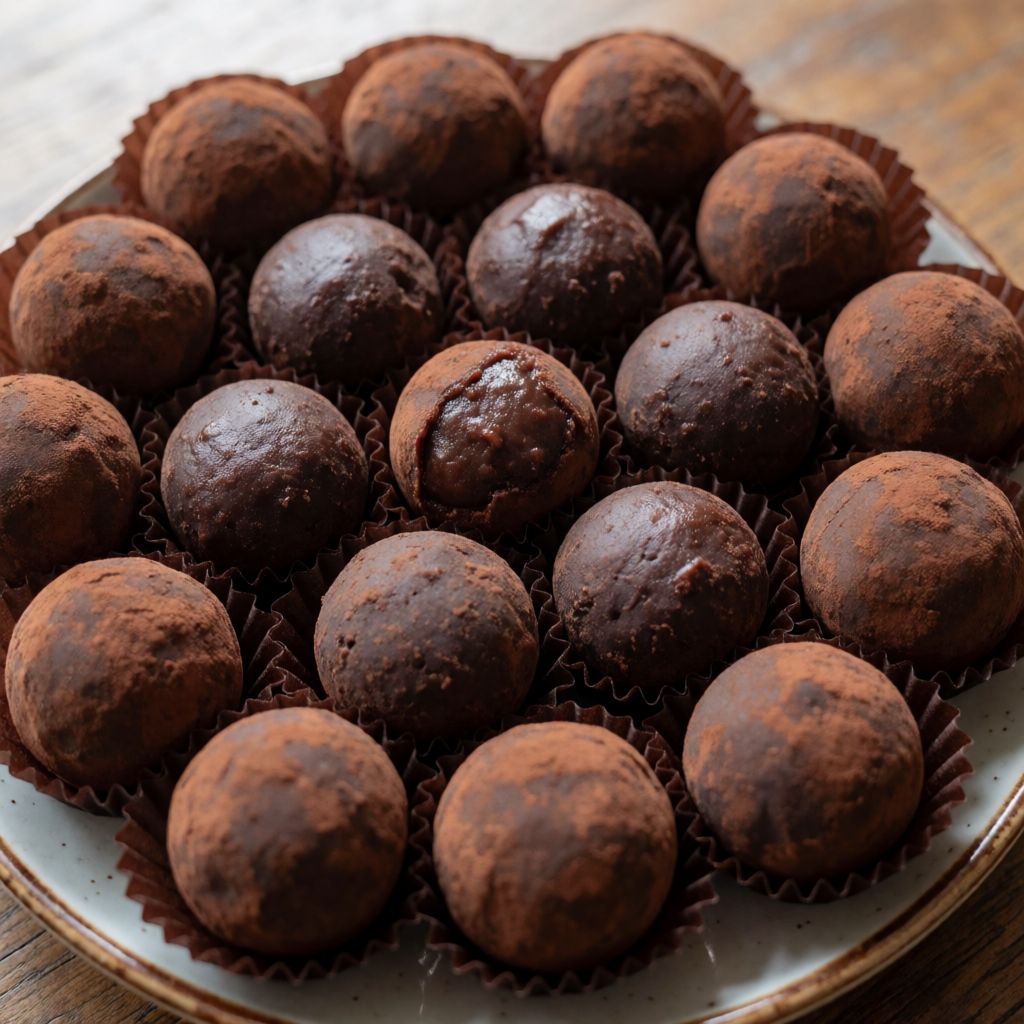
 AI photo
Chocolate Truffles
Rich, melt-in-the-mouth chocolate truffles, rolled in cocoa, liquorice powder or edible gold dust.
Labels are worked out automatically from the ingredients and can be wrong. Check the packaging if it matters to you.
Ingredients
- 100 ml Whipping Cream
- 140 g Dark Chocolate finely chopped
- 1 tsp Honey
- 1 tbsp Butter
- 1 pinch Salt
- 1 tbsp Cocoa Powder
- 1 tsp Liquorice Powder
- 1 tsp Edible Gold Dust





Steps
Heat the cream until just before boiling. Pour the hot cream into a bowl with the chocolate, honey, salt and butter.
3 minStir thoroughly until all the chocolate has melted and the mixture is completely smooth. If lumps appear, blitz quickly with a blender until smooth.
3 minTransfer to a small container lined with parchment and refrigerate overnight, or for at least 6 hours.
360 minCut into squares or roll into balls.
5 minRoll the truffles in cocoa powder or liquorice powder and sprinkle with a little edible gold dust just before serving.
2 min
This is a ganache dressed up as a sweet: cream carries heat into chocolate, chocolate carries fat into shape, and everything else — honey, butter, salt — just tunes the texture and the taste once the main reaction is done. What decides whether it works isn't skill with a whisk. It's the ratio of cream to chocolate, and whether you give the fat time to set properly in the cold.
The cream goes on until it's just about to boil — tiny bubbles gathering at the rim, a wisp of steam, not a rolling boil. That heat isn't for cooking anything; it's a carrier. You're using the heat stored in the liquid to melt the chocolate evenly from the outside in, without ever putting the chocolate itself over direct heat, where cocoa solids scorch and seize before the fat has even softened. Some say you must temper the chocolate for truffles, the way you would for a shiny coating — no, because here the chocolate never has to hold a glossy shell on its own. It only has to set, soft and even, inside a fridge. Tempering is for chocolate that stands alone in the air. This chocolate is wrapped around a dairy fat and never leaves the dark.
The butter goes in last, and it matters that the mixture isn't scalding when it does. Add it too hot and the fat separates instead of binding — you get a slick, oily surface instead of a matte, dense one, because you've broken the emulsion rather than finished it. That greasy sheen some truffles get isn't "too much butter"; it's butter added into a mixture still hot enough to melt it apart rather than fold it in.
Dark chocolate is the scaffolding, not just the flavour. Its cocoa solids and cocoa butter are what gives the set truffle its structure once cold, so choose one with enough body to hold shape — somewhere around 60–70% cocoa is the sensible middle, bitter enough to taste of chocolate rather than sugar, but not so high in cocoa that the ganache turns stiff and crumbly instead of dense and cuttable. If you only have milk chocolate in the cupboard, you can use it, but you'll need less cream — milk chocolate carries extra milk fat and sugar already, and too much liquid on top of that gives you a truffle that never quite sets.
Cream is doing two jobs: carrying heat, and supplying water and milk fat to the emulsion. The criterion for substitution is fat content, not brand — you need cream heavy enough to form a stable emulsion with melted chocolate, roughly double cream or whipping cream, nothing thin like single cream, which simply doesn't have enough fat to hold the mixture together once it cools. Coconut cream works as a dairy-free stand-in by the same logic: high fat, low water, same job.
Honey isn't there for sweetness — there's barely a teaspoon of it for 140g of chocolate, not enough to register on the tongue. It's there because it's an invert sugar: it resists crystallising and keeps a trace of moisture in the mix, so the truffle stays soft rather than turning sandy and dull after a day or two in the fridge. Golden syrup or glucose syrup do the same job. Ordinary granulated sugar does not — it has no business substituting here.
Salt is a correction, not an addition. Dark chocolate on its own reads as flat and one-note; a pinch of salt sharpens it, makes the bitterness and the sweetness both more legible. You're not salting the dessert, you're adjusting the chocolate's own volume.
Butter finishes the shine and the mouthfeel — fat added on top of the ganache's own fat gives a cleaner melt on the tongue, the difference between a truffle that feels dense and one that feels waxy. Any unsalted butter does; if you've only got salted, just drop the extra pinch of salt.
Cocoa powder, liquorice powder and gold dust are the coat, not the dish — and the only real rule for a coating is that it must stay dry. Any dry, assertive powder works by the same logic: cocoa for bitterness, liquorice for that aniseed edge some people love and some find odd (it's a fair thing to leave out, nothing is lost), even finely ground freeze-dried fruit or matcha if that's what's in your cupboard. The gold dust changes nothing about taste or texture — it's there for the two seconds before someone eats it, which, for a dinner-party dessert after a Sunday roast, is sometimes exactly the point.