
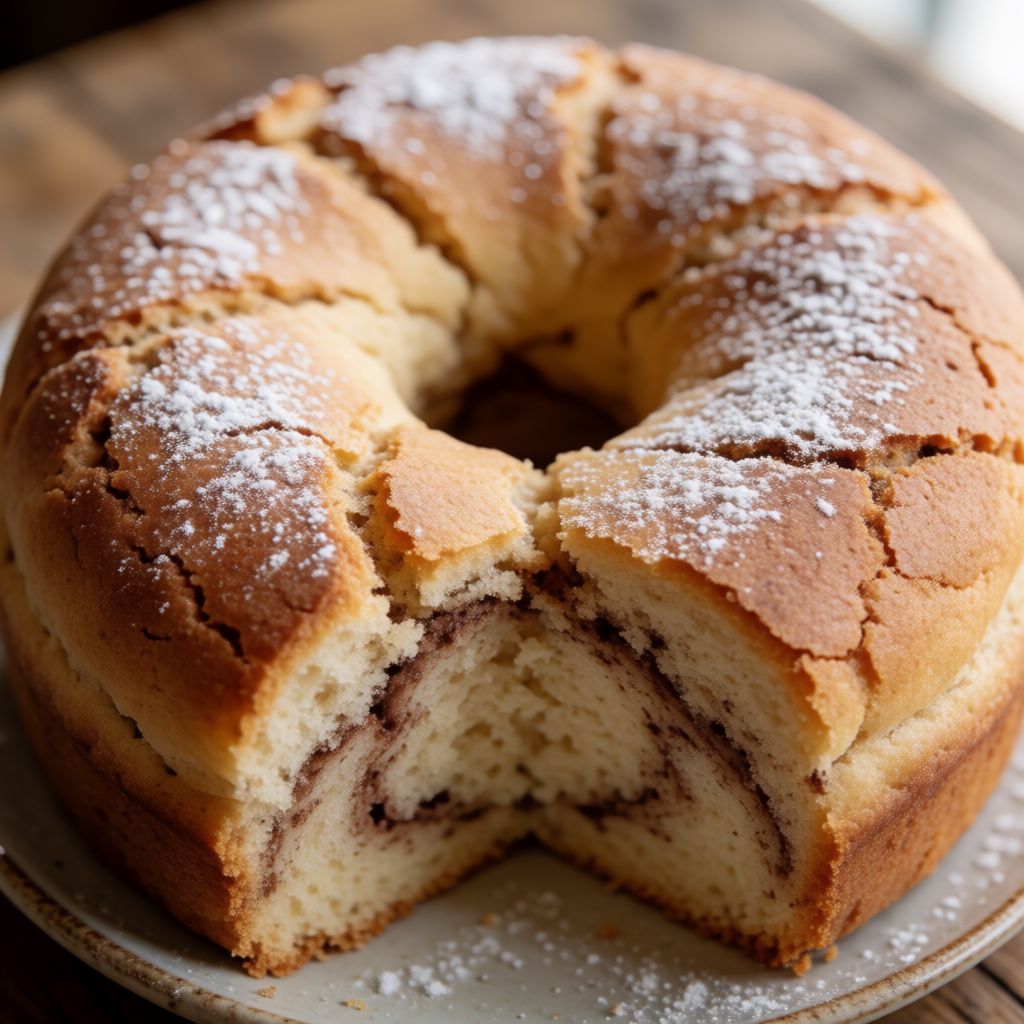
 AI photo
Ciambella: a Simple and Quick Dessert
A simple, quick ring-shaped Italian sponge cake, marbled with cocoa.
Labels are worked out automatically from the ingredients and can be wrong. Check the packaging if it matters to you.
Ingredients
- 300 g Plain flour
- 150 g Caster sugar
- 120 g Butter
- 3 pcs Eggs
- 125 ml Milk
- 8 g Cocoa powder
- 1 pinch Pearl sugar to taste
- 1 tsp Vanilla extract
- 1 pcs Baking powder
- 1 pinch Salt










Steps
In a large bowl, whisk the sugar and egg yolks with a mixer until pale and well combined.
Add the butter, cut into pieces, and whisk; then pour in the milk and mix.
Add the salt and gradually fold in the sifted flour together with the baking powder and vanilla extract, mixing well.
Gently fold in the egg whites with an upward motion to keep the cake light.
Butter the tin and dust with flour, set aside a third of the batter and pour the rest into the tin.
Mix the cocoa powder into the reserved batter and pour it over the batter in the tin.
Sprinkle with pearl sugar and bake at 180°C for 40 minutes.
40 minCheck it is done with a wooden skewer.
Turn off the oven, leave the door ajar for 5 minutes, remove the cake and let it cool.
5 min
What was changed
Vanilla extract replaces powdered vanillin, as UK shoppers use liquid vanilla extract instead.
A ciambella is a ring cake — the word just means "ring" in Italian, same root as the bread rings you see hanging in bakery windows. The ring shape isn't decoration, it's engineering: a hole in the middle means no cold, dense centre that never quite catches up with the edges. In a solid round tin the middle is always the last place to set, because heat has to travel in from all sides to reach it. Take the middle away and there's nothing left to undercook.
What decides whether this works is the eggs, split and treated as two different ingredients, not one. The yolks go in early, beaten with sugar until they turn pale and ribbon off the whisk — that colour change is air going in and sugar dissolving, and it's what gives the crumb some lift before the baking powder does its share. The whites go in last, folded "upward," which really just means you're not stirring, you're turning the bowl's contents over itself so you lose as little of that trapped air as possible. Beat them in with a spoon the way you'd stir soup and you've built a cake, then collapsed it before it saw the oven.
The marbling — plain batter against cocoa batter — is the only genuinely decorative step here, and it's cheap theatre: a third of the mix gets cocoa stirred through it, goes on top, and during baking the two batters rise together without fully merging, giving you the swirl. No piping, no layering, no skill required beyond pouring one bowl over another.
On the proportions: this is a 6-person cake, meaning six reasonable afternoon-tea slices, not six Sunday-roast-sized ones — it's rich with butter and eggs but not a filling cake, more a "goes with your tea" cake than a pudding.
Flour is the plain, untreated kind here deliberately, because the baking powder is added separately and measured on its own terms — self-raising flour already has a raising agent baked in at a fixed ratio, and stacking two sources of lift on top of each other is how you get a cake that rises fast, over-expands, and then sinks as it cools, because the structure wasn't strong enough yet to hold the volume when the oven door opened. One rising agent, under your control, is more reliable than two fighting each other.
Butter wants to be genuinely soft, not melted — melted butter coats the flour's protein and stops gluten forming, which sounds like a bonus but actually loses you the stretch that holds air bubbles in place as the cake rises. Soft butter creams into the eggs and sugar without separating. If what you have is fridge-cold, cut it small and give it real time at room temperature rather than forcing it with a microwave, which half-melts the outside before the inside gives.
Milk here is just liquid, there for moisture and crumb softness — whole milk gives you a touch more richness, but this isn't a recipe where the type of milk changes the chemistry, so use what's already in the fridge for your tea.
Cocoa powder is unsweetened, the plain baking kind, not drinking chocolate — drinking chocolate already has sugar and milk powder mixed in, and adding it here throws off both the sweetness balance and the dryness the cocoa is meant to bring to that one-third portion of batter.
On the oven: 180°C is where this cake sets without racing — hot enough that the edges firm up and hold their shape, not so hot that a crust forms before the inside has risen, which is the defect behind a cake that domes and then cracks down the middle. Every domestic oven runs its own little lie about its own temperature, so don't trust the dial blindly — trust the skewer. Push it into the thickest part, and if it comes out with wet batter clinging to it, it needs longer; if it comes out clean or with a few dry crumbs, it's done. Forty minutes is where to start checking, not where to stop the clock blind.
The oven-off, door-ajar five minutes afterward isn't fussy ritual — it's about not shocking a cake that's still mostly air and steam straight into cold kitchen air, where a sudden temperature drop can make it sink in the middle as the structure hasn't quite finished firming up. Some say you must cool a cake fully in the tin before touching it — no, because a cooling rack (or just a wire grid over a plate, since that's what most kitchens have) lets air get under the base too, so the bottom doesn't go soggy from trapped steam.
And the one thing no ingredient list gives you: once it's out, leave it. The crumb is still settling, the crust still firming, and cutting in while it's warm gets you a wedge that looks more like pudding than cake. Patience here costs you twenty minutes and saves you the whole texture.