
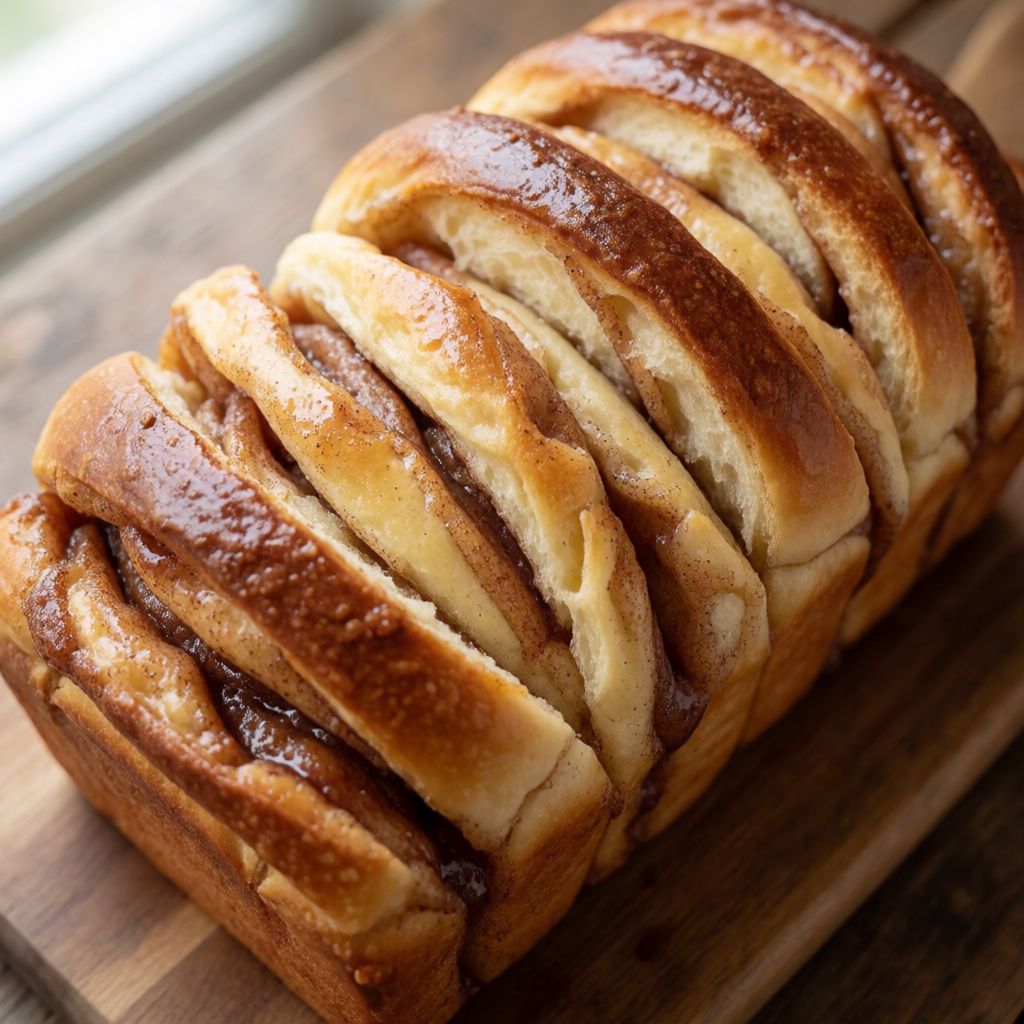
 AI photo
Pull-Apart Cinnamon Bread
A soft, pull-apart yeasted bread swirled with a buttery cinnamon-sugar filling.
Labels are worked out automatically from the ingredients and can be wrong. Check the packaging if it matters to you.
Ingredients
- 100 ml Milk
- 60 g Butter
- 20 g Yeast
- 1 pcs Egg
- 40 g Caster sugar
- 1 pinch Vanilla powder
- 330 g Plain flour
- 1 tsp Cinnamon ground
- 1 pinch Salt
- 125 g Butter room temperature
- 75 g Caster sugar
- 75 g Brown sugar
- 1½ tsp Cinnamon ground










Steps
Warm the milk and butter in a pan until the butter has melted. Remove from the heat and let the mixture cool slightly.
5 minAdd the yeast and mix well. Mix the vanilla powder with the sugar and add to the mixture.
5 minMix half the flour with the cinnamon and salt, and add to the mixture together with the egg.
3 minGradually add the remaining flour until the dough is smooth, elastic and soft.
10 minLeave the dough to rise on the counter for half an hour.
30 minWhile the dough rises, mix the butter, caster sugar, brown sugar and cinnamon in a bowl until smooth.
5 minRoll the dough into a large rectangle and spread with the filling, then cut into long strips the width of your loaf tin minus 1–2 cm.
10 minStack all the strips on top of each other and cut into pieces that can stand upright in the tin.
5 minI used small tins, but the process is the same, only the size and shape differ.
Leave the bread to rise in the tin for about 30–40 minutes, then bake in a preheated fan oven at 175°C for about 20 minutes.
20 minOr use 4 small tins instead.
This is a loaf that looks like it was built, not baked — stacked ribbons of dough, each one glued to its neighbour with butter and cinnamon sugar, so that when you pull a piece off, it tears into soft, striped sheets instead of a clean slice. The whole trick of this bread lives in two places: the yeast dough has to be slack enough to roll thin without fighting back, and the butter filling has to be soft enough to spread without tearing the dough underneath it. Get either of those wrong and you get a dense brick, or a torn mess that bakes into a solid loaf with no pull-apart left in it.
Some say you need a stand mixer for this. No — because the dough is wet and soft by design, not a stiff bread dough you'd want kneading for ten minutes on a hook. Ten minutes by hand, on a floured counter, is exactly what the recipe asks for, and that's a mechanism: gluten needs that much working to turn a sticky paste into something elastic enough to roll out and not spring back on you.
Doneness here isn't a clock number, it's the dough itself. "Smooth, elastic and soft" is a feel, not a time — press it and it should spring back rather than tear or stay dented. The first rise is done when the dough has visibly swollen and feels light and puffy when you poke it, not just "after 30 minutes" — thirty minutes is the floor, not the finish line, especially in a cooler kitchen in winter where your yeast is working slower than the recipe writer's. The second rise in the tin is the one people rush, because the loaf already looks like bread. Don't. If you cut too early, the strips haven't bonded into a loaf shape yet and the whole thing can slump sideways in the oven.
Milk and butter warmed together and cooled "slightly" before the yeast goes in is not fussiness — it's protecting the yeast. Yeast is a living thing; above roughly 40–45°C it starts dying, and a dead yeast gives you a flat, heavy loaf no matter how long you wait. If the mixture still feels hot on the inside of your wrist, it's too hot for the yeast. This is also why the egg goes in later, with the flour, rather than into the hot milk — an egg scrambles quietly and invisibly in liquid that's too warm, and you'd never know until you bit into a lumpy crumb.
The yeast itself: 20g is a lot if you're using the dried, powdered kind sold in UK supermarkets as "fast action" — that's usually meant at 7g per 500g flour. If that's what you've got, use about a third of the amount given and trust the dough's rise rather than the gram figure on the packet. Fresh yeast, if you can get it from a bakery counter, behaves closer to the quantity as written. Either way, the flour quantity (330g) matters more as a target than a law — add it gradually, as the recipe says, because flour absorbs liquid differently depending on humidity in your kitchen, and "gradually until smooth and soft" is the actual instruction, the 330g is just where most doughs land.
Two sugars in the filling — caster and brown — aren't decoration. Caster sugar dissolves fast and gives sweetness without much flavour of its own; brown sugar carries molasses, which is what gives the filling its deep, slightly burnt-caramel edge once it melts in the oven. If you've only got one sugar in the cupboard, use it, but expect the filling to taste flatter and less "toffee" without the brown. The butter in the filling has to be properly soft — room temperature, spreadable with a knife — because cold butter tears the thin rolled dough rather than gliding over it; that's the defect this step quietly prevents.
Any neutral oil has no business in this filling — butter's job here is to carry flavour and to solidify slightly in the fridge-cool dough layers before baking, holding the sugar in place so it doesn't all run to the bottom of the tin. There isn't a sensible substitute for butter in a laminated dough like this; margarine will melt differently and separate, giving you a greasy pool rather than a set filling.
Tins: a standard UK 2lb loaf tin is the obvious choice, but small individual tins — as the recipe mentions — change nothing about the mechanism, only the baking time, which will be shorter because there's less mass to heat through. Watch the colour of the crust rather than trust a borrowed number: deep golden-brown on top, and a loaf that sounds slightly hollow when you tap it, is your real cue that it's done, in a tin of any size.