
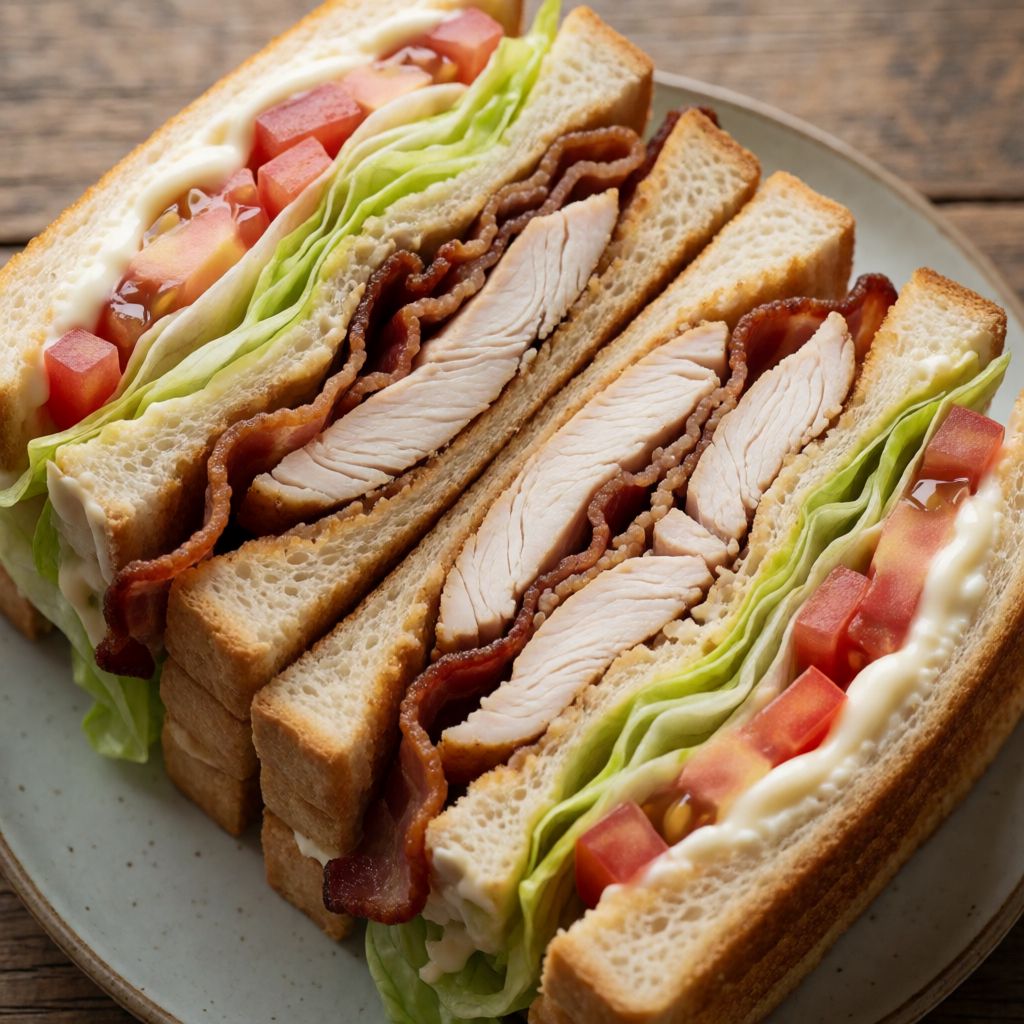
 AI photo
Club Sandwich
A classic club sandwich layered with crispy bacon, chicken breast, lettuce and tomato.
Labels are worked out automatically from the ingredients and can be wrong. Check the packaging if it matters to you.
Ingredients
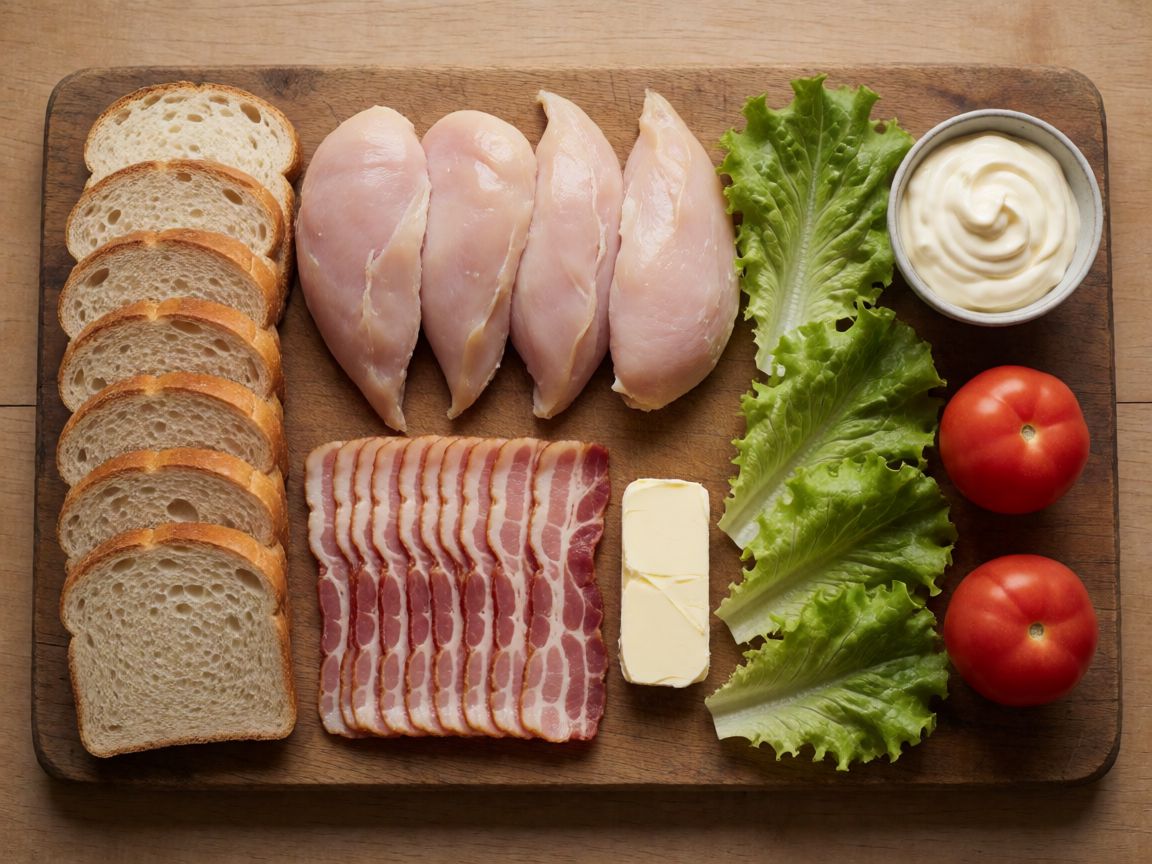
- 6 pcs Sandwich bread
- 4 pcs Chicken breast
- 8-10 pcs Streaky bacon
- 4 pcs Lettuce leaves
- 1-2 pcs Tomato
- Mayonnaise to taste
- 1 pcs Butter a slice, for frying






Steps
Heat a large frying pan, melt the butter, add the bread slices and fry on both sides until golden.
In the same pan, fry the bacon until crisp and golden, then transfer to a paper towel.
In the same fat, fry the chicken breast until it reaches 74°C at the thickest point.
5 minPat the meat and bacon dry with a paper towel, and slice the tomatoes and lettuce.
Spread a spoonful of mayonnaise on the first slice of bread, then layer the lettuce, chicken breast, tomato and bacon.
Top with a second slice of bread spread with mayonnaise on both sides, and repeat the layering for the second tier.
Cut the club sandwich in half to form two triangles.
A club sandwich is not a sandwich that happens to have three slices of bread — the three slices are the mechanism. Two tiers of filling need a middle floor to keep them apart, otherwise the chicken and the tomato argue with each other and the bread loses the argument. The whole point is architecture: each slice is a shelf, and what sits on it, and in what order, decides whether you get a club sandwich or a wet rag with ambitions.
What holds it together matters more than what's in it. Frying the bread, rather than toasting it, gives you a crumb with a dry, fat-sealed crust that shrugs off moisture instead of absorbing it — and because you fry it in the same pan you're about to use for bacon and chicken, that crust picks up their flavour before the filling even touches it. A toaster can never do that; it only dries bread, it doesn't season it. Lettuce isn't garnish here, it's a dam: it goes between bread and tomato so the tomato's water has nowhere to travel. Mayonnaise on both faces of the middle slice does the same job twice, sealing off both floors of the building.
The chicken is the one place this whole thing quietly fails if you're not watching. Push it past done and it turns to string inside a sandwich that's otherwise soft — and there's no hiding dry meat between two slices of white bread, nowhere for it to go. The point where the thickest part stops resisting your fork tells you it's ready, not a clock; the five minutes in the recipe is a floor, not a finish line.
Bread: you want a plain soft white sandwich loaf, close-crumbed enough to hold its shape when it hits hot butter, but not so dense it turns leathery. A fancy bread with big holes or a thick crust will fall apart under the layers; a very soft brioche-style loaf will go limp from the butter before it's even assembled. Butter, not a neutral oil, because you want the milk solids browning alongside the bread — that faint nutty smell as the foam settles is your cue it's ready to take the bread, and the same cue tells you when it's about to burn, which is the one mistake you can't undo.
Frying bread, then bacon, then chicken in the same unwashed pan isn't laziness dressed up as method — it's the whole reason the dish tastes of more than its parts. This is a card-table lunch, remember, nobody there was going to dirty three pans. On a domestic hob you won't get the even, sustained heat of a diner's griddle, so don't crowd the pan — fry the chicken in batches if your pan is standard-sized, because a crowded pan drops its own temperature and steams the meat grey instead of browning it. Streaky bacon, not back bacon, because you need the fat striping through the meat to render and crisp; back bacon is too lean to do anything but go leathery. If you're short on bacon, any pork belly cured and sliced thin enough to crisp quickly will do the same job.
Chicken breast is what the recipe asks for, but the sandwich's own ancestry points at turkey — the American original is said to have grown out of using up leftover Thanksgiving bird. If you've got cold roast chicken left from a Sunday roast, warm the slices briefly in the same fat the bacon left behind rather than frying raw breast from scratch; it's closer to how the dish actually started, and it saves you a pan of oil for no gain.
Tomato and lettuce aren't there to look like a salad snuck in — lettuce is the moisture barrier, tomato is the flavour that would ruin the bread if it touched it directly. Pat both meat and bacon properly dry before they go anywhere near bread; a damp surface under warm bread is exactly how a sandwich goes soft from the inside out in twenty minutes, long before anyone's taken a bite. Mayonnaise is an emulsion of oil and egg, which is why it seals rather than just greases — if you've none, soft butter beaten with a little mustard will act as a stand-in barrier, though it won't bind the layers the same way.
For four people you want about four chicken breasts, roughly 150–180g each, and eight to ten rashers of streaky bacon — two to two and a half each is generous, not excessive, given how much bacon shrinks. Don't rush the assembly: let the fried bread lose its straight-from-the-pan heat for a minute before you stack it, because hot bread against cold mayonnaise and lettuce steams itself soft from within, and let the chicken rest off the heat briefly so the juice settles back into the meat instead of running out onto the bread the second you slice it. None of this takes long, but skipping it is exactly how you end up with a sandwich that looks right and falls apart in your hand.