
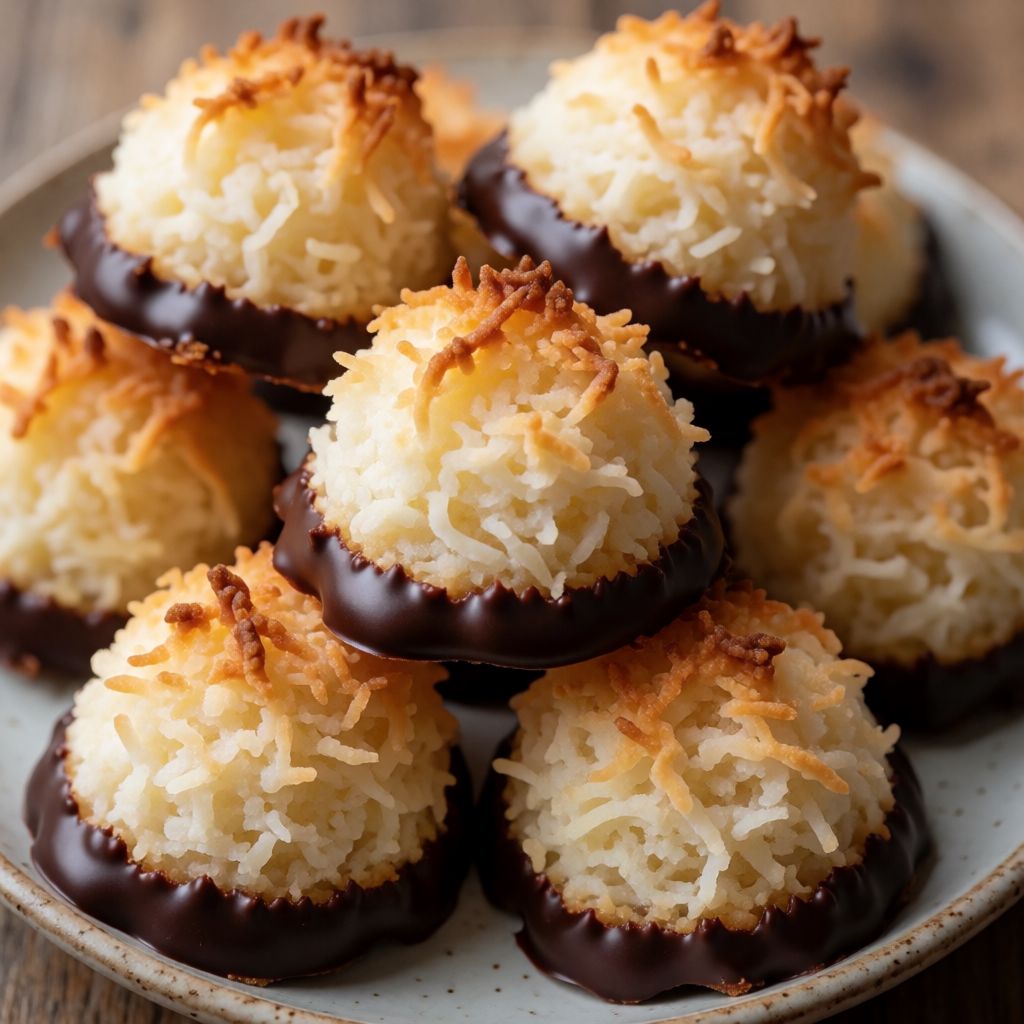
 AI photo
Coconut Macaroons
Chewy coconut macaroons dipped in dark chocolate, ready in just over half an hour.
Labels are worked out automatically from the ingredients and can be wrong. Check the packaging if it matters to you.
Ingredients
- 120 g Desiccated coconut
- 100 g Sugar
- 3 pcs Egg whites
- 1 pinch Salt
- 100 g Dark chocolate




Steps
Put the desiccated coconut into a bowl, add the sugar and egg whites.
Add a pinch of salt and mix well until the ingredients come together.
Line a baking tray with baking paper. Using two spoons, shape small portions of the mixture and place them on the tray.
Bake in a fan oven preheated to 160°C.
20 minLet cool slightly, then dip the tip of each piece into melted dark chocolate.
Once the chocolate has set, serve and enjoy.
These aren't cakes. There's no flour, no butter, no raising agent doing any work for you — just egg white, sugar and coconut, held together by nothing more than egg protein tightening up in the oven. That's the whole mechanism, and it tells you what actually decides whether this works: the ratio of egg white to coconut, and whether your oven heat matches how thin and dry desiccated coconut is.
Some say you need a yolk in there for richness, the way you'd think about a proper biscuit. No — because desiccated coconut is already roughly two-thirds fat. A yolk on top of that doesn't enrich, it just turns the inside greasy and stops the little shell from setting. The egg white is doing a structural job, not a flavour one: it coagulates, it grips the shreds, it holds the shape you squeezed between two spoons. That's also why three whites and no more — too much liquid and the mixture slumps before the oven can set it.
Coconut: buy it desiccated, fine and dry — that's the criterion, not the brand. Fine shred gives you more surface area per spoonful of egg white, so it binds properly; the bigger curled flakes sold for decorating cakes won't hold together the same way because there's less contact between pieces for the egg white to grip. Fresh coconut, grated yourself, carries far more moisture — lovely for other things, wrong here, because that extra water fights the oven's job of driving moisture out and setting a shell. If that's all you've got, dry it in a low oven first, or accept a softer, wetter macaroon and a longer bake.
Sugar is doing two things at once: sweetening, obviously, but also helping the surface caramelise and colour at the edges where it touches the tray and the air. Ordinary caster or granulated both work; caster just mixes in a touch faster because the grains are finer. Don't reach for icing sugar — it dissolves too readily into the egg white and you lose the slight crunch sugar crystals give the finished edge.
Egg whites: three whites, nothing fancier needed, and pasteurised whites from a carton do exactly the same job if you'd rather not crack eggs and wonder what to do with three yolks. What matters is that they're whole, liquid whites, not whipped to foam first — you want them wet enough to coat every shred of coconut, not aerated. Whipping them first is a step borrowed from meringue thinking and it doesn't belong here; it just makes the mixture harder to shape with two spoons.
The pinch of salt is small but not optional. It isn't there to make things salty — at that quantity you won't taste salt at all — it's there to stop the sweetness from sitting flat on the tongue. Leave it out and the macaroon tastes one-note; put it in and the sugar and coconut taste more like themselves.
Dark chocolate: any chocolate with enough cocoa solids to set firm at room temperature will do — that's the real criterion, and dark chocolate just happens to meet it reliably without added milk fat getting in the way. Milk chocolate has more fat from the milk solids, so it stays softer and can smear rather than snap when you bite in. Melt it gently — a bowl over barely simmering water, not a blast in the microwave — because chocolate heated too fast and too hot seizes into a grainy paste; that's not the chocolate failing, that's water or sudden heat shock doing damage you can't undo by stirring harder.
A word on the oven itself, since this is a domestic one, not a pastry kitchen's: fan ovens vary more than their dials admit, and a tray at the back can run hotter than one at the front. Don't trust 160°C blindly for the full time without a look halfway through — turn the tray if one side is racing ahead of the other. And give the whole business patience at the end: the macaroons need to cool before they'll take a chocolate dip properly, and the chocolate needs real time, sitting, to set hard again rather than staying tacky. There's no shortcut that doesn't show up later as a sticky mess on the plate.
As for where coconut macaroons sit in a British kitchen — desiccated coconut became a cheap, long-life import in the Victorian era, and recipes like this one grew up precisely because it kept well on a shelf and used up spare egg whites from richer things like custards and cakes that only wanted yolks. It's a tea-time biscuit in the oldest, most practical sense: something built from what was left over, dressed up with a dip of chocolate because that was the one small luxury worth spending on.