
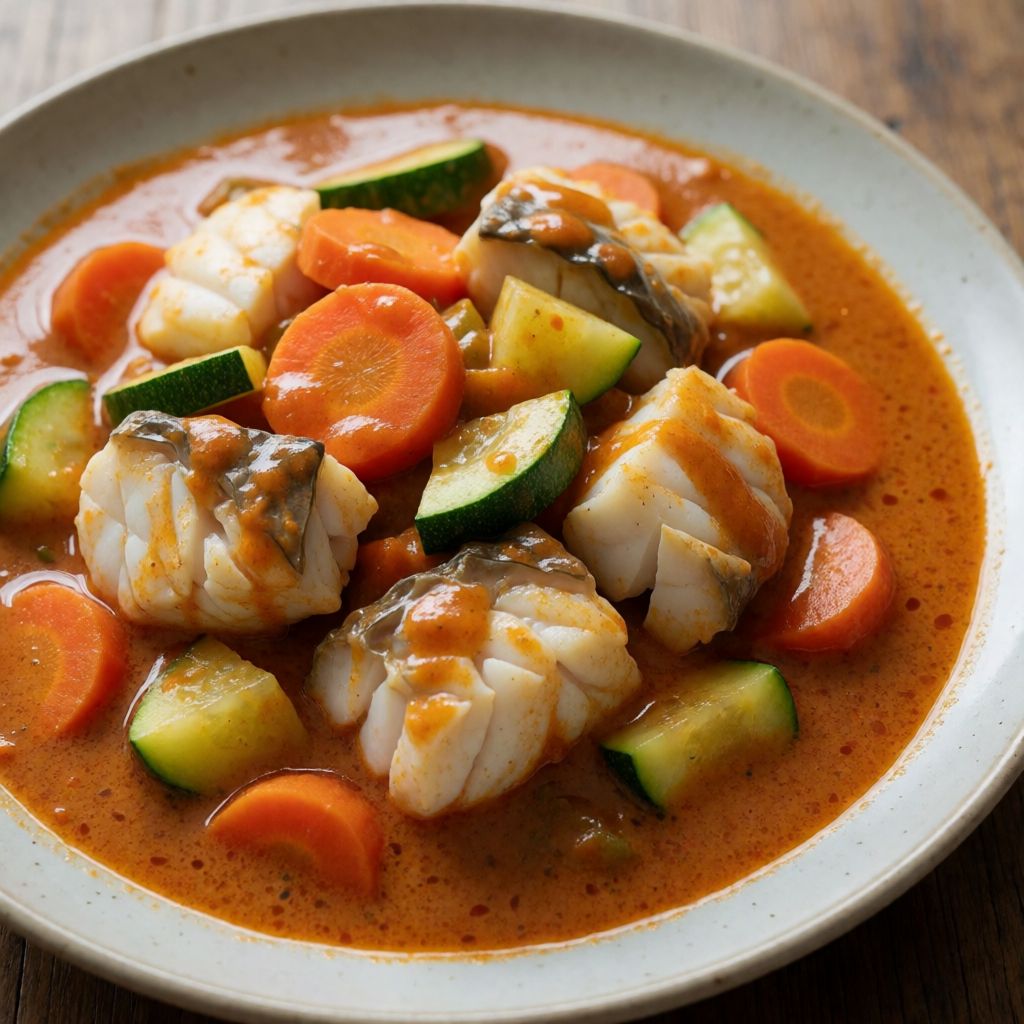
 AI photo
Cod in Red Curry Sauce with Vegetables
Baked cod fillets with vegetables in a coconut red curry sauce, served with basmati rice.
Labels are worked out automatically from the ingredients and can be wrong. Check the packaging if it matters to you.
Ingredients
- 3 tbsp Red curry paste
- 1 tsp Ginger finely grated
- 1 tbsp Soy sauce
- 400 ml Coconut milk
- 150 g Carrot finely diced
- 200 g Courgette finely diced
- 200 g Pointed cabbage thinly shredded
- 25 g Panko breadcrumbs
- 25 g Sesame seeds
- 600 g Cod
- 10 g Butter for frying
- Salt
- Black pepper freshly ground
- 300 ml Basmati rice
- 30 g Cashews
- 10 g Sesame seeds
- 1 tsp Chilli flakes
- 1 bunch Coriander finely chopped

















Steps
In a bowl, mix the curry paste, ginger, soy sauce and coconut milk until smooth to make a coconut curry sauce.
Place the carrot, courgette and pointed cabbage in a greased ovenproof dish, add the sauce and mix well.
Bake in a preheated oven at 200°C (fan) for about 20 minutes.
Pat the fish dry with kitchen paper and coat it in the panko, sesame seeds, salt and pepper mixture, then place it on top of the vegetables.
Bake for a further 10-12 minutes, or until the fish is perfectly cooked.
Meanwhile, cook the rice according to the packet instructions.
Serve the cod with red curry sauce in deep bowls with the rice, and sprinkle with coriander, sesame seeds, chilli flakes and cashews.
This is a tray-bake dressed up as a curry — the oven does the work a stove and a watchful hand would do in a Thai kitchen, and it does it honestly if you respect two different jobs happening in one dish: vegetables that need time to give up their water and sweetness, and fish that needs almost none.
What decides whether this works is not the paste or the coconut milk — those are forgiving — it's the moment you add the cod. Put it in too early and by the time the vegetables are properly soft, the fish is grey and cottony, pushed past done into dry. Put it in late enough and the fish steams gently in the sauce that's already thickened and reduced around the vegetables, arriving tender while the carrot still has a little resistance. That's why the recipe splits into two bakes — twenty minutes for the vegetables alone, then the fish joins for the last ten or twelve. The gap between those two numbers is the whole mechanism.
Some say fish curries must simmer slowly on the hob to let the flavours "marry" — no, because coconut milk and curry paste are already seasoned, already married before they meet the vegetables; what actually needs the time is the carrot's cellulose breaking down, and an oven does that more evenly than a pan where the edges scorch and the centre stays raw. The panko crust on top is doing something too: it's a lid against the dry, fierce heat of an oven, keeping the top surface of the fish from drying out while the sauce does the real cooking from below.
Start with the paste, because that's where the dish's whole character sits. A good red curry paste is shrimp paste, chilli, lemongrass, galangal, garlic — pounded, not blended, traditionally, because a mortar bruises and releases oil from the chilli skins in a way a blade just shreds. You're not making paste here, you're buying it, and that's fine — this dish was never about kazan-level labour, it's a weeknight tray-bake wearing Thai clothes. What you're choosing for is balance: too much and the coconut milk can't carry it, you get heat without the roundness underneath. Taste a dab on a spoon before you commit the whole jar.
Coconut milk itself is doing two jobs: carrying fat (which carries flavour and stops the sauce tasting thin and watery once it's baked down) and providing the liquid the vegetables steam-braise in. Full-fat, the kind that separates in the tin with a layer of solid cream on top — give it a shake or a stir before you pour, because that separated fat is not a fault, it's just cold storage doing its job. Light coconut milk will leave you with a sauce that breaks and looks greasy-thin rather than silky, because there isn't enough fat to bind what the paste releases.
The vegetable cut matters more than the recipe lets on. Dice the carrot and courgette fine and genuinely even — not for looks, but because uneven pieces cook unevenly, and a chunky carrot next to a sliver of courgette means one is still raw when the other's gone to mush. The courgette especially sheds water as it cooks; that water thins your sauce, which is why the bake is uncovered — in a kazan or a lidded pot that moisture has nowhere to go and you'd end up with soup. An ordinary ovenproof dish, no lid, lets that water evaporate off and the sauce actually tighten as it goes.
Cod: buy it thick-cut if you can, loin rather than tail end, because a thin tail piece will overcook in the time a thick loin only just gets there — and in a dish with no second chance to rescue dry fish, that matters. If cod's not to hand or the price has gone silly (it does, it's a fish with a reputation), any firm white fish that flakes rather than falls apart works the same way — haddock, pollock, even a thick hake fillet. What you're choosing for is a fillet that holds its shape under gentle heat rather than disintegrating.
The panko-sesame crust: pat the fish properly dry first, with paper, because wet fish won't hold a crumb — it'll slide off into the sauce rather than sitting as a crust. Sesame seeds toast and go nutty in that oven heat; panko stays drier and crisper than fresh breadcrumbs because it's made from crustless bread, less moisture to begin with, less to steam away limp.
Basmati rice, cooked separately, is the quiet workhorse that stops the whole bowl becoming too rich — plain starch against a fatty, spiced sauce. Cashews and the second hit of sesame and chilli flakes at the end aren't decoration, they're texture against a dish that's otherwise entirely soft: crunch is the thing this bowl would miss without them. And patience here isn't really about watching a clock — it's about not opening the oven door every five minutes to check, because every time you do, the heat drops and the vegetables' twenty minutes becomes twenty-five, thirty, and you've lost the gap between the two bakes that the whole thing depends on.