
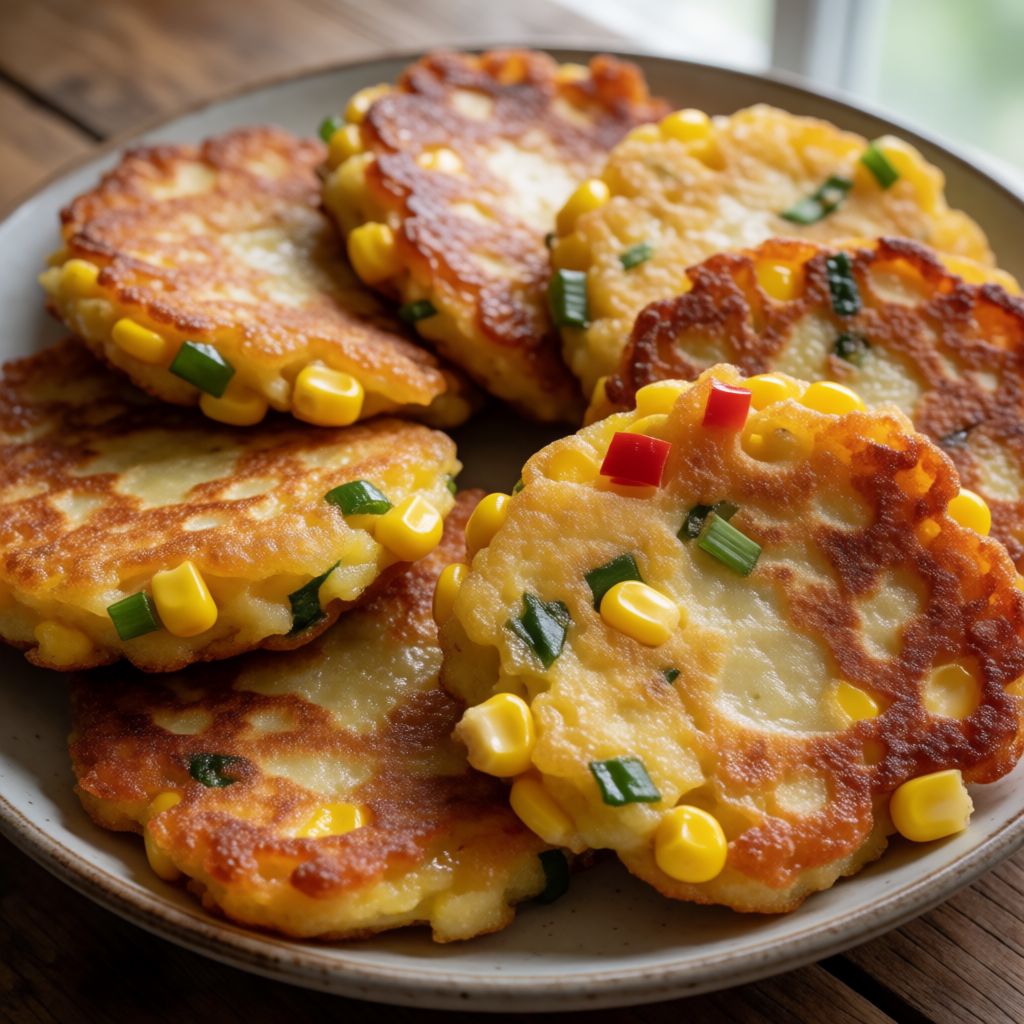
 AI photo
Corn fritters
Quick little corn fritters, baked in the oven rather than fried.
Labels are worked out automatically from the ingredients and can be wrong. Check the packaging if it matters to you.
Ingredients
- 300 g Sweetcorn tinned or frozen
- 1 pcs Onion finely chopped
- 1 clove Garlic finely chopped
- 1 pcs Red chilli finely chopped
- 100 ml Plain flour
- 2 pcs Eggs
- 1 tsp Baking powder
- 1 tsp Smoked paprika
- 1 tsp Cumin
- 1 tbsp Olive oil for frying
- 1 tbsp Butter for frying
- 2 tsp Salt and freshly ground pepper











Steps
Blitz the onion and garlic in a mini chopper or blender until finely chopped.
Add the sweetcorn and pulse very briefly — just to roughly chop it.
The mixture should still have large, visible pieces of corn kernel, so don't blend it too finely.
Mix the chopped mixture together with the remaining ingredients until evenly combined.
Shape into 10 fritters and place them on a baking tray lined with parchment paper.
Brush with oil and bake in a preheated fan oven at 190°C for about 25 minutes.
25 minTurn the fritters over halfway through the baking time.
A corn fritter is a batter that's barely a batter — just enough egg and flour to hold the kernels together, not so much that you're eating bread with corn in it. The whole thing lives or dies on one decision: how fine you blitz the corn. Pulse it into a smooth paste and you get a dense, eggy pancake with corn flavour but no corn texture — the thing people complain about when they say fritters are "stodgy". Pulse it just enough to break maybe a third of the kernels and leave the rest whole, and you get pockets of sweetness that burst against the crisp edge. That's the entire trick. Everything else is logistics.
Some say fritters have to be fried in a puddle of oil to get that crust. No — because what you're actually chasing is surface moisture leaving fast enough to crisp before the inside overcooks. A hot oven does that more evenly than a pan, especially a domestic hob where "medium-high" on four different cookers means four different things. 190°C in a fan oven is hot enough to set the egg, brown the paprika's sugars, and dry the cut surface — all at once, without you standing there flipping ten patties in batches and burning the first two while the last two are still raw in the middle.
Corn: tinned or frozen, both fine, because by the time it's baked into a fritter nobody can tell you steamed it from frozen or drained it from a can — what matters is that you drain or thaw it properly first. Wet corn means wet batter, and wet batter means you're baking off water instead of browning, which is exactly how you end up with a fritter that's cooked through but pale and sad on the outside. If you're using fresh corn off the cob in summer, you'll need less flour, because fresh kernels don't carry the starchy tinned liquid that helps bind things.
Onion and garlic go into the blender raw, which feels wrong if you're used to softening onion in a pan first — but there's no pan step here, and raw onion blitzed fine enough disappears into the mixture and cooks through in the oven's 25 minutes anyway. This is not a dish asking for the deep sweetness of long-cooked onion; it's asking for onion as seasoning, distributed evenly rather than sitting in visible chunks.
The egg is the actual binder — flour is just there to carry the egg and soak up excess moisture, which is why there's so little of it, 100ml against two whole eggs. If you've only got self-raising flour in the cupboard, skip the baking powder; using both will give you fritters that puff up in the oven and then collapse into a denser disc once they cool, because there's more lift than the egg structure can hold once steam stops pushing from below.
Baking powder here isn't for height — a fritter isn't a Yorkshire pudding — it's for lightness against the gum of the flour-egg paste, stopping the inside from compacting into something closer to a corn omelette. Skip it and the texture survives, just denser; nobody's ruined.
Smoked paprika and cumin are doing a specific job: corn on its own is sweet and a bit flat once cooked, and these two give it smoke and warmth without fighting the sweetness the way, say, a sharp vinegar would. If you don't have smoked paprika, ordinary paprika works but you lose the bonfire note — a pinch of chilli flakes toasted with the fresh chilli already in the mix gets you partway back.
The chilli is fresh heat on top of the dried spice's warmth — two different kinds of hot that don't substitute for each other. Leave it out entirely if you're feeding children or anyone heat-averse; nothing in the structure of the dish depends on it.
Oil and butter for brushing: this is the one place where "any neutral oil" genuinely applies, because you're not frying in it, just helping the surface brown and stopping it drying out like old bread crust. Olive oil with a strong flavour of its own will fight the paprika less than you'd think, since it's only a brush-coat, but if all you've got is sunflower or vegetable oil, use that and save the good olive oil for the table. The butter on top of the oil gives you a touch of browning and richness oil alone won't — dairy sugars and milk solids colour faster than most oils, which is part of why butter alone scorches if used neat at high heat, but as a thin brushed layer here it's no risk.
Ten fritters from this mix, sized by eye rather than scale — a generous spoonful each, flattened with the back of the spoon so they cook through evenly rather than staying wet in a thick middle. Count on feeding ten as a side, fewer if this is the main event on the plate, because a fritter next to a Sunday roast is doing a different job than a fritter carrying the whole meal on its own.