
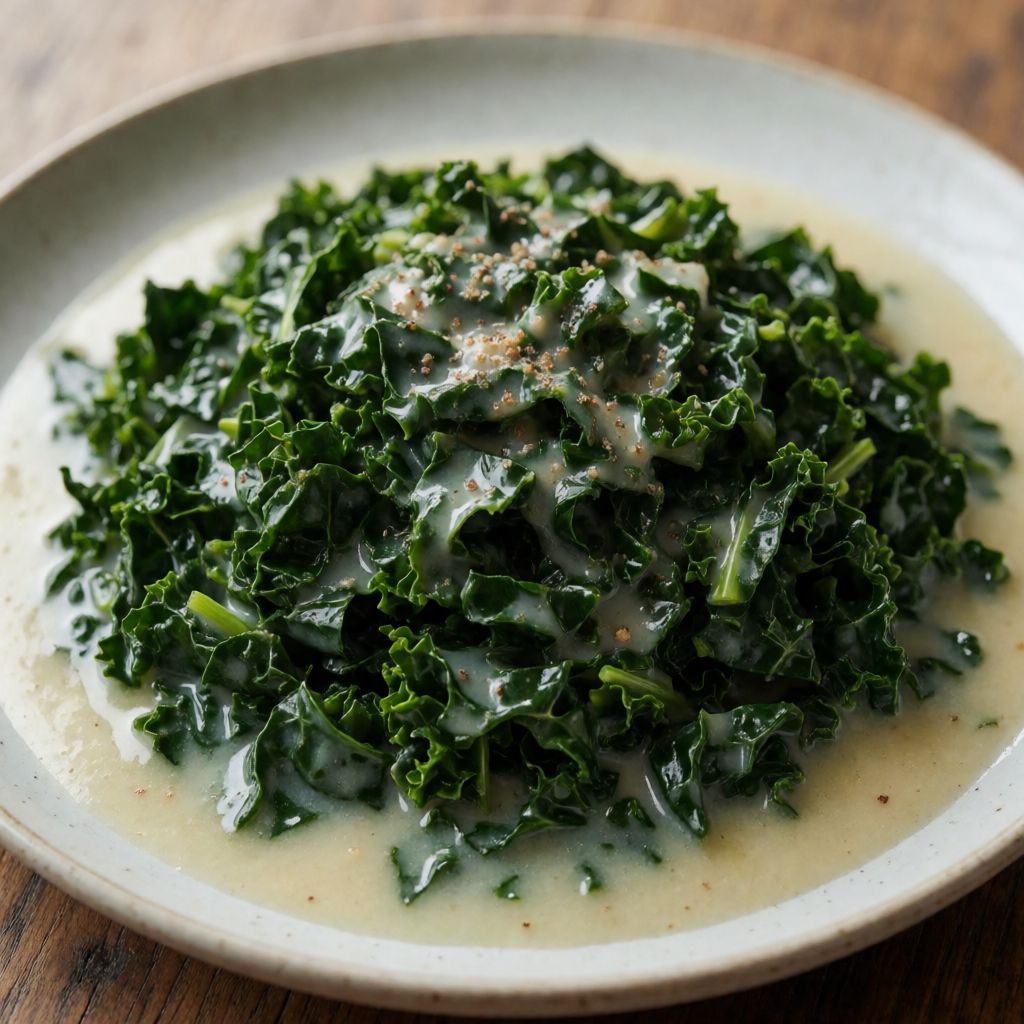
 AI photo
Creamy Braised Kale
A simple side dish of kale braised until soft in a light cream sauce.
Labels are worked out automatically from the ingredients and can be wrong. Check the packaging if it matters to you.
Ingredients
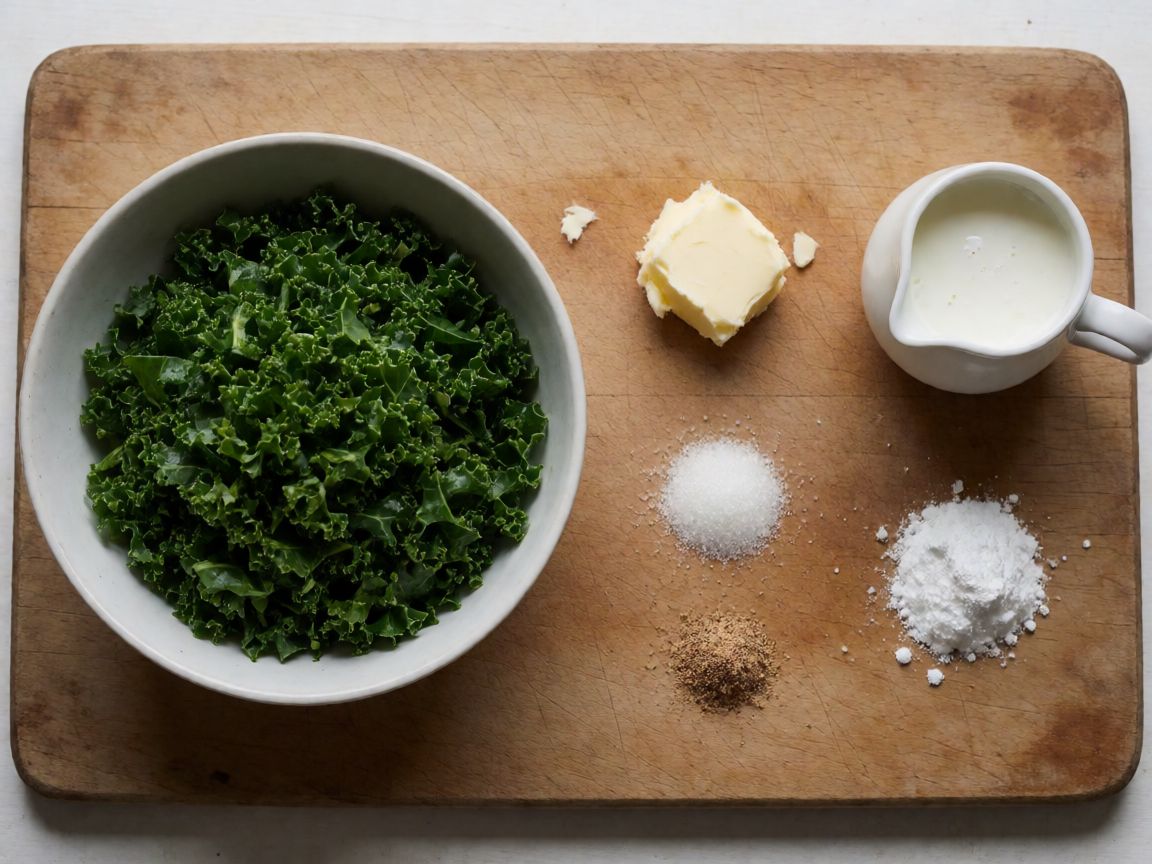
- 500 g Kale finely chopped
- 1 tbsp Butter
- 200 ml Whipping cream
- 2 tbsp Sugar
- 1 pinch Nutmeg finely grated
- 1 tsp Cornflour
- Salt to taste
- Black pepper freshly ground








Steps
Sauté the kale in the butter, stirring, for a few minutes until it wilts and softens.
Add the whipping cream, cover with a lid and simmer gently for about 30 minutes.
30 minIf the kale becomes too dry, add a little more cream, milk or water.
Season the kale with sugar, salt, freshly ground pepper and a pinch of freshly grated nutmeg.
Once the kale is soft and well seasoned, serve it as is, or thicken it slightly (for example with cornflour).
Let the kale simmer for a further 3-5 minutes, stirring, after thickening.
5 min
This is creamed kale — the vegetable cooked the way you'd cook spinach for a steakhouse, except kale isn't spinach, so the method has to work harder. Butter to start it wilting, cream to finish it, a lid to hold the steam in, and enough time on a low flame to turn a tough winter leaf into something you'd happily eat with a spoon alongside your roast potatoes. It feeds four as a side, maybe fewer if your table loves greens.
What decides whether it works is patience at step two. Kale's toughness lives in its rib and its cell walls — lignin and cellulose, the stuff that lets it stand up through a frost when lettuce has long since collapsed. Spinach has almost none of that, which is why spinach wilts in a minute and kale does not. Thirty minutes under a lid, gently, is the lower bound for breaking that structure down enough that the leaf stops fighting your fork. Rush it and you get kale that's merely warm, still chewy at the rib, swimming in cream that never got a chance to be absorbed.
Some say greens are only good cooked fast, kept bright green, barely touched by heat — no, because that's a rule for delicate leaves, and it has nothing to do with kale. Kale is a cabbage relative bred for hardiness, not tenderness, and the whole point of this dish is to use heat as the tool that spinach never needs: enough of it, for long enough, to dissolve what makes kale kale. The colour will dull from bright to a deep, matte green. That's not a mistake — that's doneness.
On the kale itself: buy curly kale or cavolo nero, strip the thickest part of the central rib out with your thumb and forefinger if it's a big leaf — that rib is the slowest part to soften, and finely chopping, as the recipe asks, is really a way of shortening the distance heat and moisture have to travel through that fibre. 500 g looks like a mountain in the pan and collapses to a modest bowlful; that's just water leaving the cells, same as any leafy green.
Butter at the start isn't there to brown anything — you're wilting, not frying — it's there to coat the leaves in fat before the cream arrives, so the two marry rather than sitting as oil-and-water. Any fat with no flavour of its own, or a mild one you don't mind tasting, does the same job: a spoonful of dripping from the roasting tray works nicely here and ties the side dish back to the joint it's sitting next to.
The cream is doing the real work of step two. Whipping cream, at roughly a third fat, is stable enough to simmer gently without splitting — it has no acid in this recipe to provoke it, so your only enemy is heat that's too fierce, which breaks the emulsion by cooking the proteins too hard and too fast, same mechanism as a sauce catching and grainy. Keep it at a bare simmer, lid on, and you avoid that. If all you have is milk, it will work the same way in principle but needs the starch (the cornflour) to do more of the thickening, since milk alone has too little fat to coat and cling the way cream does.
Sugar here isn't making a dessert of a vegetable — it's countering kale's bitterness, which comes from the same family of compounds that make cabbage and sprouts sharp-tasting. Two tablespoons is a correction, not a flavour in its own right; taste the kale at the end of its simmer first, because bitterness varies leaf to leaf and you may need less.
Nutmeg is a borrow from béchamel — a pinch of warm spice that cuts the flat, slightly raw smell warmed cream can have, without announcing itself as nutmeg. It used to be a luxury worth fighting wars over; now it's a jar at the back of the cupboard, which tells you something about how spice trade economics changed rather than about the dish.
Cornflour thickens by swelling and gelling once it hits heat — but only if you slake it first, a teaspoon stirred into a splash of cold cream or water before it goes anywhere near the pan. Tip the dry powder straight into a simmering pot and the outside of each grain cooks instantly into a seal, trapping raw starch inside: that's where lumps come from, not from the starch itself. Season with salt and pepper only at the end, once the cream has reduced a little under the lid — it concentrates as it cooks, and salting early is how you end up over-salted later without having done anything wrong on paper.