
 AI photo
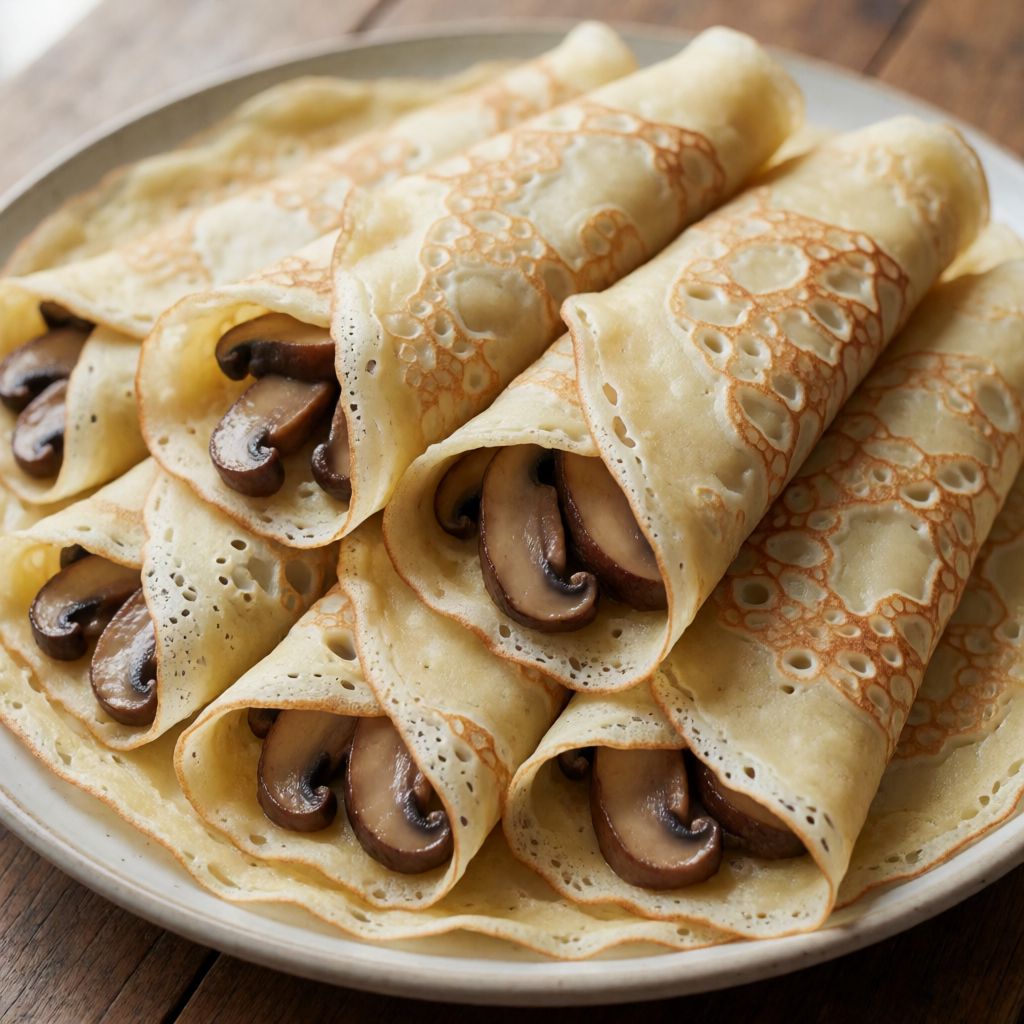
Crêpes with Porcini Mushrooms
Layered crêpes with béchamel, mushrooms and melted fontina, baked until golden.
Labels are worked out automatically from the ingredients and can be wrong. Check the packaging if it matters to you.
Ingredients
- 4 pcs Eggs
- 0.5 l Milk
- 250 g Plain flour sifted
- 1 pinch Salt
- 50 g Butter
- 0.5 l Milk
- 50 g Plain flour
- 250 g Fontina grated
- 1 kg Porcini mushrooms
- 40 g Butter
- 3 clove Garlic
- 1 bunch Chives chopped
- pinch Salt to taste









Steps
Whisk the eggs vigorously, add a pinch of salt, gradually sift in the flour, pour in the milk in a thin stream and mix until smooth.
Cover the bowl with cling film and let the batter rest.
30 minMelt the butter, stir in the flour and let it cook briefly. Remove from the heat, warm the milk and pour it into the mixture. Return to the heat and cook until it comes to the boil.
10 minFry the very thinly sliced porcini mushrooms in a pan with melted butter and garlic over high heat.
8 minRemove the garlic cloves and add the chopped chives to the mushrooms.
Heat a non-stick pan, grease with butter, pour in a ladleful of batter and spread it over the surface.
Cook the crêpes for a few minutes, then carefully flip with a spatula.
Place the finished crêpes on a plate to cool.
Line a baking dish with parchment paper and layer the crêpes, béchamel, mushrooms and grated fontina.
Bake at 180°C in a preheated static oven.
20 minRemove the bake from the oven and garnish with the fried mushrooms and chives.
This is a crêpe lasagne, really — thin pancakes standing in for pasta sheets, layered with béchamel and porcini and baked until the cheese binds the whole thing into something you can cut into squares. Three jobs, three separate pans, and the dish only works if you don't try to collapse them into one.
What decides whether it's good: the batter has to rest, the béchamel has to actually thicken before it meets the oven, and the mushrooms want ferocious heat for a short time, not a gentle simmer. Skip any of those and you get a crêpe that tears, a sauce that weeps into the dish and turns it soupy, or mushrooms that steam in their own water instead of browning.
Porcini are the one non-negotiable flavour here — everything else (eggs, milk, flour, butter, cheese) is structure and glue. If the porcini aren't right, the dish is just a cheese bake with pancakes in it, which is fine but isn't this.
Patience is the ingredient most people skip, and it's the one that actually does the work in the first two steps.
Start with the batter rest, because this is where most people cut a corner and don't understand why the crêpe fights back. Flour needs time in liquid for the starch to swell and the gluten strands — roughed up by all that whisking — to relax. Skip the rest and the crêpe tears when you flip it, or comes out rubbery at the edges. Half an hour on the counter is enough; the fridge isn't necessary here, you're not trying to slow anything down, just let the flour drink.
Some say you need a special crêpe pan for this. No — you need a pan with a flat, honest non-stick surface and a steady hand with the ladle; a domestic non-stick frying pan does the job. What you don't have is a kazan-sized flat griddle, so work in batches and keep the finished crêpes separate on a plate — stacking them hot is how they weld together into one sad disc.
The béchamel is flour and butter cooked together first — a roux — before the milk goes anywhere near it. That brief cooking of the raw flour taste out of the butter is the whole point; pour cold milk straight onto raw flour and you get lumps and a sauce that tastes of nothing but flour dust later. Warming the milk before it joins the roux isn't fussiness — a cold shock seizes the butterfat and you're back to lumps again. You want the sauce to come to a full boil and visibly thicken, coating a spoon rather than running off it, because béchamel that goes into the oven thin stays thin, or worse, separates and pools at the bottom of your dish while it bakes.
On the mushrooms: porcini are mostly water held inside a loose structure, and that structure collapses the moment heat opens the cells. High heat, sliced thin, and no crowding the pan — all this is to get the water out fast as steam rather than let it sit and stew the mushroom in its own juice. "Medium heat so they don't burn" is advice for mushrooms you want soft and sweated for a sauce. You want them caught just as they start to colour at the edges — that's the aroma, not a general sizzle. Garlic goes in for fragrance and comes back out before it browns, because burnt garlic is bitter and there's no rescuing it once it's there. If you can't get fresh porcini — and in the UK outside autumn you often can't — a mix of chestnut mushrooms with a small handful of dried porcini (soaked, liquid saved and used in the béchamel milk) gets you most of the way; dried porcini concentrate flavour precisely because the water's already gone.
Fontina is chosen for how it behaves, not for its name: a cheese that melts smoothly into long strands without turning oily or grainy. Any semi-soft cheese with good melt and not too sharp a bite stands in — a young Gruyère or an Emmental will do the job, though you lose a little of fontina's nutty backnote. A hard, dry cheese like a mature Cheddar will work flavour-wise but tends to split and go greasy under heat rather than flowing, so if that's what's in the fridge, cut it with something softer.
Butter appears three times and each time it's doing something different: emulsifying the roux, greasing the pan so the crêpe releases instead of tearing, and carrying flavour into the mushrooms without masking them the way oil with its own smell might. If you need a substitute anywhere, the rule is the same each time — something with no flavour of its own for the pan, something with real body for the roux. A neutral oil can grease a pan; it can't make a béchamel.
Six servings here means a baking dish roughly the size of a standard lasagne dish — enough crêpes to give you three or four honest layers, not a single sad one. Thirty minutes of prep and twenty of baking is the recipe's own estimate; treat it as the floor, not the ceiling — the béchamel is thick enough when it holds a line on the spoon, the bake is done when the top has taken colour and the cheese has stopped looking shiny-wet and started looking settled.