
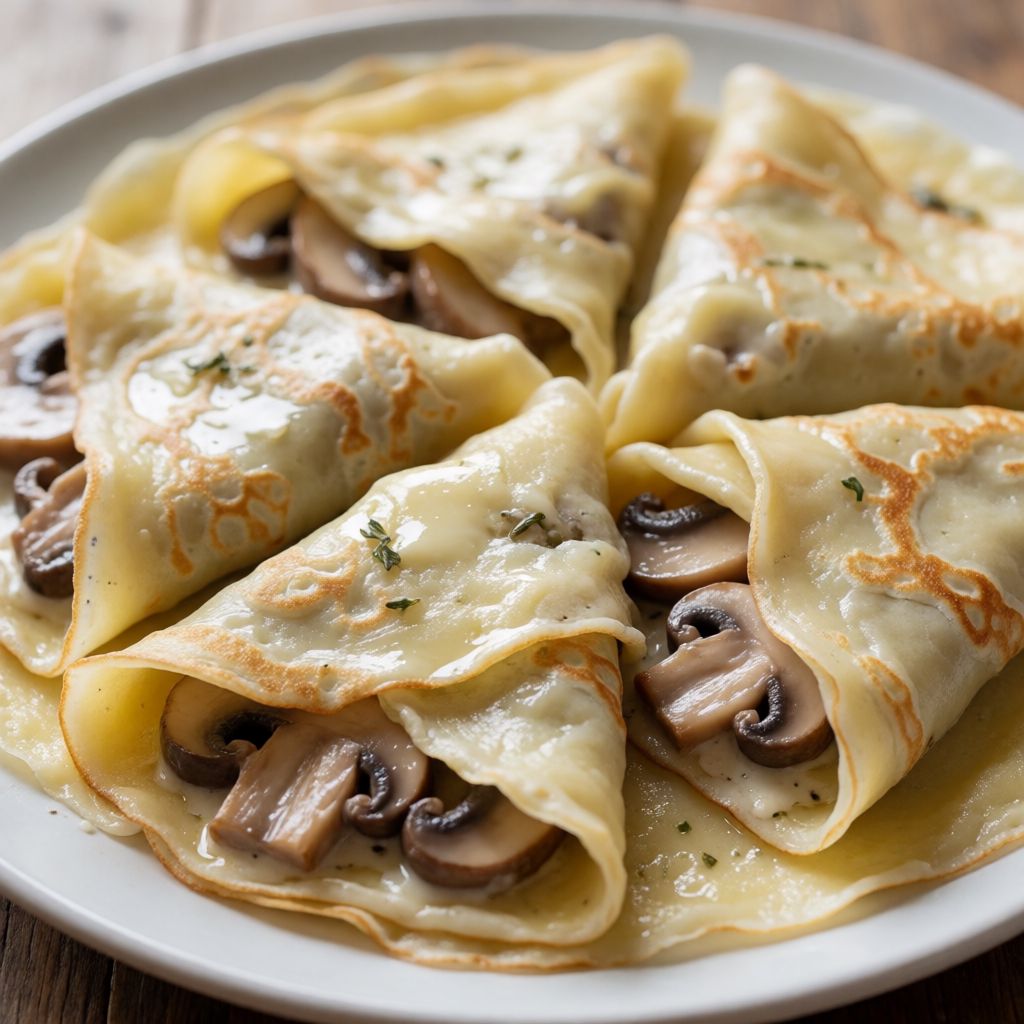
 AI photo
Crespelle with Mushrooms
Savoury Italian-style crepes filled with mushrooms, melted Taleggio and Parmesan, baked until golden.
Labels are worked out automatically from the ingredients and can be wrong. Check the packaging if it matters to you.
Ingredients
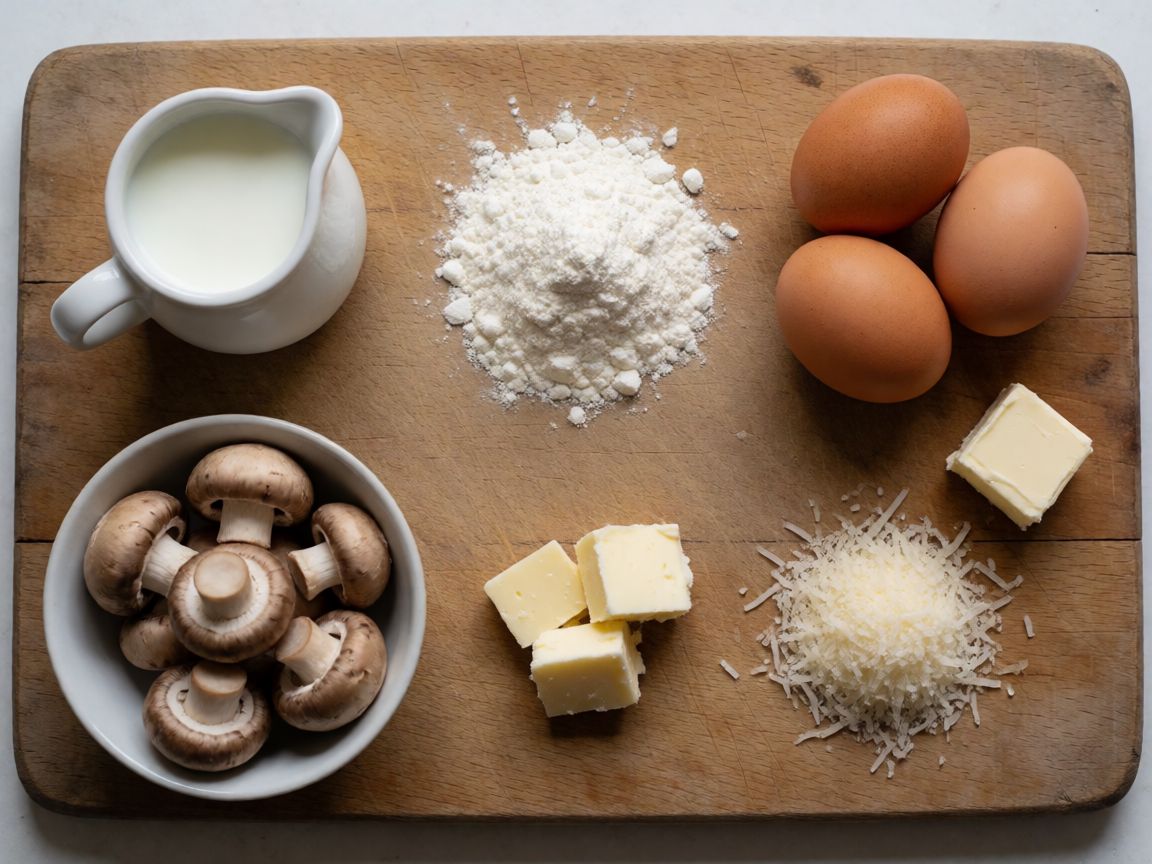










Steps
Slice the mushrooms and sauté them in a pan with olive oil until all the moisture has evaporated. Season with salt and add the parsley.
In a bowl, whisk the eggs with the milk and a pinch of salt. Add the sifted flour and mix well.
Pour in the cooled melted butter, mix, and let the batter rest in the fridge.
25 minGrease a pan with butter and heat it. Pour in a ladleful of batter, tilting the pan to spread it evenly.
Cook each crepe on both sides for a few seconds. Repeat until all the batter is used.
On half of each crepe, place mushrooms and Taleggio. Fold over the other half, add more mushrooms and Taleggio, then fold into a triangle.
Arrange the crespelle in a greased baking dish, overlapping them. Dot with butter and sprinkle with Parmesan.
Bake the crespelle at 200°C.
Serve hot.
A crespella is just an Italian crepe pretending it's never heard of France — thin, eggy, cooked fast in a dry pan, then used as a wrapper instead of a dessert. Here you're folding it round mushrooms and melted Taleggio and baking the whole tray until the cheese goes molten and the top blisters. It's a crepe doing the job of pasta: thin sheet, rich filling, bake to bind. What decides whether it works is moisture — in the batter, in the mushrooms, and in the pan — because this dish fails wet, not burnt.
The batter rests in the fridge for a reason that has nothing to do with flavour maturing or tradition demanding patience for its own sake. Flour needs time to actually absorb the liquid around it and for the gluten strands you've just agitated with a whisk to relax. Skip the rest and you cook a batter that's still fighting you — it tears when you flip it, because the gluten is tight and elastic rather than slack. Some say resting batter is just something Italian grandmothers insist on. No — it's starch hydration and gluten relaxation, both measurable, both the difference between a crepe that folds like cloth and one that cracks like a biscuit.
The flour is plain, unremarkable — you're not after chew or structure here, you're after a thin, pliable sheet, so a strong bread flour would just make the crespelle tougher to fold without giving you anything back. Plain flour, properly rested, is already soft enough.
Eggs and milk together are what make the batter a batter rather than a paste: the egg gives it enough protein to set into a thin, foldable skin when it hits the hot pan, the milk thins it to pouring consistency and keeps the crespella tender rather than rubbery. If your batter looks thick after mixing, add a splash more milk before it goes in the fridge, not after — resting while too thick just wastes the rest.
The melted butter folded into the batter at the end does two jobs: it adds a little fat so the crepe releases from the pan without sticking (less reliance on your greasing alone), and it rounds off the eggy edge with something richer. Let it cool first — pour hot butter into cold eggy batter and you get patches of half-cooked egg, which nobody wants to discover mid-pancake.
On the pan itself: you don't need a dedicated crepe pan, a wide, flat, non-stick frying pan does the job, but it has to be properly hot before the first ladleful goes in — a cool pan means the crespella sits and sets slowly, picking up grey, leathery patches instead of cooking fast and even. You're tilting the pan to spread the batter because crepes this thin don't forgive a spoon pushed around after the fact — the batter has to move while it's still liquid, which is a matter of seconds.
Parmesan on top isn't there for flavour alone — on a domestic hob or oven without a grill fierce enough to properly brown, Parmesan is what gives you the only real crust you'll get, because it browns and crisps at a lower temperature than most cheeses thanks to its low moisture. Taleggio won't crust the same way — it just melts — so the two cheeses are doing different jobs, not duplicating one.
If you don't have Taleggio to hand — and in an ordinary UK supermarket it isn't always sitting there — look for the criterion, not the name: a semi-soft cheese that melts loose and savoury rather than rubbery. A young Fontina or a soft Gruyère-style cheese will behave the same way in the bake, even if the smell is milder. Don't reach for mozzarella as a straight swap — it strings and seizes rather than pooling, and you'll get stretchy ropes instead of a melted filling.
For the mushrooms, any firm cultivated variety works — chestnut, button, even a mix with something wilder if you want more character — the method stays the same: slice, dry-sauté in olive oil until the water's gone, season at the end once there's no liquid left to dilute the salt. Parsley goes in off the heat, so it stays green and fresh rather than wilting into the pan and losing its point.
The bake at 200°C isn't about cooking anything raw — everything inside is already cooked — it's about melting the cheese through and getting enough surface heat for the Parmesan and butter on top to colour and crisp before the crespelle underneath dry out. That's a short window, so this is a dish you watch through the oven door, not one you set a timer for and walk away from — patience here means staying close, not waiting long.