
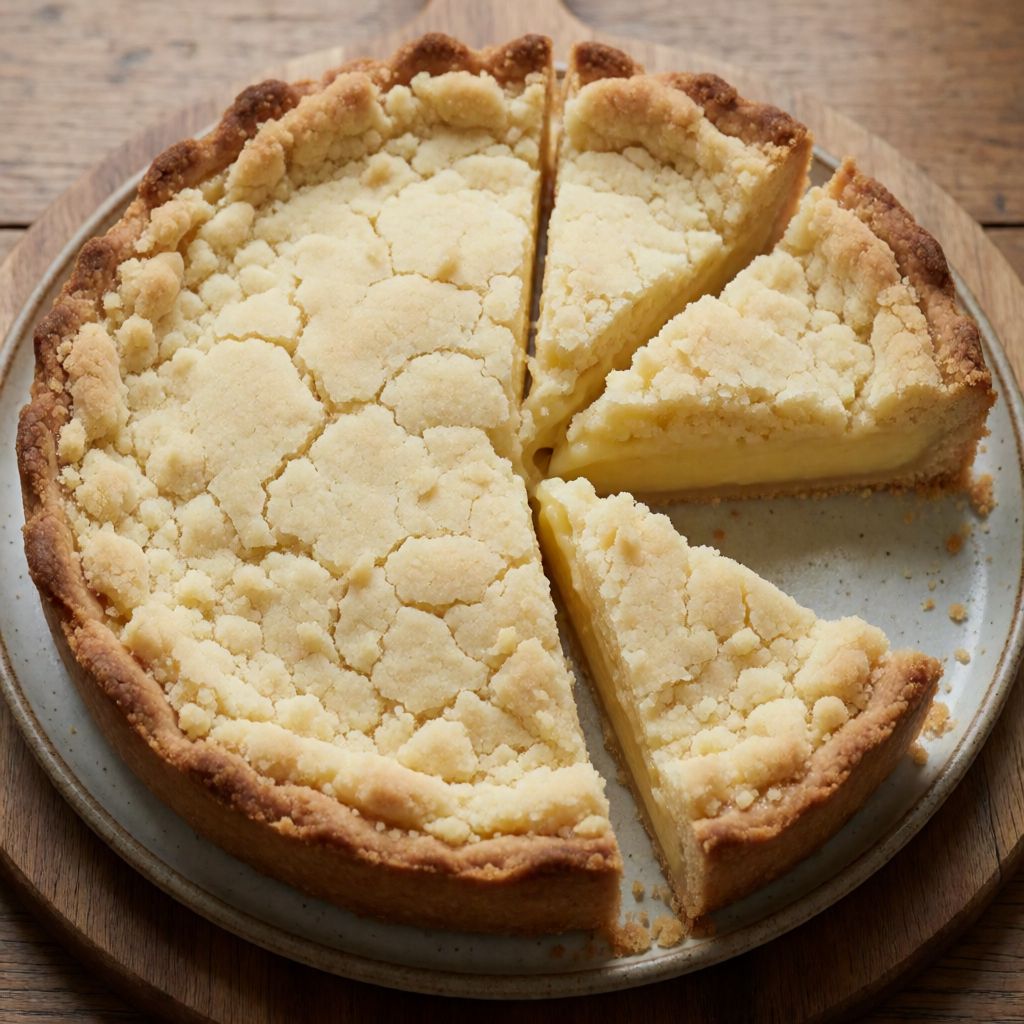
 AI photo
Crumbly Pastry Cream Pie
A crumbly shortcrust pie filled with smooth vanilla and lemon pastry cream.
Labels are worked out automatically from the ingredients and can be wrong. Check the packaging if it matters to you.
Ingredients
- 300 g Plain flour
- 100 g Caster sugar
- 100 g Butter
- 1 pcs Egg
- 1 pcs Baking powder
- 500 ml Milk
- 3 pcs Egg yolk
- 60 g Caster sugar
- 40 g Plain flour
- 1 pcs Lemon zest to taste
- 0.5 pcs Vanilla pod









Steps
In a bowl combine the flour, sugar, butter and egg; rub together with your fingertips until crumbly, then add the baking powder
Put the crumble mixture in the fridge
30 minCombine the egg yolks with the sugar and whisk until pale and fluffy, then add the sifted flour
5 minHeat the milk with the vanilla pod and lemon zest until almost boiling
Stir the egg mixture into the hot milk
Bring the cream to the boil, stirring, until it thickens
Let the cream cool
Butter a 22 cm tin and line it with baking parchment
Press half the crumble mixture into the base of the tin and pack it down well
Spoon in the pastry cream, leaving 1 cm from the edge
Cover with the remaining crumble mixture
Bake in a fan oven at 160°C for 35 minutes
35 minOr bake in a conventional oven at 180°C for 40 minutes
40 minLet the pie cool before serving
This is two doughs, really: one dry and crumbly that sleeps in the fridge, one wet and silky that's cooked in a pot, built into a sandwich inside a tin. Whether it works is decided before the oven gets involved — by how cold your butter was when you rubbed it into the flour, and whether you boiled the custard long enough. Not by a stopwatch.
Picture a thick case of shortbread-ish crumb pressed into a tin, holding a pool of set custard, capped with more crumb and baked until the top goes the colour of a digestive biscuit. Cut it cold, not warm — warm, the custard runs instead of standing, and you lose the slice on the knife instead of the plate.
The crumble isn't pastry in the sense of something you roll out. It's rubbed sugar-butter-flour-egg, like a scone dough someone interrupted halfway, kept deliberately crumbly so it can be pressed into a tin rather than rolled over one. Underneath it, a custard of egg yolks, sugar, flour and milk, perfumed with lemon and vanilla, needs no gelatine and no cheffy tricks: flour cooked all the way through a boil is what gives it body once it's cold again.
Some say custard curdles if you let it boil — true, for egg yolks thickened with nothing else. Here the flour is a bodyguard: starch granules swell as they heat and physically keep the egg proteins from clumping into scrambled threads. You're meant to bring it to the boil, stirring. Stop short of that and the flour never fully gelatinises — the "cream" stays thin and starchy no matter how long you leave it in the fridge afterwards.
Flour in the crumble: plain, and its gluten strength barely matters, because you never knead it — you rub it. The whole point of rubbing is to coat flour particles in fat before any liquid can turn them stretchy. Butter has to be cold, straight from the fridge, because warm butter melts into the flour instead of coating it in separate flakes, and a glued-together dough bakes dense, closer to a biscuit than a crumb. Any cold, solid, mild-tasting fat does the same job structurally — lard would hold up the crumb just as well, it just tastes of lard.
Sugar here isn't only sweetness: it's hygroscopic, it competes with the flour for the egg's moisture, and that competition is what keeps the crumb short instead of tough. The egg is the glue — and one egg to 300g flour is a stingy amount of glue on purpose. You want something you can press into a tin, not a dough you could roll. The baking powder is a small lift so base and lid don't bake into a flat slab; it's a cake habit borrowed into something that's really shortbread crossed with crumb, which is why the recipe calls it crumbly rather than shortcrust. And the thirty minutes in the fridge is patience doing work no oven can rush: the butter re-firms, whatever gluten formed while rubbing relaxes, and the mixture presses into the tin instead of springing back at you.
In the custard, the milk wants to be full-fat — it's carrying both richness and aroma, and skimmed milk carries neither well. Only yolks go in, no whites, because whites set rubbery and cloud what should be smooth and rich rather than bulky. Whisking the sugar into the yolks until pale and fluffy is sugar pulling moisture out of the yolk before the flour arrives — the same mechanism as whisking a sponge, just smaller. The flour thickens because it's boiled, not merely warmed through; if all you have is cornflour, use about half the weight, since it thickens harder gram for gram.
Lemon zest and vanilla go into the hot milk, not the custard directly, because fat carries aroma better than water does, and milk is mostly fat and water working together. Use unwaxed lemon zest if you can — the wax on a supermarket lemon ends up in your milk otherwise, and no amount of vanilla hides it. No pod to hand, a few drops of vanilla extract stirred in once the custard is off the heat does the job better than you'd think — heat burns off more fragrance than it releases, so adding extract late is not a cheat, it's correct technique.
A domestic UK kitchen usually has a loose-bottomed or springform 22cm cake tin rather than a proper tart ring, and that's fine — line it with parchment anyway, because the crumble base has no gluten network to cling to metal the way rolled pastry does. Baked dry against bare tin, it can stick and crack when you try to free it. Press the first half of the crumble down firmly, not loosely scattered — a loose base lets the custard weep through underneath while baking, and you end up with a soggy ring instead of a sliceable base.
This whole construction — cheap larder stuff, milk, eggs, flour, sugar, turned into something that reads as a treat rather than a store-cupboard emergency — has cousins everywhere a household had a cow and a hen but no money for filled pastry needing lamination skill. Britain has its own version of that economics in baked egg custard tarts and bread pudding: stretch what's already there, don't buy more. The last patience this pie asks of you is letting it cool fully before cutting. The custard only finishes setting as it cools — cut it warm and you'll see why the recipe tells you to wait.