
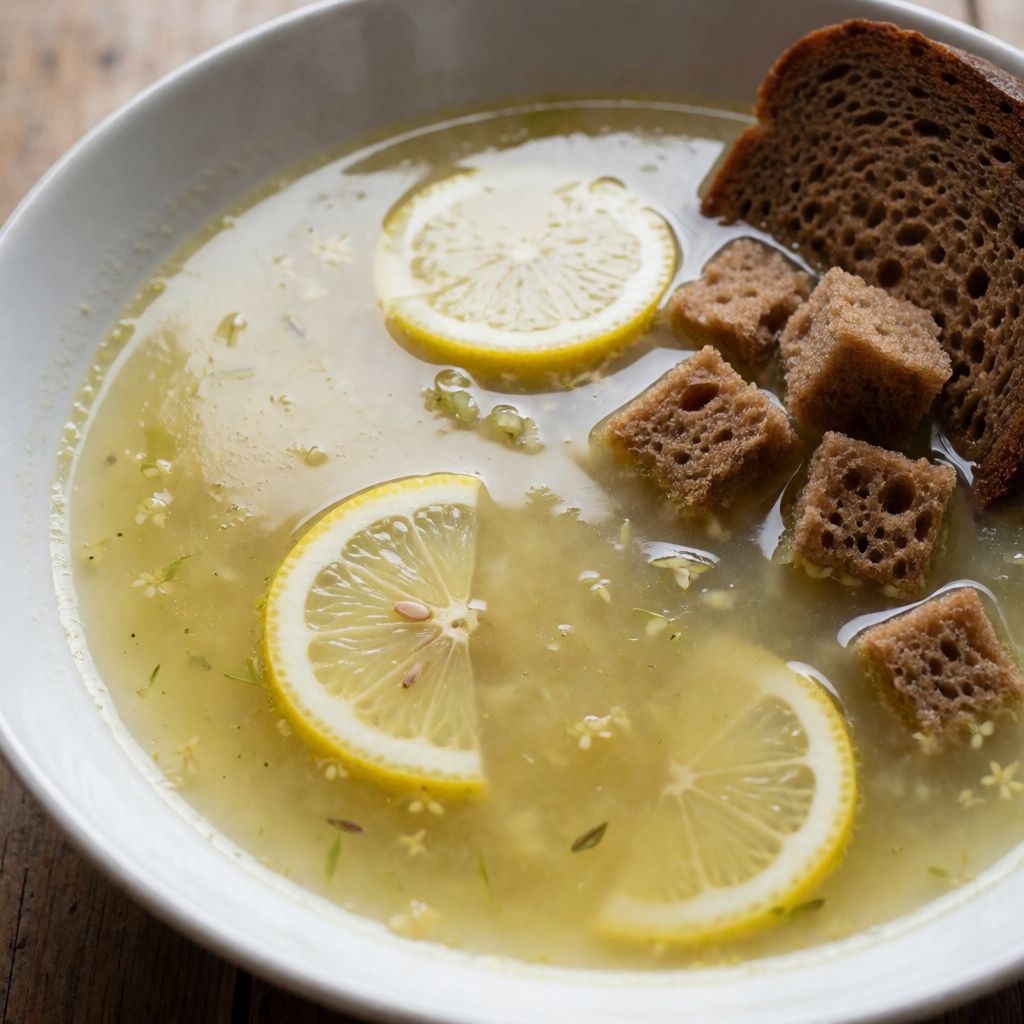
 AI photo
Elderflower Soup
A warm, lightly sweet soup made with elderflower cordial, served hot with a crunchy rye crumble, yogurt and diced apple.
Labels are worked out automatically from the ingredients and can be wrong. Check the packaging if it matters to you.
Ingredients
- 400 ml Elderflower Cordial concentrated and sweet
- 300 ml Water
- 20 g Cornflour
- 100 ml Water for mixing with the cornflour
- 0.5 pcs Lemon finely grated zest and juice
- 2 pcs Rye Bread slices
- 30 g Brown Sugar
- 100 ml Greek Yogurt 10%
- 1 pcs Apple finely diced








Steps
Pour the elderflower cordial and water into a saucepan and slowly bring to the boil.
In a small bowl, mix the cornflour with water, then stir it into the saucepan.
Bring back to the boil and simmer gently for 3 minutes.
3 minAdjust the consistency of the soup, adding more water or cordial if it's too thick, or a little more cornflour if it's too thin.
Stir in lemon juice and finely grated zest to taste, with a little extra sugar if you like.
Finely crumble the rye bread slices and mix with the brown sugar.
Bake the bread mixture in the oven at 150°C until crisp.
Serve the soup hot with Greek yogurt, the crunchy crumble and diced apple.
This is a Scandinavian-style sweet soup wearing an ordinary saucepan's clothes — hot, pale gold, thickened like a fruit compote and eaten with a spoon as a first course or a light pudding, not as the savoury bowl a British table expects before a roast. Elderflower cordial, the stuff you'd normally dilute for a summer drink, is used here concentrated, as the whole backbone of the dish. Nothing strange about that once you see it: the cordial is already sugar, acid and flower boiled down once. You're just un-diluting it and thickening it a second time.
What decides whether it works is the starch. Cornflour in water, heated past a certain point, swells and locks the liquid into a loose gel — that's the entire mechanism of this soup's body, no roux, no reduction by evaporation. Get that stage wrong and you either get lumps or a soup that pours like squash. The second thing that decides it is when the lemon goes in. Too early, while the pan is still at a hard simmer, and the acid starts breaking the very starch chains you just built, thinning the soup back out after you worked to thicken it. That's why it's stirred in near the end, off the boil.
The third thing — and this is where the dish earns its place as a proper course rather than a cordial you heated up — is contrast. Hot soup, cold-ish yogurt, and a crumble that's been baked, not just crumbled: three temperatures and three textures in one bowl. Take any of them away and you're left with sweetened water.
Elderflower cordial is doing the job a stock does in a savoury soup — it's the flavour base, not a flavouring. Buy one described as concentrated, meant for diluting 1 part to 4 or 5 with water; if yours is already a ready-to-drink squash, it's too weak and watery for this, and the soup will never thicken to more than a syrup no matter how much cornflour you throw at it. If you've made your own cordial from elderflower heads and lemon, even better — homemade batches tend to run stronger and more floral, which is exactly what you want when it's carrying a whole dish rather than topping up a glass.
Cornflour (cornstarch) is the only thing standing between "soup" and "flavoured water." Mix it with cold water first, always — stirring dry starch straight into something hot seals each granule's outside into a jelly skin before the water inside it can get in, and you get permanent floating lumps, not a problem that cooking longer fixes. Any pure starch does the same job: potato starch, arrowroot, even rice starch, all swell in hot liquid without adding their own taste. Flour will thicken it too, but it brings a cooked-dough flavour and a cloudier look that doesn't belong in something this clear and gold.
Lemon zest and juice aren't a garnish here, they're the correction. Cordial on its own is flat-sweet; the zest brings back the bitterness and aromatic oil that boiling drives off, and the juice cuts the sugar enough that the soup tastes of elderflower again instead of just sweetness. Add it to taste because cordials vary wildly in strength brand to brand — go in cautiously and build up, you can't take it back out.
Rye bread, crumbled fine and baked with brown sugar at a temperature gentle enough not to scorch the sugar before the crumb dries out, becomes the one crunchy thing in the bowl. The sugar melts, coats the crumb, and sets hard as it cools — that's a toffee shell on toasted bread, not a sprinkle of sugar sitting on top. Rye earns its place because it's dense and low-gluten, so it crumbles into coarse grit rather than fine dust the way a soft white loaf would. No rye in the cupboard — use any dark, dense, slightly sour bread; a soft sandwich loaf will just turn to crumbs that go soggy the second they hit the soup, and then you've lost your contrast.
Greek yogurt at 10% gives you fat and tang against all that sweetness — don't reach for a fat-free one, it has nothing to push back with and the soup will taste thinner for it. Any thick, soured, unsweetened dairy does the same job: crème fraîche, a good natural yogurt, even soured cream in a pinch. The diced apple is the one raw, cold, crisp thing in a bowl of soft and hot and crunchy — keep the dice small and leave the skin on if it's a firm variety, it holds its shape better and doesn't go mealy sitting in warm liquid for the few minutes between plating and eating.
Patience here isn't about long hours, it's about not rushing the thickening. Bring the cordial and water up slowly, let the starch do its swelling at a true simmer rather than a hard boil, and taste before you add more sugar — the cordial's sweetness creeps up as it reduces slightly, and you can easily tip it from pleasant into cloying if you season by habit instead of by spoon.