
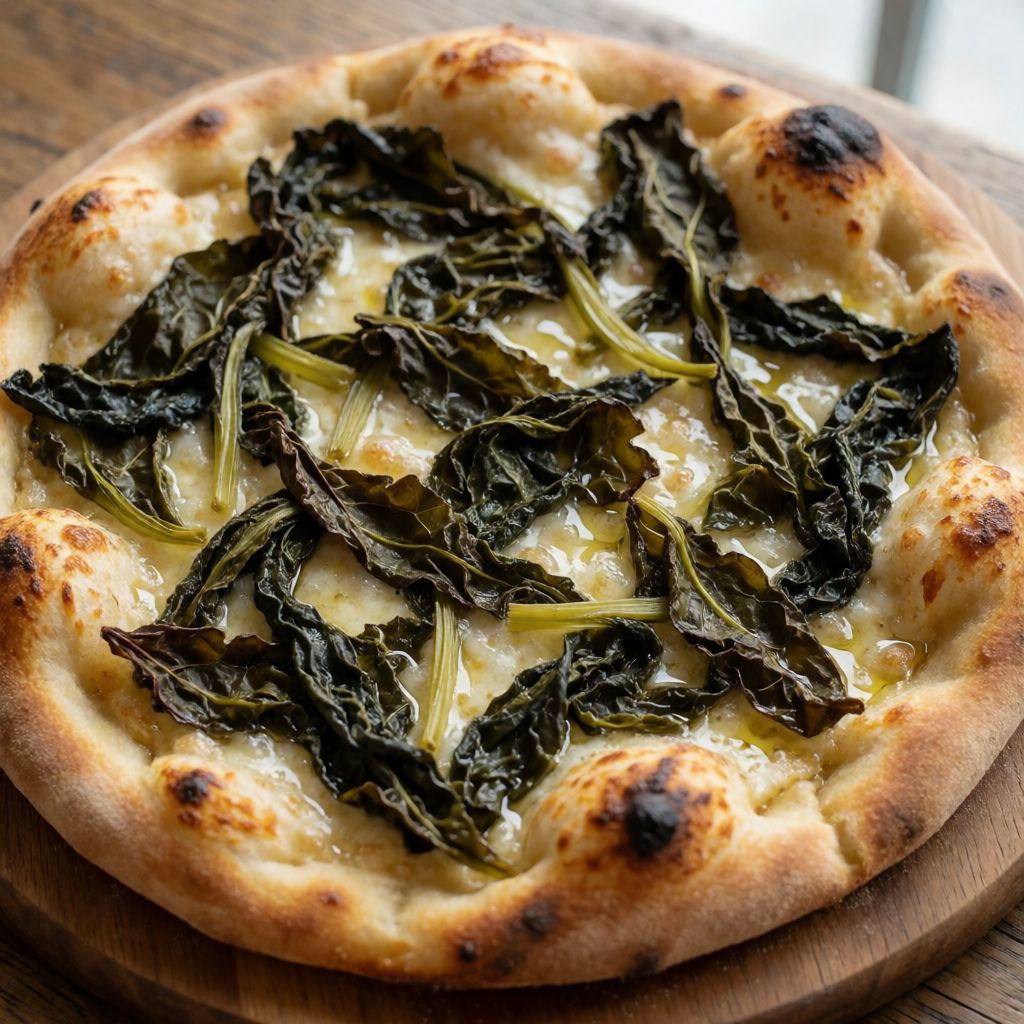
 AI photo
Escarole Pizza
A rustic double-crust pizza filled with braised escarole, garlic, chilli, anchovies and olives.
Labels are worked out automatically from the ingredients and can be wrong. Check the packaging if it matters to you.
Ingredients
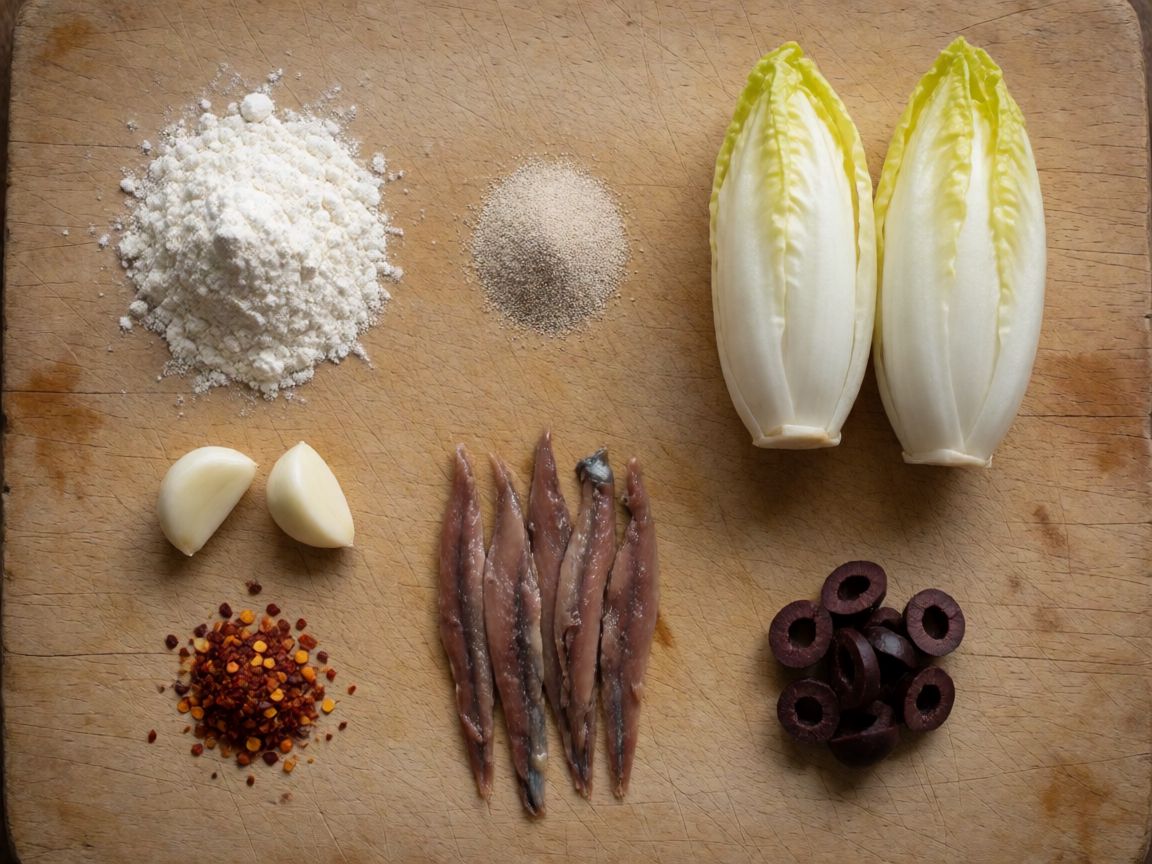
- 500 g Plain flour
- 5 g Yeast
- 10 g Salt
- 1 tbsp Olive oil
- 250-300 ml Water warm
- 2 pcs Escarole lettuce
- Olive oil to taste
- 2 clove Garlic
- 1 pcs Chilli flakes optional
- Salt to taste
- 4-5 pcs Anchovies in oil
- 150 g Black olives, pitted pitted








Steps
Pour the flour into a bowl, add the yeast dissolved in warm water, the olive oil and salt. Knead for 10 minutes until smooth and elastic.
10 minShape the dough into a ball and leave to rise, covered with cling film, for 2 hours.
120 minClean and wash the escarole lettuce.
In a pan, brown the garlic and chilli flakes, add the anchovies in oil and cook until they melt.
Add the escarole leaves and cook on high heat, stirring often.
If needed, add a little hot water, cook until the vegetable is tender, then add salt and the olives. Let it cool.
Divide the dough into two parts and roll out the first to about 30x20 cm.
Spread the cooled escarole filling over the dough, cover with the remaining dough, pinching the edges to seal.
Brush with olive oil, cut a few slits to let steam escape, and bake for 30 minutes at 200°C.
30 minLet it rest for at least 1 hour before serving.
60 min
This isn't a pizza in the sense you know it — there's no sauce showing, no cheese bubbling on top. Think of it closer to a Puglian focaccia ripiena, a filled flatbread, where the dough is a wrapper for a bitter-greens-and-anchovy stuffing, sealed shut and baked like a pasty that's forgotten it's a pasty. It comes from the same economics as most stuffed breads in southern Italy: escarole was cheap, bitter, and needed cooking down to be worth eating, and bread dough was the thing you already had rising on a Sunday. Wrapping the greens in dough meant one oven slot did the work of two dishes.
What decides whether it works is moisture control, twice over. First in the filling: escarole holds a lot of water, and if you tip it into the dough still wet from cooking, the base turns to paste and never crisps — this is why the recipe tells you to let it cool, because cooling isn't about temperature for your hands, it's about the steam finishing its escape before the lid goes back on. Second in the seal: pinch the edges properly or the filling's residual moisture will find the gap and leak out as the bread bakes, leaving you a dry patch of dough with nothing on it and a scorched puddle on the tray.
Flour, yeast, salt, oil, water — this is as plain a dough as it gets, no eggs, no sugar, no milk, because it's built to carry a wet, garlicky filling, not to taste of much on its own. Plain flour is right here; you don't want the extra gluten strength of a strong bread flour fighting you when you're trying to roll it thin and then press two sheets together at the edges. 300 ml water rather than 250 is the safer bet in a UK kitchen — your flour here tends to be slightly lower in protein than Italian tipo "00", and it drinks less, so start at 250 and add only if the dough still tears when stretched instead of giving.
Ten minutes of kneading by hand sounds like a lot until you remember what it's for: gluten doesn't form on contact with water, it builds under repeated stretching, strand by strand, which is why a dough kneaded for two minutes tears like damp paper and one kneaded properly stretches like a drum skin. Two hours covered isn't a guess at a nice round number — it's the lower bound for a modest 5g of yeast to double a kilo-ish of dough at normal room warmth, and in a British flat in winter with the heating off, it may well want longer. Judge it by the dough, not the clock: press a finger in, and if the dent springs back slowly, leaving a soft impression, it's ready; if it snaps back instantly, give it more time.
Escarole is a chicory, not a lettuce in the soft, watery sense, and that matters — it's structured enough to survive hard frying without collapsing to mush, and bitter enough that garlic, chilli and anchovy are doing necessary work, not just flavouring for its own sake. If you can't find it, any robust chicory-family green does the job on the same logic — radicchio, curly endive, even a mix of chard and a handful of rocket for bite. What you're looking for is a green that holds its shape in the pan and has enough character to stand up to anchovy, not something delicate that'll dissolve into the oil.
The anchovies aren't a fish course, they're a seasoning mechanism: cooked gently in oil until they "melt," they stop being distinct fillets and become a savoury backbone the greens can lean on, the way Parmesan rind works in a soup. If you genuinely can't use fish, a few capers mashed with extra salt gets you some of that same salty depth, though it won't be the same dish — be honest with yourself that it's a substitution, not an equivalent.
Any oil with no smell of its own works for cooking the garlic and greens — a flavourless light oil at a pinch — but olive oil earns its place here specifically because its slight bitterness and grassiness sit alongside the escarole's own bitterness instead of fighting it; this is one of the few times "any neutral oil will do" is a worse answer than usual.
The hour's rest at the end before cutting is not laziness dressed up as a step — it's the same logic as resting a joint after the Sunday roast. Cut into it hot and the filling, still steaming, runs straight out the first slit you make; given the hour, the moisture redistributes and settles, and you get a clean slice instead of a puddle on the board. Patience is the ingredient nobody lists in grams, but it's doing as much work here as the yeast.