
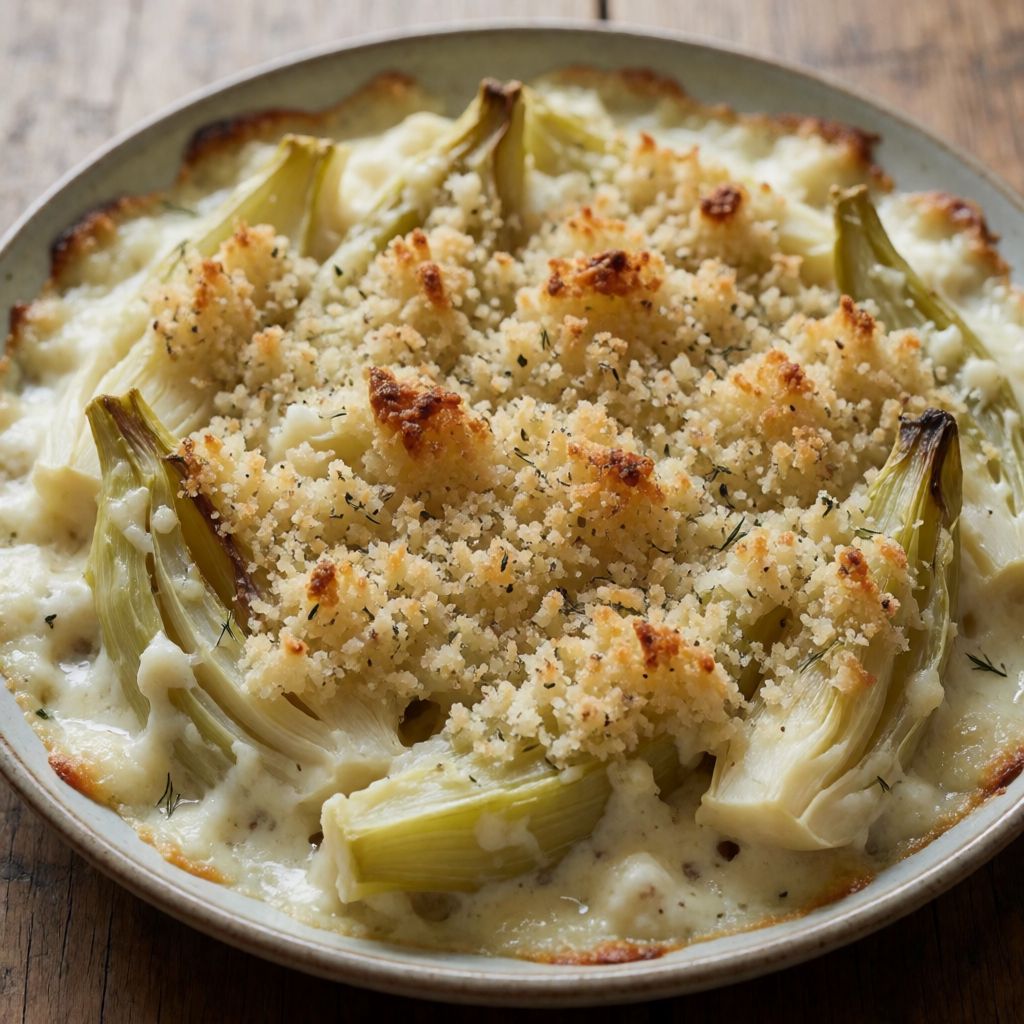
 AI photo
Fennel Bake
A creamy baked fennel dish layered with béchamel sauce and Parmesan.
Labels are worked out automatically from the ingredients and can be wrong. Check the packaging if it matters to you.
Ingredients
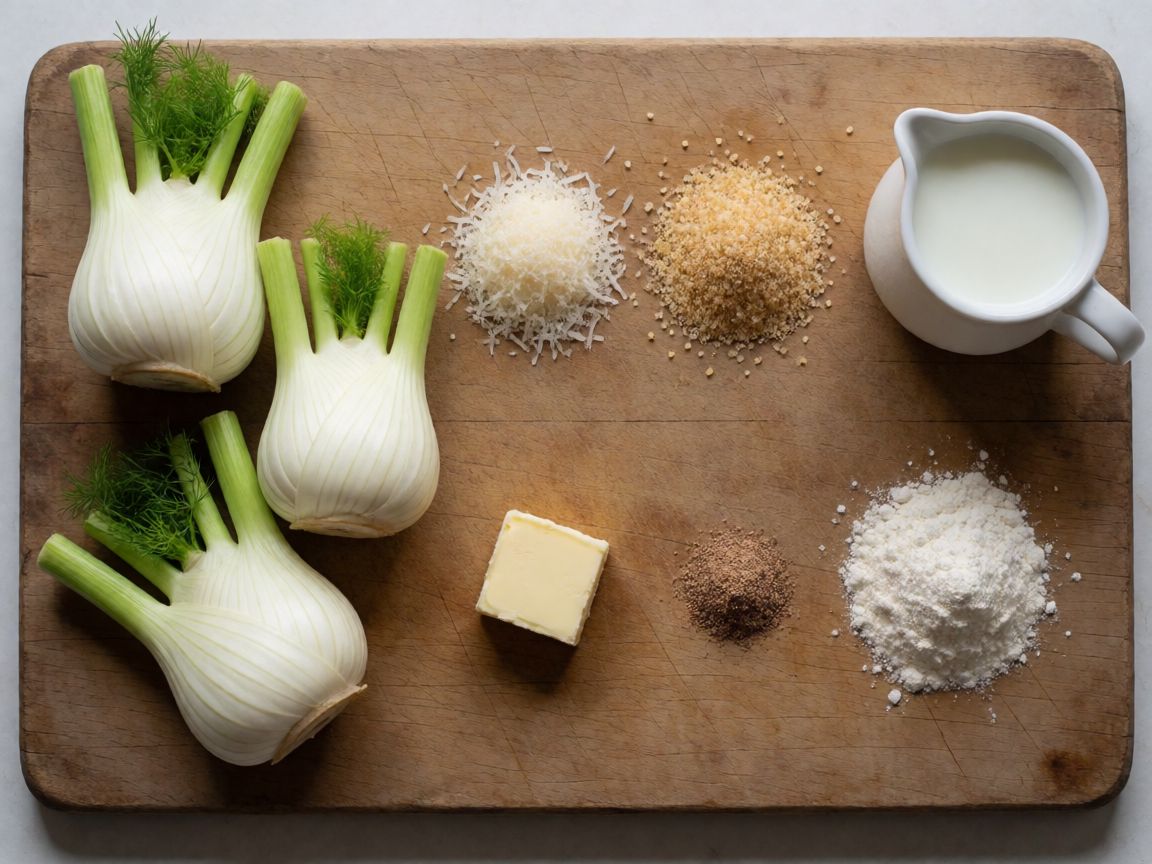
- 3 pcs Fennel
- 80 g Parmesan
- Breadcrumbs to taste
- 500 ml Milk
- 50 g Butter
- 50 g Plain flour
- Nutmeg to taste
- Salt to taste
- Vegetable oil for greasing, to taste









Steps
Melt the butter in a saucepan, add the flour and cook for a minute, stirring constantly.
1 minGradually pour in the milk, stirring to avoid lumps, and cook over medium heat until thickened.
Season with nutmeg and salt to taste.
Trim the fennel and slice it about half a centimetre thick.
Put the fennel into a pan with plenty of water, add a little salt and bring to the boil.
Simmer the fennel for about 5-6 minutes.
6 minPour a little oil into a baking dish and sprinkle the base with breadcrumbs.
Arrange the first layer of fennel, then spread a layer of béchamel sauce over it.
Arrange a second layer of fennel and sprinkle with Parmesan.
Keep alternating layers of béchamel, fennel and grated cheese, finishing with a top layer of Parmesan or breadcrumbs.
Heat the oven to 200°C and bake for about 20 minutes.
20 min
Fennel gets treated like French gratin dauphinois here — bulbs standing in for potato, béchamel doing the same binding job it does in a dozen other dishes you already know. That's not an accident. Béchamel is one of the handful of "mother sauces" because it solves a real problem: cheese sauce made straight with cream or milk alone either curdles or just slides off everything. Flour cooked in butter first (a roux) coats each starch grain in fat so it can't clump when the liquid hits it, and it thickens the milk into something that will actually sit on the fennel instead of pooling at the bottom of the dish.
What decides whether this works is not the oven, it's the pan of boiling water before it. Fennel raw is dense and faintly bitter — that aniseed edge comes through sharp and a bit medicinal. A few minutes in salted water softens the fibre and mellows the flavour into something sweeter, closer to cooked celery with a whisper of liquorice. Skip this step, or rush it, and the oven will never catch it up: 200°C for twenty minutes browns the top beautifully while the inside of a raw-cut bulb stays stubbornly raw. Bake is for colour and heat-through, not for cooking the vegetable.
Some say you can swap fennel for celeriac or leeks and get the same dish. No — you'll get a perfectly fine dish, just not this one. The whole point of using fennel is that faint anise note surviving the blanch and threading through the cream and Parmesan. Lose the fennel character and you've made a different gratin with the same sauce.
Fennel: three bulbs for four people sounds generous until you remember how much water cooks out of it and how thin you're slicing — half a centimetre, so it goes translucent-soft without turning to mush in the boiling water. Choose bulbs that are tight and pale, not browning at the edges or splitting — a bulb that's starting to flower in the middle (you'll see a woody core when you cut it) has gone past its best and will stay fibrous no matter how long you simmer it.
Parmesan is here for two things: salt and that nutty, slightly sulphurous depth that plain cheddar won't give you, plus it browns on top into a proper crust rather than just melting flat. Any firm, well-aged hard cheese that grates fine and doesn't turn oily under heat will do the same job — a mature Gran Padano, or in a pinch a strong farmhouse cheddar grated fine, though you'll lose some of that savoury edge.
Butter and flour in equal-ish weight (50g each here, with 500ml milk) is the roux ratio that gives you a medium-thick sauce — thick enough to layer, not so thick it sets like paste. Cooking the flour in the butter for that first minute isn't decorative: raw flour tastes of raw flour, and a sauce that hasn't had the flour cooked out will taste chalky under all that cheese. Milk goes in gradually and stirred, not poured and left, because that's what stops lumps — cold liquid meeting hot roux all at once seizes before you can work it in.
Nutmeg is traditional in béchamel for a reason beyond habit — a little grated nutmeg cuts through the flatness of plain milk-and-flour and gives the sauce a warmth that plays well against the aniseed in the fennel. You don't need much; it should be a background note you'd struggle to name blind, not a flavour in its own right.
Breadcrumbs on the base and optionally the top are doing a mechanical job, not a flavour one: they stop the bottom layer sticking to the dish, and on top they give you a drier, crunchier contrast to the soft sauce underneath — useful if you're finishing with breadcrumbs instead of a last layer of Parmesan, which is really just a question of whether you want that final texture crisp-dry or crisp-cheesy.
On patience: don't rush the roux stage by dumping all the milk in at once to save time, and don't skip the fennel's time in the water because the oven feels like it'll finish the job — it won't. Twenty minutes at 200°C is enough to colour the top and heat the layers through once everything underneath is already properly cooked, not a substitute for that work.