
 AI photo
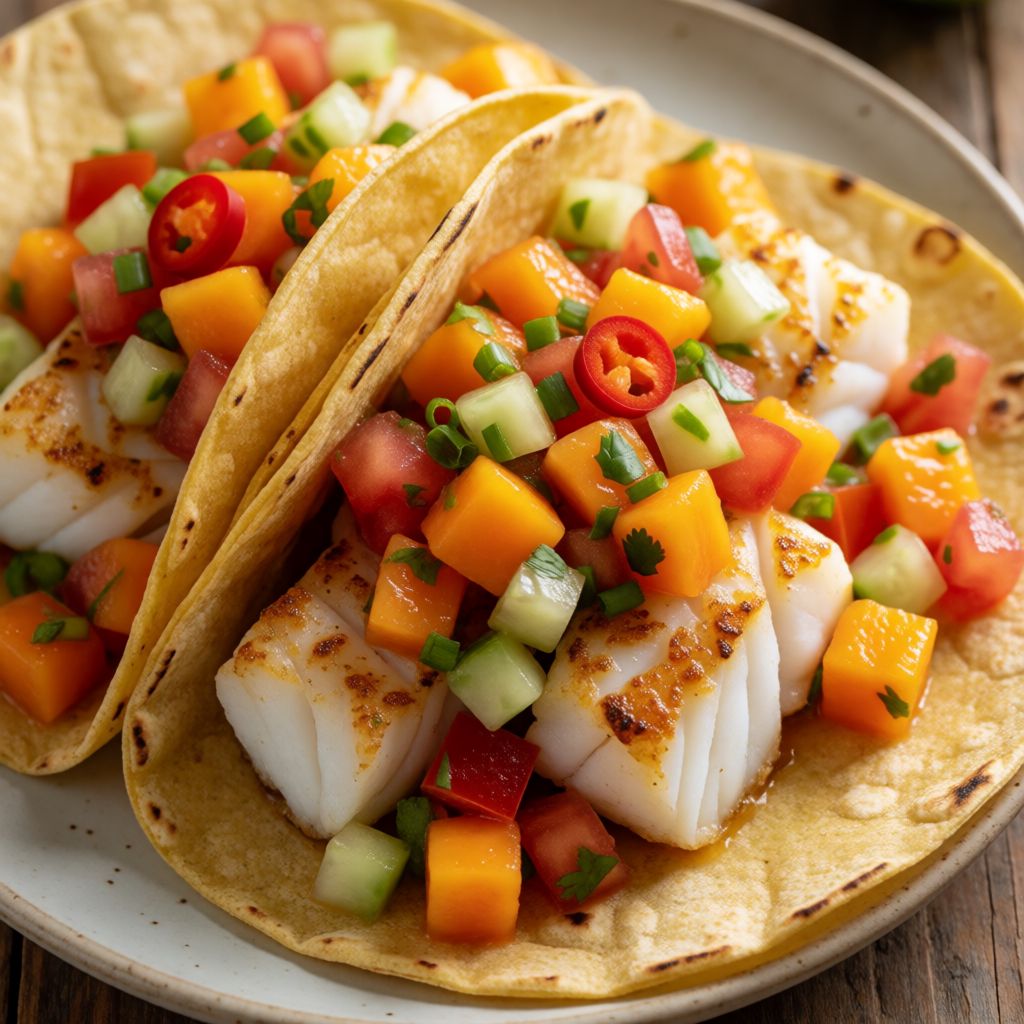
Fish Tacos with Cod and Mango Salsa
Crispy baked cod tacos with fresh mango salsa, avocado and baby spinach.
Labels are worked out automatically from the ingredients and can be wrong. Check the packaging if it matters to you.
Ingredients
- 1 pcs Mango finely diced
- 5 pcs Tomato cut into wedges
- ½ pcs Cucumber finely diced
- 1 pcs Spring onion finely chopped
- 1 bunch Coriander finely chopped, fresh
- ½ pcs Red chilli finely chopped
- 1 pcs Lime juice and finely grated zest
- 800 g Cod cut into nice pieces
- 25 g Breadcrumbs dried
- ½ pcs Lemon finely grated zest
- 1 tsp Mint finely chopped, fresh
- Salt
- Black pepper fresh
- 8 pcs Tortillas small
- 60 g Spinach
- 2 pcs Avocado diced
- 1 bunch Coriander fresh













Steps
For the salsa, mix the diced mango, tomato wedges, diced cucumber, spring onion and chilli with the chopped coriander.
Season with lime juice, lime zest, salt and pepper.
Put the breadcrumbs, lemon zest, salt, pepper and mint into a mini chopper and blend until smooth.
Pat the fish dry and coat it evenly with the crumb mixture.
Bake the fish in an ovenproof dish in an oven preheated to 175°C (fan) for 16–18 minutes.
17 minCheck the fish is cooked through and remove from the oven.
Warm the tortillas in a dry hot frying pan or in the oven.
To serve, place the baked fish, baby spinach and avocado on the warm tortillas, scatter with coriander and serve with the mango salsa.
This is a dish built on two separate decisions: what happens to raw fish in a hot oven, and what happens to raw fruit and veg left alone with salt and lime for ten minutes. Get those two things right and the tortilla is just a vehicle. Get them wrong and no amount of coriander on top will save you.
Cod is a lean, flaky fish — very little fat to render, very little connective tissue to melt. That means it goes from translucent to cooked to dry in a narrow window, and there's no basting it back from overcooking the way you can rescue a chicken thigh. The crumb coating isn't decoration — it's insulation. A layer of toasted breadcrumb, lemon zest and mint sits between the oven's heat and the flesh, slowing down how fast the outside cooks relative to the inside, so the middle has a chance to finish before the outside turns to cardboard. Some say fish needs a wet batter to stay moist — no, because batter traps steam against the crust and goes soggy the second it leaves the oven; a dry crumb stays crisp and does the insulating job without it.
175°C fan is not a random number — it's hot enough to toast crumb and firm up protein at a pace you can actually watch, not so hot that the outside scorches before the centre of a thick piece catches up. You're not counting to seventeen and stopping. You press the thickest piece: it should flake apart in clean segments along the natural grain, not mush, not resist. Sixteen minutes is the earliest you check, not the moment you're done.
Cod: look for pieces of even thickness, because an oven doesn't know mercy — a thin tail end and a thick loin end on the same tray will finish at different moments, and you'll either undercook one or ruin the other waiting for it. Any firm white fish with that same low-fat, flaky structure will do the same job — haddock, pollock, coley. Avoid anything oily like salmon here; it changes the whole character of the dish, because oily fish doesn't need the crumb's insulation the same way and the flavours were built around something neutral.
Breadcrumbs, dried: their job is surface area and crunch, nothing more romantic than that. If you've no dried breadcrumbs, stale bread blitzed in a processor does the same work — the "dried" part matters because fresh breadcrumbs carry moisture that steams under the oven heat instead of toasting. Panko works too and gives you more crunch for less density, since its shards are coarser and catch more air.
Lemon zest and mint in the crumb: zest gives you fragrant oil without added liquid — that's the whole reason zest is used instead of juice in a dry coating, juice would turn your crumb to paste. Mint here is doing a cooling, green note against hot fish and sweet mango; if you haven't got fresh mint, a small pinch of dried will do at a fraction of the quantity, since drying concentrates it.
Mango: you want one that gives slightly under the thumb, not rock hard and not collapsing — a hard one won't release its sugar when it macerates with the lime and salt, a soft one turns to mush under the dicing knife. No mango in the shop, or out of season and flavourless? Ripe peach or even pineapple gives you the same sweet-acid counterweight to the chilli and the fish — the mango isn't sacred, it's just doing a sweetness job.
Chilli and spring onion: these exist to stop the salsa being only sweet. A salsa with mango and no heat is a fruit salad wearing a disguise. Deseed the chilli if you want warmth without the burn sitting at the back of your throat for the whole meal — the heat lives mostly in the membrane, not the flesh, so that's a genuine lever, not folklore.
Avocado and spinach go in raw and last, because they're there for contrast, not transformation — cold, soft avocado against a hot crumbed fillet, a few leaves of spinach for the bitterness cress or rocket would also supply. Don't dice the avocado until you're assembling; it browns the moment it meets air, and nobody's salsa needs a grey streak through it.
On the hob limits: a domestic oven's fan setting runs hotter and more even than a non-fan one, which is why 175°C fan is specified rather than a generic "180°C" — if your oven has no fan, push it up roughly 15–20 degrees and keep the same visual check, because the number on the dial means less than what the fish is doing. And warming the tortillas in a dry frying pan isn't an optional flourish — a cold tortilla straight from the packet is stiff and cracks when you fold it; thirty seconds of direct heat on each side makes it pliable, because the starches in the flour soften with heat the same way they do in any flatbread.