
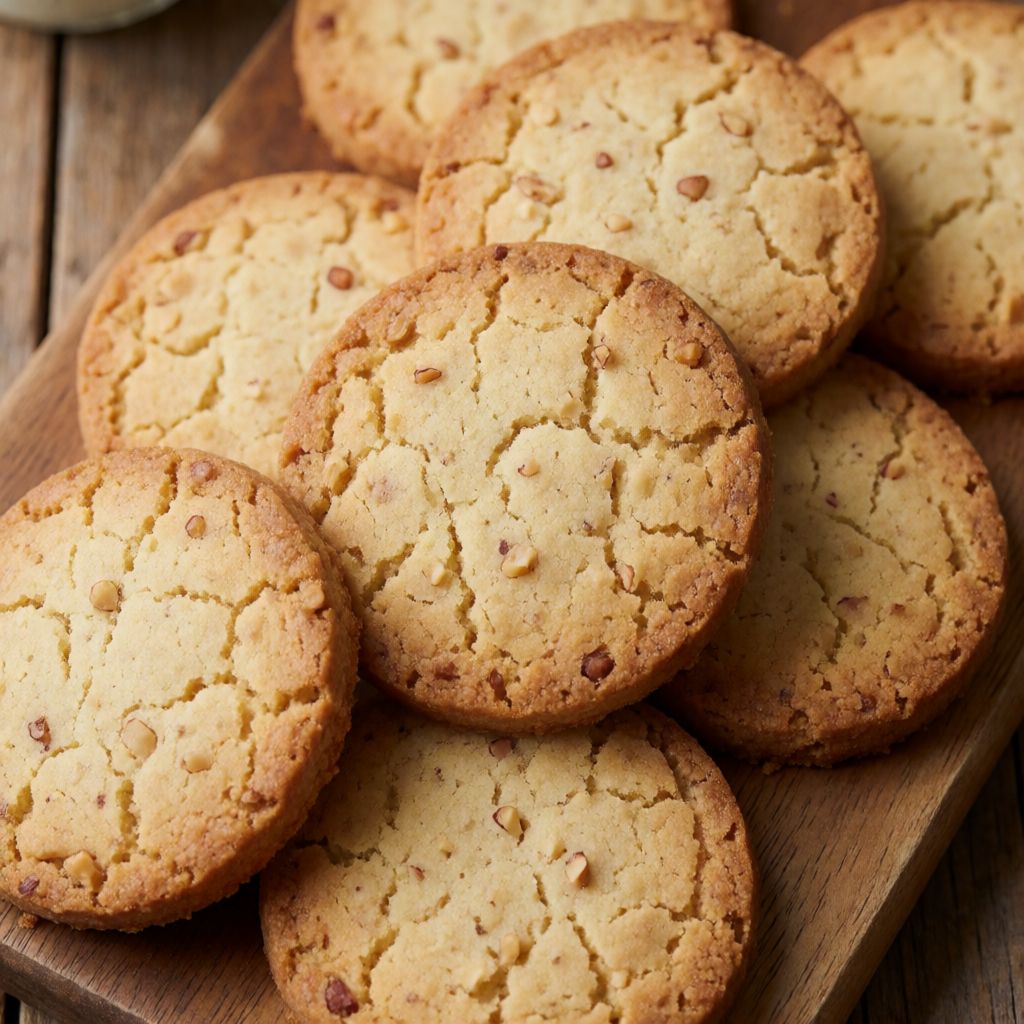
 AI photo
Ginger and Hazelnut Biscuits
Classic spiced biscuits made with ginger and toasted hazelnuts, perfect with a cup of tea.
Labels are worked out automatically from the ingredients and can be wrong. Check the packaging if it matters to you.
Ingredients
- 300 g Plain flour
- 1 tsp Baking powder
- 120 g Caster sugar
- 0.5 tsp Ginger ground
- 1 tsp Vanilla powder
- 150 g Butter soft, at room temperature
- 1 pcs Eggs
- Water cold, as needed for the dough
- 1 pcs Egg white whisked
- 25 g Hazelnuts
- 25 g Pearl sugar











Steps
In a bowl, mix the flour, baking powder, sugar, ginger and vanilla powder well. Rub the butter into the flour mixture until crumbly. Beat the egg and knead into a dough.
Leave the dough in the fridge for at least 1 hour.
60 minToast the hazelnuts in a dry hot pan until the skins start to crack.
Wrap the nuts in a clean cloth and rub to remove the skins. Then chop the nuts finely.
Roll out the dough on a lightly floured surface and cut out biscuits onto a baking tray lined with parchment.
Brush with egg white and sprinkle with the finely chopped nuts and pearl sugar.
Bake in a preheated fan oven at 175°C for about 9-12 minutes.
11 minTake the biscuits out of the oven and let them cool on a wire rack.
This is a short-crust spice biscuit — flour, butter, sugar, egg, rubbed together into a sandy dough rather than a creamed one. That order matters more than the ginger. Rubbing cold-ish butter into flour coats the flour particles in fat before any liquid touches them, which is what keeps the biscuit short — meaning it shatters instead of bending. If you creamed butter and sugar first the way you would for a sponge, you'd whip in air and build gluten strands when the egg and flour meet, and you'd get something closer to cake than snap.
What decides whether it works is the rest in the fridge and the thickness you roll to. An hour isn't a ritual — it's the butter re-setting to a workable firmness and the flour hydrating evenly, so the dough rolls without tearing or sticking stubbornly to your worktop. Skip it and you'll fight the dough the whole time, pressing extra flour in to stop it sticking, which toughens the final biscuit. Roll it too thin and it'll be a crisp, over-browned wafer by the time the sugar on top has caramelised; too thick and the centre stays pale and a bit raw-tasting while the edge is already dark.
The toasted hazelnut and pearl sugar topping is doing a specific job, not just decoration. Toasting the nuts before they go anywhere near the oven again is what gives you actual hazelnut flavour — raw nuts taste mostly of nothing, roasting is what develops the oils into that rounded, almost cocoa-adjacent note. The egg white brushed on first is glue, plain and simple: without it the nuts and pearl sugar would mostly fall off onto the tray.
Flour is just the structure here — plain flour, not strong bread flour, because you don't want much gluten developing. Baking powder is a small lift, not a rise: these aren't meant to puff, just to stay slightly tender rather than rock-hard. If your baking powder has sat in the cupboard since last Christmas, test it in a cup of hot water first — no fizz, no lift, and your biscuits will be flatter and denser than they should be.
Butter has to be properly soft, not melted and not fridge-cold straight from the packet. Cold butter won't rub into the flour, it'll just sit there in lumps; melted butter turns the whole thing greasy and the texture goes from "short" to "flat and oily." Room temperature in a British kitchen in winter can mean genuinely cold — if your butter resists a light push with a finger, give it more time rather than the microwave, which melts the edges before the centre softens.
The sugars do two different jobs and shouldn't be swapped for each other. Caster sugar inside the dough dissolves into the mix smoothly, giving an even sweetness without grit. Pearl sugar on top stays as visible, crunchy beads through the bake — that's its entire purpose, texture and shine, not flavour depth. If you can't find pearl sugar, crushed sugar cubes or a coarse demerara sprinkled on top get you closer than caster would; caster on top just melts flat and disappears.
Ground ginger and vanilla powder are both there for a gentle warmth, not heat. Vanilla powder is less common on UK shelves than vanilla extract — if you only have extract, add it with the egg rather than with the dry ingredients, since it's a liquid and mixing it into flour directly does nothing useful. Ground ginger loses potency sitting in a jar for months; if yours is old and smells faint when you open the lid, use a touch more rather than trusting the gram measure blindly.
The egg itself is binder, not leavening — it pulls the crumbly, rubbed-in mixture into a dough you can actually roll. The separate egg white for brushing is a different job entirely: it dries to a thin, slightly glossy, tacky-enough-to-hold-nuts layer. Don't use the whole egg for brushing — the yolk makes the surface go deep brown too fast in the oven, before the biscuit itself has set.
Hazelnuts toasted and skinned by hand in a cloth is the traditional route because peeled hazelnuts cost more and bitter, papery skins ruin the taste otherwise — rubbing them off in a tea towel is just the cheap, low-tech way round buying pre-blanched ones. If you've got blanched hazelnuts already, skip the cloth business entirely and just toast them straight — the skin removal step existed to solve a problem you no longer have.
On a standard UK fan oven, 175°C is where sugar on top starts to caramelise and the biscuit edges colour without the centre staying doughy — but ovens run hot or cool by 10-15 degrees depending on the dial's honesty, so go by colour at the edge, not the timer. Nine minutes in one oven is eleven in another; the first time you make these, start checking at nine and don't walk away.
If you don't have an electric mixer or just prefer hands, rubbing butter into flour by fingertip is genuinely better here — you feel the crumb becoming sandy, which a machine will happily blitz past into a paste. That's patience doing real work, not an extra step for show: five slow minutes with cold fingers beats thirty seconds of a food processor turning butter to grease.