
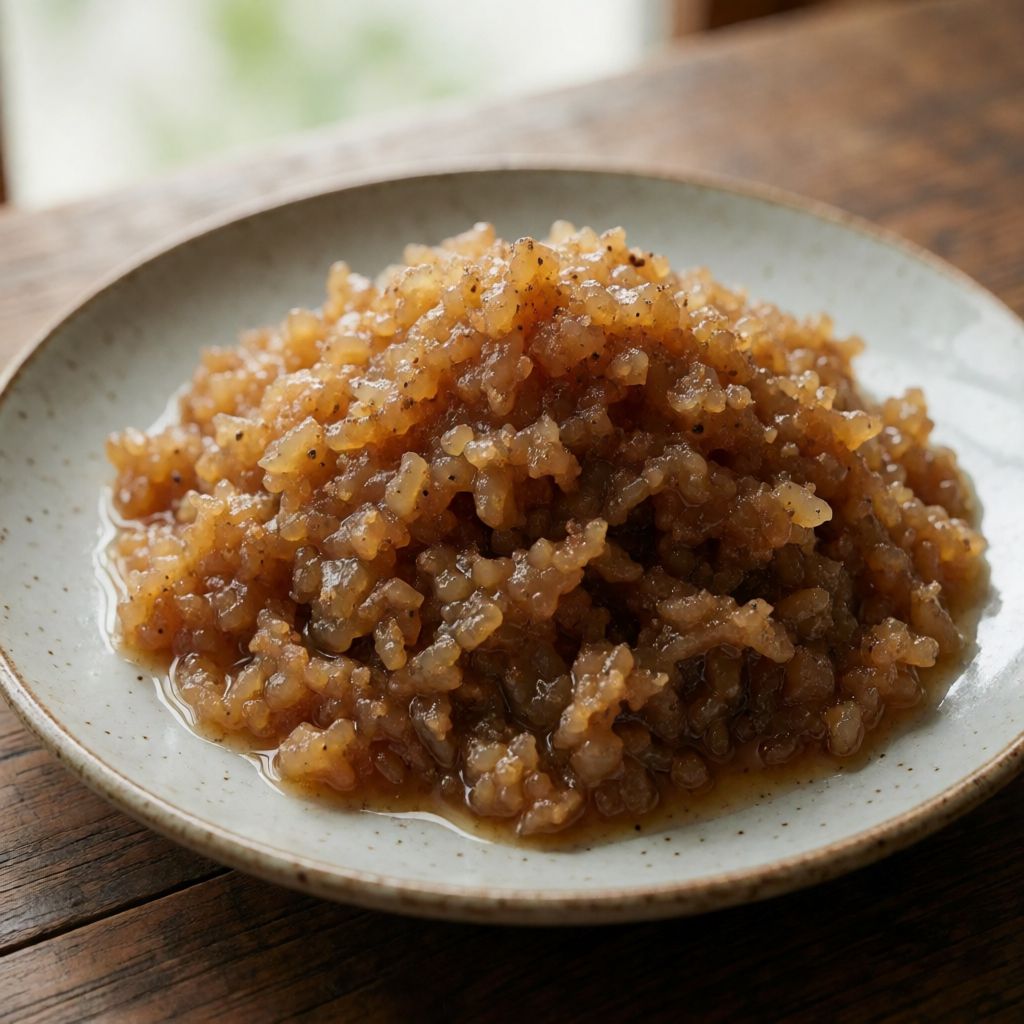
 AI photo
Spiced Ginger Syrup for Lattes and Tea
A warming spiced ginger syrup to flavour your lattes and tea.
Labels are worked out automatically from the ingredients and can be wrong. Check the packaging if it matters to you.
Ingredients
- 135 g Sugar
- 250 ml Water
- 1 tbsp Glucose syrup
- 1 tbsp Ginger ground, or thin slices of fresh ginger (approx. 10 g)
- 1 pinch Black pepper freshly ground
- 0.5 tsp Cardamom ground
- 1 tsp Cinnamon ground





Steps
Put all the ingredients in a saucepan and bring to the boil over medium heat.
5 minSimmer for about 15-30 minutes.
22 minTest the syrup: take half a teaspoon of syrup, let it cool to room temperature and check that it has a honey-like consistency — if it's too thin, keep simmering.
2 minIf the syrup turns out too thick, simmer it again over low heat, adding a little water (a few millilitres).
2 minStore the syrup in the fridge in a sealed container for up to 2 weeks.
This is not really a recipe, it's a method for holding spice in suspension in sugar so you can spoon warmth into your tea or coffee without reaching for jars of five different spices every morning. The whole thing hangs on one mechanic: water boiling off until what's left is thick enough to cling to a spoon instead of running off it. Everything else — the pepper, the cardamom, the cinnamon — is just along for the ride while that happens.
The heat you start with matters less than people think. "Medium" here means get it to a boil without scorching sugar that's still sitting undissolved on the bottom of the pan — that's the only job it has. Once it's bubbling, you drop it down to a simmer, because a hard boil near the end throws syrup up the sides of the pan, it dries there, and those dried crystals are exactly what seeds the whole batch into a grainy, sandy mess later. Sugar syrup doesn't fail because you did something wrong in the middle — it fails at the edges, literally, where it's splashed and dried.
Sugar and water are the syrup — everything else is seasoning dissolved into it. 135 g sugar to 250 ml water, reduced down, gives you a jar's worth, not one cup's worth, which is why the "serves 1" on the card is a technicality: you're making a concentrate you'll spoon into cup after cup over two weeks, not a drink in itself.
Glucose syrup is the one ingredient that looks decorative and isn't. Sucrose molecules, left alone in a cooling syrup, like to lock arm in arm into crystals — that's what makes old honey go grainy and what makes a neglected sugar syrup turn gritty in the jar. Glucose is a different-shaped molecule; it gets in between the sucrose and physically blocks that locking. That's the whole reason it's there, and it's why you shouldn't skip it on the grounds that "it's just more sugar." If you haven't got it, golden syrup or light corn syrup do the identical job — any syrup that isn't pure sucrose will do, because the criterion is interrupting the crystal lattice, not any particular brand on the shelf. Honey works too, but it brings its own flavour along, and it's a touch more acidic, which pushes the finished syrup slightly thinner — no bad thing if you're short on patience.
Ginger, fresh or ground, is giving you heat, not sweetness, and it's worth knowing which one you're buying when you shop. Fresh ginger sliced thin releases its oils slowly and you can lift the slices out at the end, leaving a clean amber syrup. Ground ginger dissolves into the liquid itself and stays there — fine, even better for a muddier, chai-shop depth, but it means the syrup will always look a shade darker and slightly cloudy. Ten grams either way is a light hand; if your ginger's old and fibrous, use a bit more rather than simmering longer, because simmering longer concentrates sugar, not flavour.
Cardamom, cinnamon and black pepper are doing three different jobs, not just "spice." Cardamom's aromatics are mostly oil-soluble and need the heat and the time to coax them into the water at all — this is why fifteen minutes is a floor, not a target, if you want to actually taste it rather than just see green specks. Cinnamon gives sweetness-adjacent warmth almost immediately. The pepper is the odd one — it's there for a faint catch at the back of the throat once the drink's gone down, the same reason a pinch turns up in some mulled wine and spiced bread recipes. Leave it out and the syrup is still good, just rounder, with nothing to push against the sweetness.
Why bother making this instead of buying a bottle of flavoured syrup at the shop? Because what you're buying there is mostly sugar water with a few pence of flavouring and a brand name doing the rest of the work on the price tag. Here the ratio is yours to adjust, the spice load is yours to taste, and the whole batch costs you less than one bottle. It keeps a fortnight in the fridge, sealed, not because of any magic in cinnamon but because a syrup this concentrated is inhospitable to mould — not immune to it, inhospitable, which is why "sealed container" matters more than people assume: every time you dip an open jar with a wet spoon, you're giving mould a foothold it wouldn't otherwise have.
Stir it into milky tea — British tea, with milk already in it — and the fat in the milk will carry the cardamom and cinnamon oils further across your tongue than they'd travel in black tea or a straight espresso. That's not folklore, that's just what fat does to aromatic oils. One spoonful is a start; taste before you add a second.