
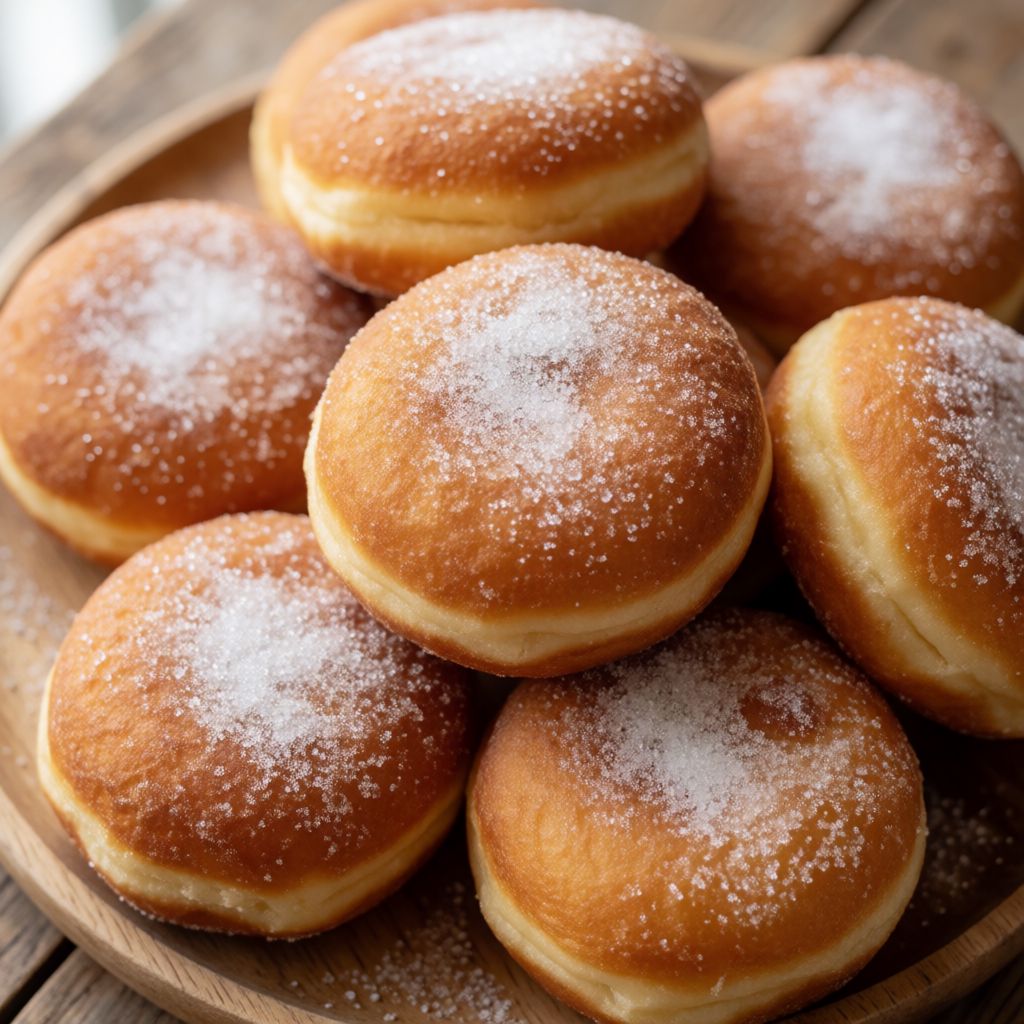
 AI photo
Gluten-Free Graffe
Gluten-free graffe are soft Italian-style doughnuts, deep-fried and rolled in sugar.
Labels are worked out automatically from the ingredients and can be wrong. Check the packaging if it matters to you.
Ingredients
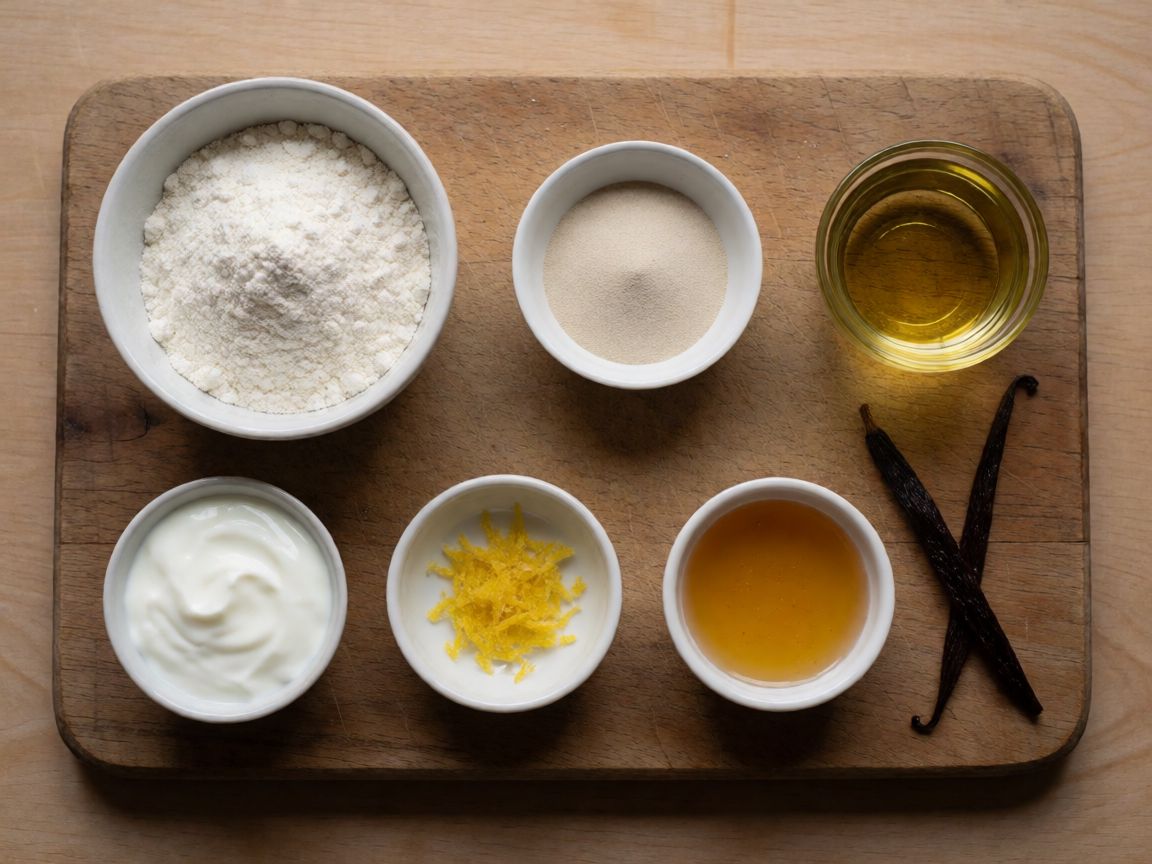
- 500 g gluten-free flour mix
- 16 g yeast
- 50 g yogurt
- 370 g water
- 50 g acacia honey
- 6 g salt
- 30 g vegetable oil
- 1 pcs lemon or orange zest zest of one fruit
- peanut oil as needed for deep-frying




Steps
Dissolve the yeast in the honey, then add the water, yogurt, sifted flour and lemon or orange zest. Mix vigorously, then add the salt and oil.
Knead for a few minutes, transfer the dough to a greased bowl, shape into a ball and cover with cling film.
Leave to rise in a switched-off oven with the light on.
48 minTurn the dough onto a floured surface, divide into 15 portions of 60-65 g each, shape into balls and place on parchment.
Using a ring cutter, flatten each ball so the dough spreads beyond the edges, carefully making a hole in the centre.
Cover with cling film and leave for a second rise in a switched-off oven with the light on.
55 minHeat the oil in a pan to 170°C. Test readiness with a small piece of dough.
Fry each graffa, turning constantly, until golden brown.
4 minPlace the graffe on paper towels and roll them in sugar.
Graffe are the doughnuts Naples fries for Carnevale: a ring of yeasted dough, deep-fried, rolled hot in sugar while it can still hold a grain. Take away the wheat flour and you take away the thing that normally does the holding — gluten, the stretchy net that traps the gas yeast makes. A gluten-free mix has no net. It has starches (rice, maize, tapioca, whatever the bag contains) and almost always a gum — xanthan or guar — standing in for gluten's job of binding water and air together. That's the whole shift in logic: you're not building elastic strands when you knead this dough, you're hydrating starch and distributing a gum evenly so it can do its one trick, which is swell and gel and hold a bubble where gluten would have stretched around one.
Some say gluten-free dough can't really rise, it can only puff from the baking powder already in the mix. No — yeast still eats sugar and makes carbon dioxide exactly as it would in a wheat dough; the only question is whether something is there to hold the gas in place long enough to see it. The gum does that job, just less forgivingly than gluten does. It won't stretch indefinitely and it won't repair a tear. That's why this dough gets handled gently and twice: once to rise as a ball, once after shaping, and never pushed around more than it needs.
What decides whether these come out right is less the mixing and more two moments: how the second proof is judged, and what the oil is doing when the ring goes in. Everything before that is preparation; those two are where the dish is actually made or lost.
On the flour: any proper gluten-free bread-mix blend works, the kind that already contains a gum, because a straight rice flour or straight almond flour on its own won't gel enough to trap gas — you'd get a flat, heavy puck, not a ring that springs. If your mix doesn't list xanthan or guar gum on the packet, add a small pinch yourself; it's cheap insurance against a dough that just won't hold its shape once it's cut.
Yeast dissolved into the honey first, before the water goes in, is just feeding it the simplest sugar available so it wakes up fast and reliably — honey (or any sugar, acacia honey just carries less flavour of its own than darker honeys, so it won't fight the orange or lemon zest) gives yeast glucose and fructose it doesn't need to break down first. This matters more in a gluten-free dough than a wheat one, because you don't get a second chance to coax a sluggish rise along with extra kneading — there's no gluten to develop no matter how long you work it, so a slow start stays slow.
Yogurt and the water together set the hydration and bring a little acidity and protein. The acidity softens the gum's set just enough to keep the crumb tender rather than rubbery, which gluten-free baking tends toward without any intervention — without it, you can end up with something that holds its ring shape perfectly and chews like a rubber band. Any plain yogurt does this; a thin kefir works at a pinch, just hold back a touch of the water since kefir runs looser.
The oil worked into the dough — any oil with no smell of its own, so a flavourless vegetable or sunflower oil, not olive — coats the starch granules and keeps the crumb from drying into something sandy once it's cooled past the first ten minutes out of the fryer. Zest does the opposite job: it's the only loud flavour in the dough, there to cut through the flatness of fried starch and sugar, and it's worth using real zest rather than extract, because the oils you want are in the skin, not a bottle.
Salt goes in after the wet mix is together and the yeast has had its early sugar hit, because salt slows yeast down on contact; adding it last is just sequencing the fermentation correctly, not a ritual. Nothing mystical about the order — it's the same reason you don't salt meat and then wonder why it's dry; direct contact changes the chemistry, timing it avoids the problem.
For frying, peanut oil is traditional because it has a high smoke point and almost no taste of its own at frying temperature, so it leaves the honey and zest to speak. If you don't want peanut in the house, any refined, high-smoke-point neutral oil does the same job — sunflower, rapeseed, refined groundnut sold under other names. In an ordinary UK kitchen you don't need a dedicated fryer: a wide, heavy pan with a cooking thermometer clipped to the side does the same thing, provided you don't crowd the rings — each one needs its own patch of oil to float freely and colour evenly, which is also why they go in a few at a time, never the whole batch at once. Rolling them in sugar straight onto paper towels, while still warm, isn't about speed for its own sake — sugar sticks to the residual oil and moisture on a hot surface and just falls off a cold, dry one, so timing the sugar to the heat of the graffa is the whole trick, not a garnish step tacked on at the end.