
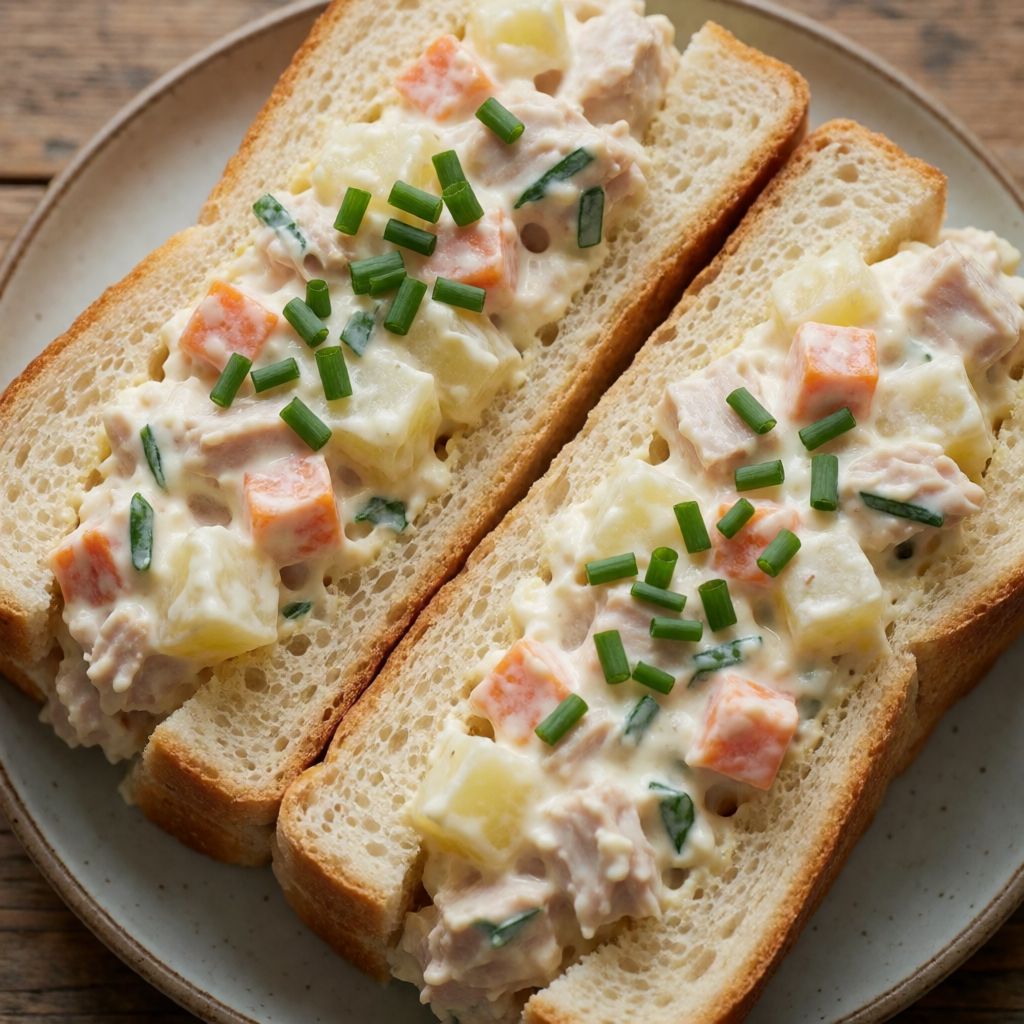
 AI photo
Nemo Sandwich
A sandwich shaped and decorated to look like Nemo the clownfish, filled with tuna and a potato salad mix.
Labels are worked out automatically from the ingredients and can be wrong. Check the packaging if it matters to you.
Ingredients
- 2 pcs sliced white bread
- boiled potato, diced to taste, bound with a little mayonnaise, in place of ready-made Russian salad
- tuna in oil to taste
- chives to taste
- 1 pcs carrot
- mayonnaise to taste, used both to bind the potato filling and to pipe Nemo's eyes
- ketchup to taste



Steps
Take two slices of bread and use a knife to shape them into a little fish body.
Prepare the filling: in a bowl, mix the tuna in oil with the diced boiled potato and a little mayonnaise to bind, in place of Russian salad.
Fill the bread with this filling and cover with the second slice.
Cut the carrot into very thin strips to decorate the fish's body and give it colour.
Also cut thin carrot slices for the tail.
Wrap the sandwich with the carrot strips, using chives as string to hold them in place.
Using a piping bag, pipe mayonnaise for the eyes and ketchup for Nemo's pupils.
What was changed
Diced boiled potato bound with mayonnaise replaces boiled potato, diced, since ready-made Russian salad is hard to find in British shops.
This isn't cooking, it's construction — a fish built entirely from things you'd normally put between two slices of bread and forget about. No heat touches this dish, so forget about doneness in the usual sense. The only thing that decides whether it works is whether the carrot bends into a curve instead of cracking, and whether the bread holds a shape instead of tearing when you carve it.
The filling is a tuna-potato mix standing in for the Russian salad you'd otherwise buy in a tub — diced boiled potato, tuna, a spoon of mayonnaise just to glue them together, nothing more. Too much mayonnaise and the filling turns soft and weeps into the bread, so the slice goes soggy at the seams and your fish falls apart in a child's hand. You want enough to bind, not enough to pour.
The skeleton is two slices of ordinary white bread, knife-shaped into a fish body before you ever put filling near them. Fresh bread bends slightly before it tears; a few days old and it just crumbles under the knife. That's the real reason you reach for a fresh loaf here and not the heel-end of last week's — not tradition, just structural integrity.
Start with the bread. You want sliced white — soft, even-crumbed, sold for sandwiches, not for toast. A dense close-crumbed loaf like a sourdough or a wholemeal cob won't carve cleanly; it tears along its own grain instead of following your knife. White sandwich bread has no grain to speak of, which is exactly why it shapes so easily — this is the same reason it's the bread of choice for any sandwich meant to be looked at rather than just eaten.
Tuna in oil, not in brine. The oil carries flavour and keeps the flesh from going dry and stringy once it's mixed with potato; brine-packed tuna tastes thinner and the texture turns chalky in a cold filling like this. Drain most of the oil off, though — you're binding with mayonnaise, not drowning the potato in two fats at once.
For the potato, go for a waxy variety — the kind that holds its dice shape after boiling rather than crumbling into mash. New potatoes or a salad potato work; a big floury baking potato will fall apart the moment you stir it with the tuna, and then you've got paste, not salad. Boil it whole in its skin if you can — peeling after cooking loses less of the potato to the peeler and keeps the dice sharper-edged.
Mayonnaise does two separate jobs here and deserves two separate thoughts about it. In the filling it's glue — a spoon, maybe two, enough to coat without soaking. Piped for the eyes, it needs to be a touch stiffer, straight from the jar rather than loosened, or it just spreads into a blob instead of holding a dot. If you don't have a piping bag, a small freezer bag with one corner snipped off does exactly the same job — the bag isn't the point, the small controlled opening is.
Carrot: pick one that's still firm enough to snap cleanly in half when you test it in your hand. An old, slightly rubbery carrot bends instead of snapping at that test — which sounds like what you want, but that rubberiness means it won't curve cleanly into thin strips either, it'll just squash. Fresh and crisp is what gives you a strip that curls obediently round the bread without splitting.
Chives are the string, and they're also the only ingredient here doing a job you can't easily substitute with pure mechanics — you need something thin, pliable, and food-safe to tie the carrot down. In their absence, the green tops of a spring onion, cut into fine strands, do the same holding job. Ketchup for the pupils is just contrast — any thick, dark-ish condiment that pipes as a dot and doesn't run would do, but ketchup is what's already in the fridge, which is really the whole economics of this dish: everything in it is something a British kitchen already has in, repurposed into a shape a child will actually eat.