
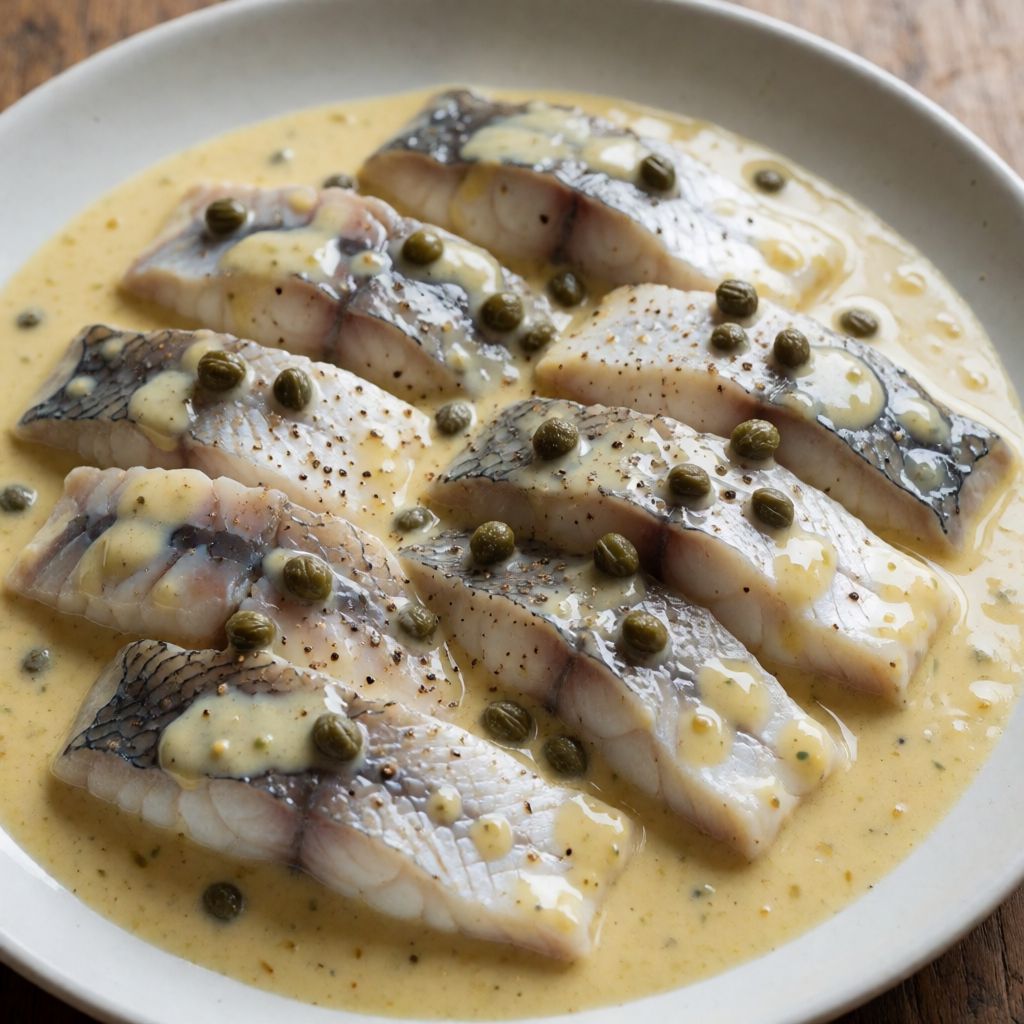
 AI photo
Herring with Mustard Dressing
Cold cured herring tossed in a creamy mustard-honey dressing, served with rye bread and fried eggs.
Labels are worked out automatically from the ingredients and can be wrong. Check the packaging if it matters to you.
Ingredients
- 100 ml Crème fraîche 38%
- 2 tbsp Dijon mustard
- 1 tbsp Wholegrain mustard
- 1 tbsp Honey
- 1 tbsp Capers
- 1 pinch Black pepper freshly ground, to taste
- 250 g Herring
- 6 pcs Rye bread slices
- 6 pcs Caper berries whole
- 1 pcs Red onion sliced into rings
- 3 pcs Eggs fried, sunny side up
- 1 bunch Chervil chopped










Steps
In a bowl, mix the crème fraîche, Dijon mustard, wholegrain mustard and honey well, then stir in the capers. Season to taste with freshly ground pepper and, if you like, a little more mustard.
5 minSeason to taste with freshly ground pepper and, if you like, a little more mustard.
Cut the herring into smaller pieces and mix with the mustard dressing.
Serve with rye bread, caper berries, red onion rings and sunny side up eggs, sprinkled with chervil.
Nothing in this dish goes near a flame except the egg. That is the whole point: the herring is already "cooked" — by salt and vinegar, weeks ago, in a barrel somewhere in the North Sea or the Baltic — and all you are doing here is dressing it properly and giving it something to sit on.
Some say raw fish needs heat to be safe or pleasant to eat. No — because brine and acid do the same job heat does: they denature the protein, turn translucent flesh opaque and firm, and kill off what needs killing. That is cured herring's whole trick, and it's the same trick behind ceviche, behind gravlax, behind a jar of rollmops at the back of your fridge. So don't go hunting for a "fresh" herring fillet and panic when it looks already cooked through — it is meant to.
What decides whether the plate works is balance, not skill. Crème fraîche brings fat, mustard brings heat, honey brings sweetness against the vinegar sharpness of both the mustard and the fish itself. Push any one of those too far and the dressing collapses into either a mustard slap or a bland cream. The second thing that decides it is the herring — buy it already properly cured, don't try to invent that process at home in an evening, you haven't got the time or the barrel.
The egg is the one live-fire moment, and it's doing real work, not garnish: pierced at the table, the yolk turns into a second sauce, richer and plainer than the mustard one, there to calm it down a bite at a time.
Start with the dressing, because it's the only thing you're actually making. Crème fraîche at 38% fat is thick enough to hold its shape and rich enough to blunt the mustard's sting without drowning it — any soured cream that thick and that gently sour will do the same job: full-fat sour cream, even mascarpone loosened with a squeeze of lemon if that's what's in the fridge. Thin crème fraîche, the low-fat kind sold for dolloping on pudding, will split and run thin under the mustard's acid, and then you've got soup, not a dressing.
Two mustards, doing two different jobs. Dijon is smooth, no seed left whole, and its heat comes up the back of the nose rather than sitting on the tongue — that's the one carrying the main punch. Wholegrain is milder and slower, there for the texture, little pops of seed between your teeth. Leave one out and the sauce goes either too hot and flat, or too soft and forgettable — use them together on purpose, not because the list says so.
Honey isn't sweetening the dish, it's correcting it. Cured herring and vinegar-based mustard are both already sharp; without the honey the dressing is all edges. This is, structurally, a cousin of the Scandinavian mustard-dill sauce served with cured salmon — same logic, same economic root: a cheap, keeping fish needed something at the table that made it look and taste like more than a wartime staple pulled out of a barrel. Capers go in last, whole or roughly chopped, and they're not there to blend in — they're small sour detonations meant to interrupt the cream, the same job the caper berries do on the plate, just bigger and blunter.
On the herring itself: 250 g is not a lot, because it's rich and salty and strong — this isn't a fillet you eat by the plateful, it's eaten in company with bread, egg and onion that all exist to carry and calm it. If you can't find whole cured herring, soused mackerel will stand in honestly, since it's cured the same way; smoked mackerel flaked through will give you richness but lose the specific vinegar sourness the dressing is built to answer. A jar of herring already in mustard-dill sauce, sold in most UK supermarkets as a Scandinavian import, is a perfectly fair shortcut — rinse off its own sauce first so your fresh one isn't fighting another.
Rye bread isn't a serving suggestion, it's load-bearing. A dense, closed crumb holds up under cream and fish without going to mush the way a soft white slice would in under a minute — if your knife meets real resistance going through it, that's the crumb you want; if it meets air, that's a different bread for a different dish. Pumpernickel or a dark sourdough will do the same job. The onion goes on raw for the crunch and the bite the rest of the plate doesn't have — if it tastes too sharp for you, five minutes in cold water takes the aggression out without costing you the crunch.
The egg wants a heat gentle enough that the white sets lacy and opaque at the edge while the yolk is still loose and shiving under its own skin — that's the cue, not a clock. Chervil is the right herb here for its faint aniseed lift, but it wilts and bruises within the hour and isn't always on the shelf — flat parsley with a small pinch of chopped tarragon gets you close enough. And give the dressing five minutes to sit before it meets the fish — mustard and honey need that time to actually marry, not just occupy the same bowl — that's patience doing the last ten percent of the work no amount of stirring harder will do for you.