
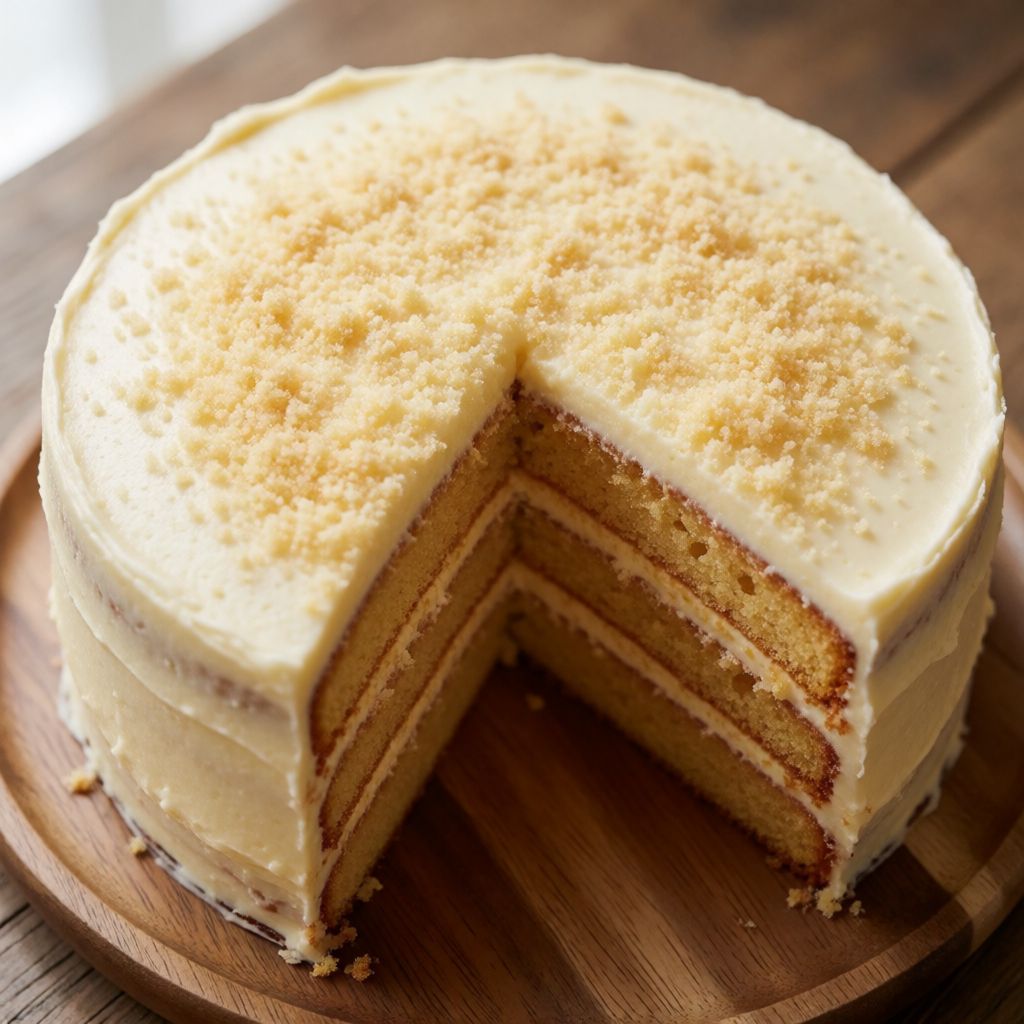
 AI photo
Honey Cake
A soft, moist honey cake with a light vanilla flavour, perfect with a cup of tea.
Labels are worked out automatically from the ingredients and can be wrong. Check the packaging if it matters to you.
Ingredients
- 4 pcs Eggs
- 300 g Honey
- 150 ml Vegetable oil
- 250 ml Milk
- 350 g Plain flour
- 1 pcs Baking powder
- 1 tsp Vanilla extract
- 10 g Butter for greasing








Steps
Beat the eggs with the honey in a bowl until the mixture doubles in volume.
5 minAdd the vegetable oil and milk, then finally the flour mixed with the baking powder and vanilla extract.
Grease and flour a baking tin, pour in the batter and bake at 180°C.
42 min
What was changed
Vanilla extract was used instead, as vanillin sachets are hard to find in British shops.
This is a one-bowl honey sponge, not the towering layered medovik some people picture the moment they hear "honey cake." No cream, no stacking ten thin layers, no chilling overnight. It's closer to a Victoria sponge that swapped sugar for honey — mix, pour, bake, cut into wedges for tea after the Sunday roast, while the oven's still warm from the joint. Six people, generous slices.
What decides whether it rises properly or sits flat and dense isn't just the baking powder — it's the foam you build in step one. Eggs beaten with honey trap air; that trapped air is half your lift, the chemical rise from the baking powder is the other half, and they only work together if you don't knock the air back out when you fold in the oil and milk. Beat weakly, and even fresh baking powder can't save you — there's nowhere for the gas bubbles to expand into.
Some say honey makes a cake healthier than sugar. No — it's still sugar, fructose and glucose, same calories, same effect on you. What honey actually does differently is hold onto water. That's why this cake stays soft on day two and day three without any trick, while a plain sugar sponge starts drying out. That moisture-holding is the real reason honey cakes outlasted sugar cakes for centuries before refined sugar got cheap and fast to make — not magic, just chemistry that happened to suit a world without fridges.
Eggs are your structure and your air supply. Whisking them with honey is slower and less dramatic than whisking with sugar, because honey is a dense syrup already carrying water — don't expect stiff meringue peaks. Look for the batter turning pale, thickening, and the whisk leaving a ribbon on the surface that holds its shape for a second or two. That's doubled enough. Trust the look, not a stopwatch, because a stand mixer and a hand whisk will never get there at the same minute.
Honey should be the runny kind, not set or creamed. If all you've got is set honey, warm the jar gently in hot water until it pours. Lumps of unmixed honey don't burn off in the oven — they sink and turn into dense, gummy pockets in the crumb that people then blame on "undercooking," when the real fault was mixing. Flavour-wise, a mild honey (acacia, wildflower) lets the cake just taste sweet; a strong one (heather, chestnut) will make the cake taste of itself. Either is correct — it's a choice, not an error.
Oil's job is any fat with no smell of its own — sunflower, vegetable, rapeseed, whatever's in the cupboard. Olive oil is the wrong tool here; its flavour fights the honey. Oil also stays liquid at room temperature, unlike melted butter, which is why an oil cake stays tender for days while a butter cake firms up as it cools — another reason this style of cake keeps well without effort.
Milk isn't just there to loosen the batter for pouring. Its water turns to steam in the oven and pushes the crumb open alongside the CO2 from the baking powder — two separate lifting mechanisms doing the same job from different directions. Whole milk gives slightly more richness; semi-skimmed works fine, just a touch less velvety.
Flour goes in last and should be stirred in only until it disappears — no longer. Overmixing develops gluten, and gluten in a cake means chewy and tough instead of tender. Plain flour plus a separate measure of baking powder, rather than self-raising, gives you control over how much lift you're actually getting, since self-raising flour's strength varies by bag and fades with no warning on the label. On baking powder itself: more isn't better — too much leaves a soapy aftertaste and can make the structure collapse under gas it can't hold, so stick to the amount given rather than "topping it up for luck."
Vanilla extract, not essence if you can help it — extract carries vanilla's own aromatics, essence is usually synthetic vanillin and reads flatter on the tongue. Here it's a background instrument, rounding off edges, not a solo. And the butter for greasing: its only job is to coat every ridge of the tin thinly enough that the cake releases whole. A torn patch of crumb left stuck to the tin isn't a baking failure, it's a greasing failure — get it into the corners, flour it after if the tin has any pattern, and the cake comes out in one piece.