
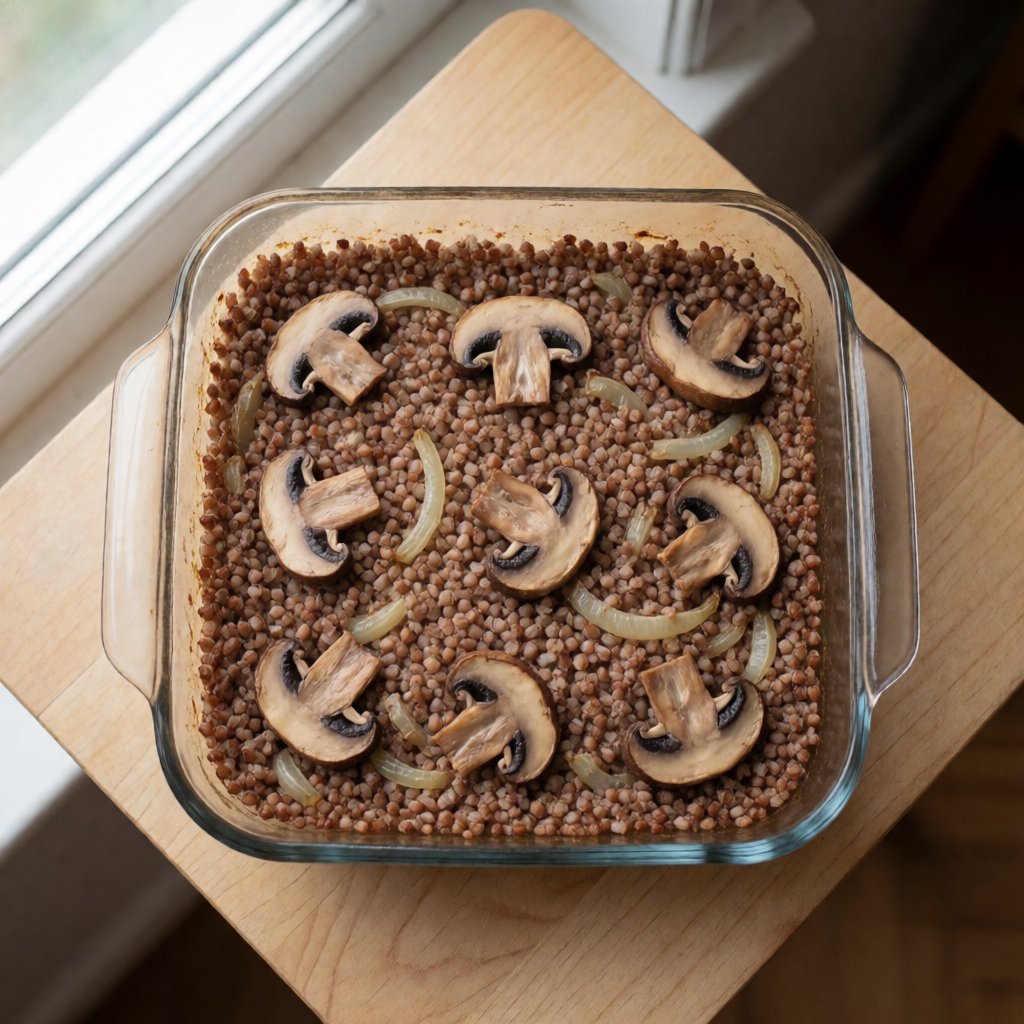
 AI photo
Buckwheat with Mushrooms and Onion
Baked buckwheat with mushrooms and onion, cooked until tender.
Labels are worked out automatically from the ingredients and can be wrong. Check the packaging if it matters to you.
Ingredients
- 150 g Buckwheat rinsed
- 200 g Mushrooms sliced
- 1 pcs Onion halved and thinly sliced
- 300 ml Boiling water
- 1 tbsp Sunflower oil
- 0.5 tsp Salt






Steps
Slice the mushrooms and halve and thinly slice the onion, then mix with the oil and salt.
Spread the rinsed buckwheat over the bottom of the dish, top with the mushroom and onion mixture, and pour over the boiling water.
Cover the dish with foil.
Place the dish in the oven at 200°C for 40 minutes.
40 minRemove the dish from the oven.
This is not a fry-up, whatever the pan and the onion might suggest — it's a steamed grain dish wearing an oven dish as a disguise. You put raw buckwheat down, raw mushroom and onion on top, pour boiling water over the lot, seal it, and let heat and trapped steam do the cooking from both directions at once. Nobody browns anything. Nobody stirs anything. What decides whether it turns out right has almost nothing to do with the 200°C on the dial and everything to do with whether the water you poured in is the exact amount the buckwheat can drink, and whether the foil keeps that steam locked in long enough for grain and mushroom to finish together.
Some say mushrooms must be fried hard in a dry pan first, otherwise they turn to slime in anything wet. Not wrong for a frying pan — but irrelevant here, because this dish wants the mushroom's water. Raw mushroom and onion, tossed in oil and salt, sit on top of dry buckwheat; the boiling water you pour over does two things in one go. It starts the buckwheat swelling the instant it lands, no lag while cold water comes up to temperature grain by grain. And it turns the mushrooms into their own small steamer, so their juice drips down and seasons the grain beneath them. That dripped juice is the only sauce this dish will ever have — there's no reduction, no stock, no finishing butter. Skip the foil and that juice evaporates into your oven instead of your bowl.
Buckwheat here means the groat, not flour, and rinsing it isn't ritual — it washes off the fine dust and broken bits that would otherwise cloud the water and make the finished grain gluey at the edges. If your buckwheat is the pale, unroasted kind rather than the familiar reddish-brown roasted groat, it'll taste greener and need slightly less water, since roasting toasts out some natural moisture that unroasted grain still holds — go by the look of the water line at the end, not the clock, and you'll correct for either.
Mushrooms: any kind that has water to give off works, which is most of them — button, chestnut, a mix if you've got odds and ends in the fridge. Thicker, meatier mushrooms like portobello will release less liquid relative to their bulk, so if that's what you've got, consider adding a splash more boiling water, maybe 20ml, so the buckwheat still gets enough to drink. Dried mushrooms are the wrong tool for this method — they want long soaking and real stock, not a 40-minute steam.
Onion: raw and thinly sliced because it's never going to meet direct heat in this method — it cooks entirely by steam, so cut it thin enough that steam alone can soften it through in the time the buckwheat needs anyway. A thick-cut onion in this dish stays stubborn and a little raw-tasting at its core, not because the recipe is wrong but because you gave the steam too much onion to get through.
Oil: this wants something with no flavour of its own, because its only job here is to coat mushroom and onion so they don't dry and toughen at the surface where they meet the air gap under the foil, and to carry what little fat-soluble flavour there is down into the grain. Sunflower is right for that. Light olive oil, rapeseed, any neutral vegetable oil does the same job; a fruity extra virgin olive oil would just put its own flavour over the mushroom's, which is the one flavour this dish is actually built around.
Water and salt: 300ml boiling water to 150g buckwheat is close to a 2:1 ratio, which is the standard absorption line for this grain — enough to fully swell the groat without leaving a puddle at the bottom once it's done. Boiling, not cold, matters for timing: cold water added to raw grain spends its first several minutes just coming up to temperature, which throws your 40-minute floor out before anything's even started swelling. Half a teaspoon of salt split across mushroom, onion and the water underneath is a seasoning floor for two people — taste nothing until it's out, because there's no stage to adjust it mid-cook, this isn't a dish you taste and correct as you go.
As for the kitchen itself: a UK oven dish with a sheet of foil over it is doing exactly the job a kazan lid does elsewhere — sealing in steam a domestic pan on the hob can't hold, because flat lids and loose-fitting glass tops leak. Foil pressed down at the edges is the cheap, honest substitute, and it's the same logic as foiling a roasting tin for Sunday lamb, so your oven has already taught you this trick without you noticing. Patience here means leaving the foil alone for the full 40 minutes rather than lifting it to check — every peek lets steam out that the grain still needed, and you end up adding time to make up for impatience you could have avoided for free.
·