
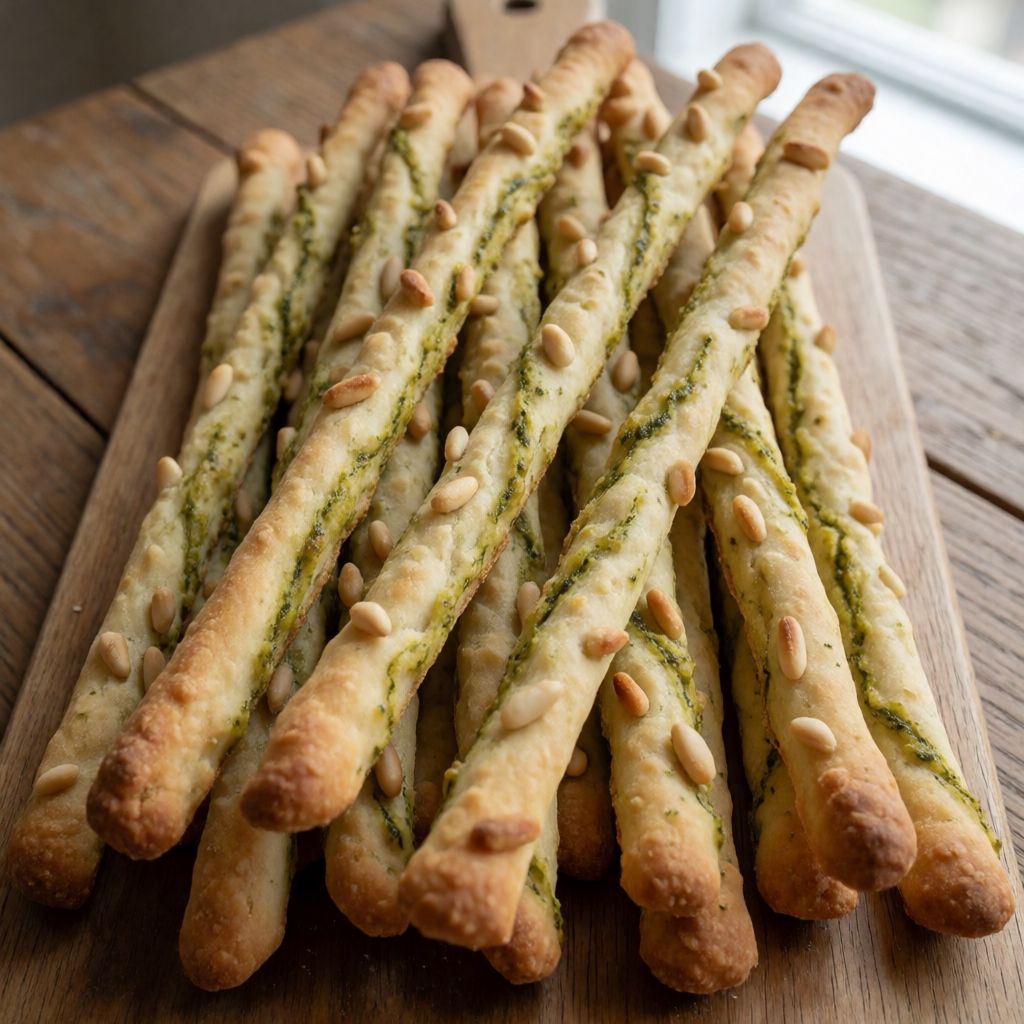
 AI photo
Pesto Grissini
Thin, crisp breadsticks made with a flavourful pesto dough and finished with a poppy seed coating.
Labels are worked out automatically from the ingredients and can be wrong. Check the packaging if it matters to you.
Ingredients
- 720 g strong white flour
- 8 g yeast
- 12 g salt
- 500 ml water
- 15 g pine nuts
- 80 g pesto
- poppy seeds to taste
- durum flour to taste
- olive oil to taste





Steps
Sift the strong white flour into a bowl, add the crumbled yeast and half the water, mixing as you go.
Add the pine nuts, salt and a little more water.
Dissolve the pesto in the remaining water and pour it into the dough.
Mix the dough well in the bowl, and once the consistency allows, knead it by hand.
Cover the bowl with a tea towel and leave the dough to rise at room temperature.
30 minTransfer the dough to a work surface and do the first fold.
Return the dough to the bowl, cover and let it rise.
20 minRepeat the folding and rising.
20 minGrease the bottom and sides of the bowl with olive oil, place the dough in and leave to rise at room temperature.
60 minDivide the dough into 2 portions, shaping each by folding and tucking it under itself.
Transfer the pieces into a container with durum flour on the bottom and dust more on top.
Cover with a lid and leave to rise at room temperature.
30 minLeave in the fridge.
60 minDivide the dough into smaller pieces, about 20-25 g each.
Roll them by hand into even-length strips.
Carefully roll the strips in poppy seeds and place on a parchment-lined baking tray.
Bake in an oven preheated to 180°C.
28 min
Grissini are just bread that got thin enough to stop being bread and start being a biscuit with ambitions. Same dough as a loaf — flour, yeast, salt, water — but you roll it down to a finger's width, and at that thickness the oven dries it all the way through before it can brown too much. A slice of ciabatta has a crust and a crumb. A grissino is all crust, no crumb, which is why it snaps instead of tears.
What decides whether these work is the dough's hydration and how patiently you let it rest. At 500ml water to 720g flour you're close to 70% hydration — wet enough to be slack and a little stubborn under your hands, and that's correct, because a stiff dough rolls into stiff, dense grissini that go hard rather than crisp. The folds and the long, broken-up rise (30, then 20, then 20, then 60 minutes) aren't there to make the dough "rise more" in a vague sense — each fold builds gluten strength gradually, in layers, the way kneading would, but without beating the air back out of a wet dough your hands can't really knead properly anyway.
The pesto and pine nuts aren't decoration stirred in at the end — dissolving the pesto into the last portion of water is how its oil and basil get distributed evenly through the crumb instead of sitting in streaks. Basil pesto brings its own oil, so this dough needs less added fat than a plain breadstick would.
On the flour: "strong white" means high protein, 12-13%, because protein is what becomes gluten, and gluten is what lets you stretch this dough into long strips without it tearing. A standard plain or self-raising flour from the baking aisle doesn't have enough protein for this — your grissini would be short and crumbly instead of pulling into long, bendy ropes. Bread flour, strong flour, "00" with high protein — any of these, look at the protein number on the pack if the name doesn't tell you.
Durum flour for dusting is doing a specific job: it's coarser and doesn't absorb moisture as fast as regular flour, so it sits on the surface instead of melting straight into the dough and gluing everything to the container. If you don't have it, fine semolina does the same job — coarse, dry, slow to hydrate. Plain flour will work in a pinch but will clump wetter and faster, so use more and watch it.
Yeast at 8g for 720g flour, with four separate rise periods — that's a long, cool fermentation by design, not an accident of a badly written recipe. A fast, hot rise gives you a yeasty, slightly sour taste and a looser structure; this slower build gives flavour time to develop and the gluten network time to set without you having to beat it in. Some say the dough needs a warm spot — airing cupboard, near the radiator — to rise properly. No, because what yeast actually needs is time and food, not heat; warmth just rushes it, and rushed dough tastes of nothing but yeast.
Pine nuts: whole, not ground, so you get the occasional soft bite against all that crunch — texture contrast is the point, not flavour intensity, since there's only 15g for the whole batch. If pine nuts aren't in the cupboard — and at UK prices, fair enough — a flaked almond or even a sunflower seed does the job of "small crunchy thing inside a crunchy stick," though you lose the specific resin-sweet pine flavour.
Pesto: use a good shop-bought basil pesto or your own, but be aware that jarred pesto varies wildly in oil content, and oil here is already doing double duty as flavour and as a tenderiser softening the gluten slightly. If yours looks very oily, hold back a touch of the olive oil you'd use to grease the bowl.
Salt at 12g against 720g flour is close to the standard baker's ratio (about 1.5-2%) — not a lot of room to improvise here, because too little and the dough ferments too fast and tastes flat, too much and it chokes the yeast down to nothing.
On the oven: 180°C, fan or not, in a British kitchen with a hob and a standard oven that may run 10-15 degrees out from the dial — this isn't a kazan or a stone deck oven, it's a tray in a box, and that's completely fine for grissini, because what you're after here is even, gentle drying, not blistering heat. You'll know they're done by colour and by touch, not by the clock alone: pale gold going toward a light tan at the ends, and when you nudge one with a finger it should feel rigid, not give like warm bread. 28 minutes is your starting point — pull one out and snap it; if the middle still bends rather than cracks, give it a few more minutes and check again.
Eight people from one batch sounds generous for a handful of breadsticks, but remember these are a starter, a side to soup, something to put out with drinks before a Sunday roast rather than a meal in themselves — portion them that way and the count makes sense.