
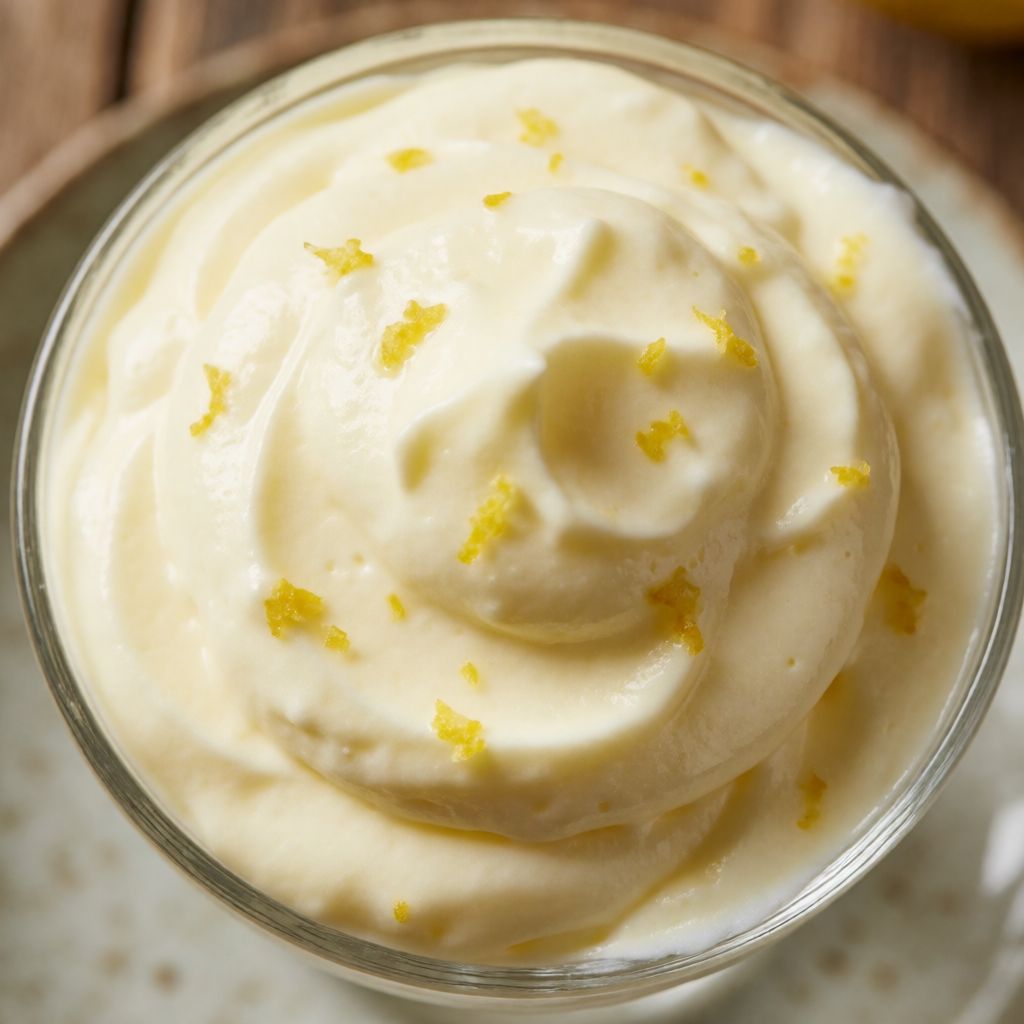
 AI photo
Lemon Chantilly Cream
A silky lemon pastry cream lightened with whipped cream, perfect for filling cakes or spooning into glasses on its own.
Labels are worked out automatically from the ingredients and can be wrong. Check the packaging if it matters to you.
Ingredients
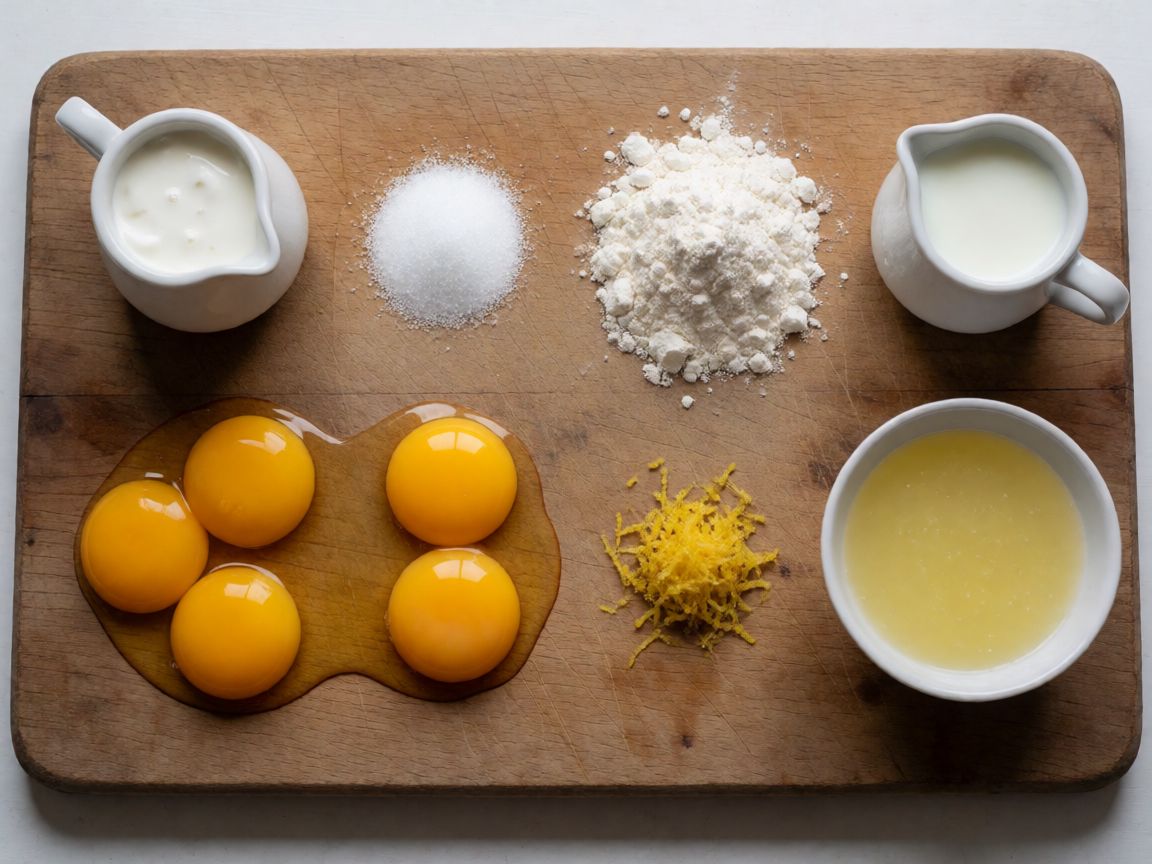
- 500 ml Double cream
- 85 g Caster sugar
- 30 g Plain flour
- 4 pcs Egg yolks
- 250 ml Milk
- 1 pcs Lemon zest from one lemon
- 0.5 pcs Lemon juice juice of half a lemon







Steps
In a small saucepan, combine the milk and lemon zest, place over low heat and bring to the boil.
Separately, beat the egg yolks with the sugar using an electric mixer for 6–7 minutes, until pale and fluffy.
7 minSift the flour so no lumps form, then add it to the beaten yolks and mix well.
Pour the hot milk into the yolk mixture, stirring constantly.
Pour everything back into the saucepan and place over low heat, stirring continuously with a wooden spoon until the cream thickens.
As soon as the cream starts to simmer, add the lemon juice and cook for a further 2–3 minutes.
3 minLeave the cream to cool completely.
Whip the double cream and gently fold it into the cooled cream, using upward strokes.
Transfer the Chantilly cream into a bowl or serving glasses and chill in the refrigerator for at least 1 hour before serving.
60 min
This is a lemon pastry cream wearing a borrowed name. True Chantilly is only whipped cream, sugar, nothing else — named after a château where someone first thought to lighten a dessert with air instead of more cream. Here the cream is just the top layer. Underneath sits a proper crème pâtissière: yolks, sugar, flour, milk, cooked until it holds a shape. Fold the two together and you get something that eats like a mousse but sets like a custard — lighter than the French original, heavier than plain whipped cream, which is exactly the point of combining them.
What decides whether this works is two separate temperature decisions, not one. The first is in the saucepan: you're thickening egg yolks without scrambling them, and the only thing standing between "silky" and "sweet scrambled eggs with lemon" is the flour. Egg proteins alone seize somewhere around a near-boil. Starch gets in the way of that — it dilutes the protein, traps water, and lets the mixture actually reach a simmer without curdling. That's the whole reason this recipe has flour in it and a crème anglaise doesn't. Low heat and a wooden spoon aren't fussiness: a metal spoon pulls heat away from your hand and tells you nothing, a wooden one stays cool and lets you feel the moment the spoon starts dragging through thickened cream instead of sliding through liquid. That drag is your real signal, not a stopwatch.
Milk and zest, heated gently: the job is to pull lemon oil out of the peel into fat-free milk, and that oil is volatile — push it to a hard boil and you cook off the bright top notes, leaving dull bitterness from the white pith underneath the zest instead. "Low heat to the boil" here means you watch for the first shiver on the surface and pull it off then, not a rolling boil held for safety's sake. If your lemon smells perfumed and sharp before you even zest it, you're fine with a basic UK supermarket lemon — unwaxed if you can, since you're using only the skin.
Yolks beaten with sugar for several minutes isn't there to make a pretty pale ribbon for its own sake. Sugar crystals are sharp-edged and, left undissolved, would sit in the custard as grit. Beating works the sugar into the yolk's fat and water until it half-dissolves and the mixture goes pale — that's your visual proof the sugar has actually gone to work, not just a cosmetic stage. If you rush it, you'll find out later as grittiness on the tongue, and you won't know why, because by then it's buried in cooked custard.
Flour, sifted: the lumps you're avoiding aren't an aesthetic problem, they're a structural one. An unsifted clump of flour is dry in the middle; it never properly hydrates in the custard and stays as a hard little bead even after cooking, because the outside cooks and seals before the centre gets wet. Sift it, and every particle meets liquid on its own. If you only have self-raising flour in the cupboard, it will still thicken the custard — the raising agent does nothing useful here and nothing harmful either, since nothing is baking. Cornflour is the real alternative, but it thickens roughly twice as hard, so you'd use less, not the same weight.
The hot milk goes into the yolks, not the other way round, and gradually — that's tempering, and it exists for one reason: eggs scramble fast when they meet sudden heat, slowly when the heat arrives in stages. Pour it all at once and part of the yolk mixture hits near-boiling milk directly; you'll see tiny solid flecks appear, which is cooked egg, which is the defect you were trying to avoid, now baked in. Stir while you pour and you're spreading the heat out across the whole mixture instead of concentrating it on whatever yolk touched the milk first.
Lemon juice goes in only once the custard is already thickening, not at the start with the zest. Acid loosens starch's grip and can thin a custard that hasn't set yet, so added early it works against the very thing you're trying to build. Added late, once the structure is mostly there, it just does its proper job: brightening the flavour without undoing the set.
Double cream, for the folding stage, needs its high fat content to hold air once whipped — that's not a British quirk, it's the actual mechanical requirement. Whipping cream (lower fat) will whip, but more softly, and the Chantilly layer will slacken faster in the fridge and on the spoon. If double cream isn't in the fridge, whipping cream is the honest substitute, not a lesser crime, just a softer result. What you can't substitute is the folding technique itself — upward strokes, not stirring — because stirring knocks the air straight back out of cream you just spent minutes whipping into it. This whole dessert, cream over custard, only exists because someone worked out that lightness could be added mechanically, by beating air in, rather than by using less. That's the entire economic history of Chantilly: once sugar got cheap enough for ordinary kitchens, whipping became a form of theatre anyone could afford, and it's been riding on top of heavier custards ever since.