
 AI photo
Lentil, Asparagus and Radish Salad
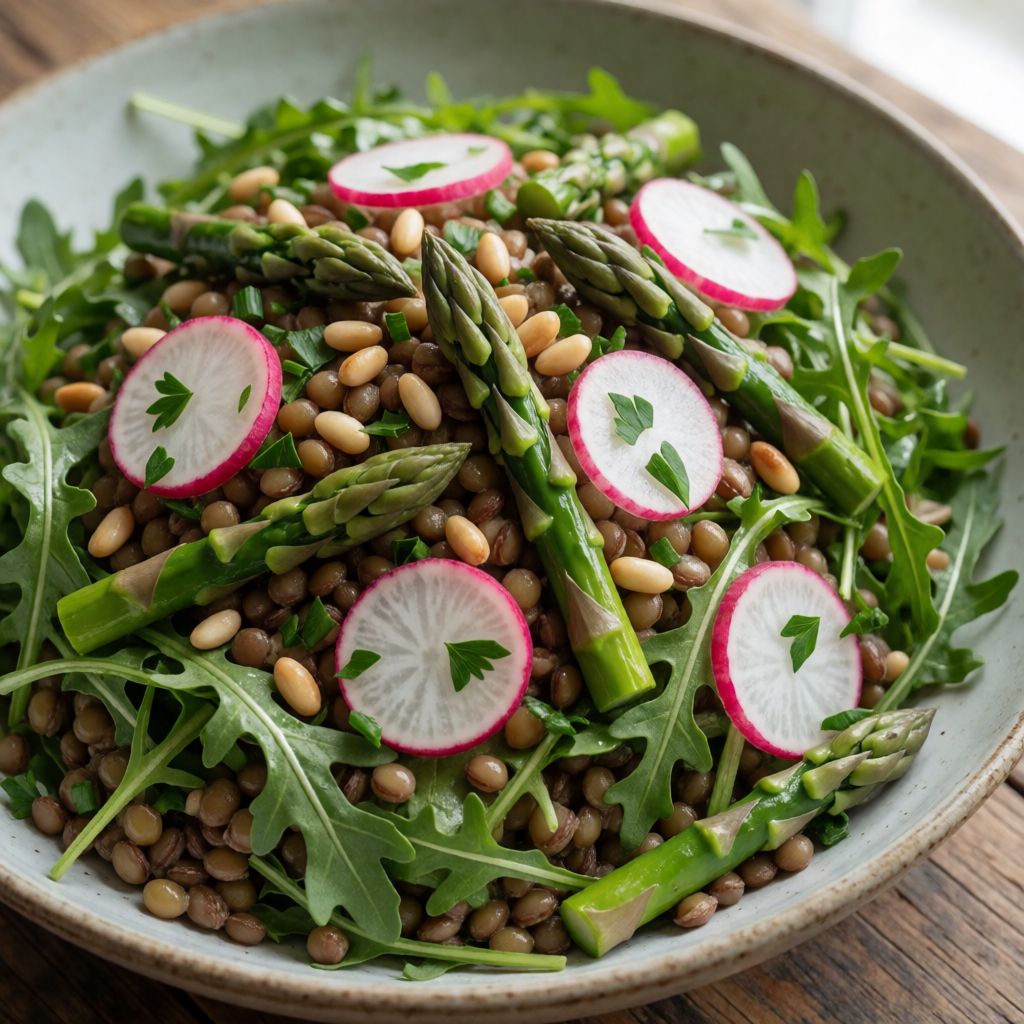
A fresh salad of lentils, asparagus, rocket and radish, finished with a wild garlic dressing.
Labels are worked out automatically from the ingredients and can be wrong. Check the packaging if it matters to you.
Ingredients













Steps
Rinse the lentils and cook them according to the package instructions.
Toast the pine nuts in a dry pan until golden brown, then set aside.
Snap off the woody end of the asparagus.
Melt the butter in a hot pan, let it sizzle and quickly fry the asparagus for about 1 minute.
1 minArrange the salad on a serving plate.
Toss the rocket and lentils with the parsley and dressing.
Scatter the warm asparagus over the salad, then sprinkle with radish and pine nuts.
For the wild garlic dressing: mix all the dressing ingredients until smooth, then stir in the finely chopped wild garlic leaves at the end.
This isn't really a salad in the leaves-and-dressing sense. It's a warm-cold assembly where lentils give you something to chew on, asparagus gives you a flash of heat, and rocket and radish give you the bite that stops the whole thing being mushy. What decides if it works is timing: the lentils have to be tender but holding their shape, not falling apart into soup, and the asparagus has to hit the plate while it still has its minute-old heat in it.
Puy lentils are the right choice here precisely because they don't collapse. Some say lentils are lentils — no, because the common split red ones disintegrate into a paste the second they're properly cooked, which is exactly what you don't want sitting under rocket. Puy, or any small dark lentil that says "holds its shape" on the packet, keeps its skin intact and gives you a little resistance between the teeth. That resistance is the whole point of putting lentils in a salad instead of a stew.
The asparagus gets barely any cooking — about a minute in sizzling butter — and that's not a shortcut, that's the method. A minute in foaming butter browns the surface just enough to bring out sweetness without cooking the inside past "snap." Any longer and you've made boiled asparagus with extra washing up, and it goes grey and loses the crunch that's supposed to contrast with the soft lentils. Snap off the woody end rather than cutting it with a knife — the stalk itself tells you where tender ends and fibrous begins, it breaks exactly at that point, a knife doesn't know that and will cut through good stalk along with bad.
The dressing is where the dish gets its personality, and wild garlic is doing something specific: it's garlic without the harsh raw bite, because the leaf form doesn't have the concentrated sulphur compounds a clove does. If you can't find it — and in most of the UK outside a few weeks in spring, you won't — don't reach for garlic cloves as a straight swap, you'll overpower everything else on the plate. Use a small handful of chives with a very small crushed garlic clove, or just leave it out and lean a bit harder on the lemon and mustard. The mustard isn't flavour so much as glue: it's what lets the oil and lemon juice hang together instead of separating on the plate, an emulsifier doing quiet unglamorous work.
Pine nuts toasted dry, no oil, in a pan with nothing else in it — because oil would just fry them unevenly and you'd burn the outside chasing colour in the middle. Dry heat lets the natural oils in the nut do the work slowly and evenly. Watch them, don't walk away: pine nuts go from pale to burnt in the time it takes to answer the phone, there's barely a window between "golden" and "bitter." If you don't have them, a toasted flaked almond or a few sunflower seeds will give you the same crunch-and-nuttiness role, though pine nuts carry a particular buttery sweetness almonds don't quite match.
Rocket and radish are both there for peppery bite — rocket mustardy and soft-leaved, radish sharp and crisp. If your rocket's gone a bit tired in the fridge drawer, don't bother with it limp; wild garlic leaves themselves, or baby spinach with a squeeze more lemon, will do the peppery-green job adequately. Radish sliced thin matters more than radish sliced thick: thin lets it wilt very slightly into the warm asparagus and lentils rather than sitting there as a hard disc you have to work around.
Butter rather than oil for the asparagus because butter browns — it has milk solids that caramelise and give you that nutty smell as it sizzles, which is the flavour you're actually frying for, not just a cooking medium. Olive oil in the dressing, by contrast, should be one with "no smell of its own" if you want the wild garlic and lemon to lead — a hefty, grassy extra virgin will fight them. A light, mild olive oil or even a neutral rapeseed oil (and rapeseed is the one actually grown in the UK, cheap, local, genuinely a sensible everyday choice here) will let the dressing taste of what you put in it rather than of the bottle.
On a standard British hob you don't need anything special here — no kazan, no wok, just a pan hot enough that butter foams and spits the second it goes in. That's your heat cue for the asparagus step: don't measure it in a number on a dial, measure it in whether the butter talks back to you.
Lentils done "according to the package" is honest advice but worth one word: start checking a few minutes before the packet says, because lentils go from stubbornly raw to collapsed in a short window, and the bag's printed time is a guide written for nobody's actual hob, pan or altitude. Drain them while they've still got a tiny bit of bite — they'll keep softening a little in their own heat and in the dressing after you toss them. This feeds four as a starter or a light lunch, less as the only thing on the table after a proper Sunday roast, where it'd sit nicely as the thing that follows the meat rather than competes with it.